This technical execution explores the aromatic encapsulation of Clitopilus prunulus within an avian protein matrix. By utilizing the mushroom's delicate farinaceous (floury) volatiles as the core of a ballotine-style stuffing, we create a thermal chamber that prevents the evaporation of the mushroom's 2-acetyl-1-pyrroline compounds. The inclusion of baby spinach provides a mineralic and chlorophyllic contrast, while the chicken acts as a neutral, lipid-rich conductor for the mushroom's complex umami profile.
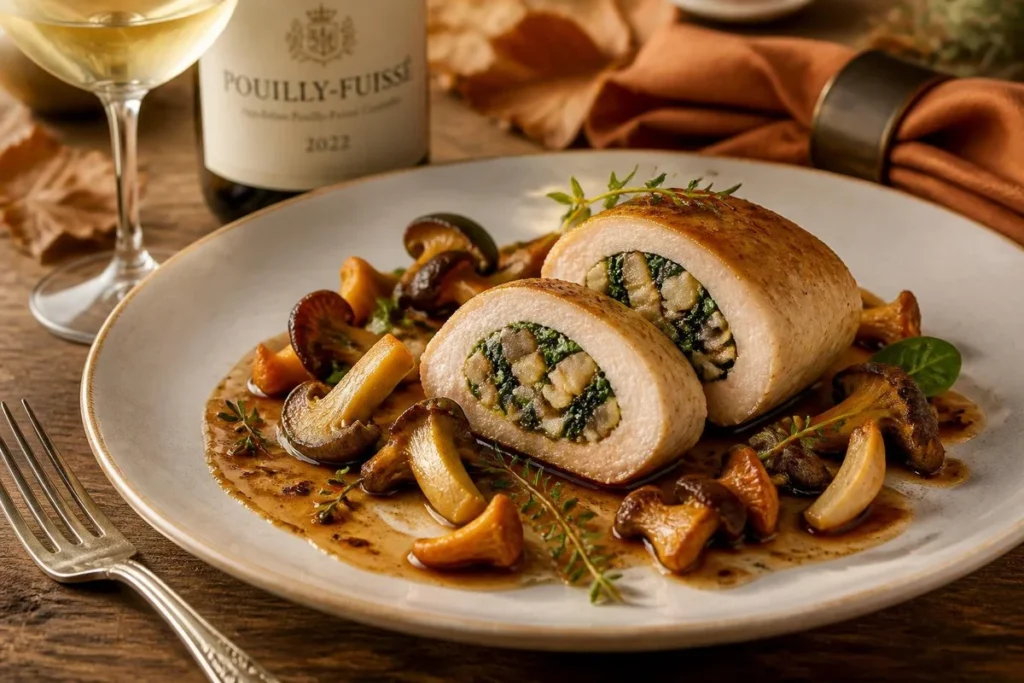
Miller Mushroom and Spinach Stuffed Chicken Breast
This technical execution explores the aromatic encapsulation of Clitopilus prunulus within an avian protein matrix. By utilizing the mushroom's delicate farinaceous (floury) volatiles as the core of a ballotine-style stuffing, we create a thermal chamber that prevents the evaporation of the mushroom's 2-acetyl-1-pyrroline compounds. The inclusion of baby spinach provides a mineralic and chlorophyllic contrast, while the chicken acts as a neutral, lipid-rich conductor for the mushroom's complex umami profile.
The Culinary Physics of This Dish
The Clitopilus prunulus possesses a fragile cellular structure that releases moisture rapidly when exposed to direct heat. To circumvent this, we utilize Internal Convection Steaming. By sealing the mushrooms inside the chicken breast, the moisture released by the fungi is trapped, creating a high-humidity micro-environment. This "steams" the mushrooms in their own juices, ensuring the volatile bread-like esters saturate the poultry fibers rather than escaping into the pan. The spinach acts as a thermal buffer, absorbing excess moisture and providing an earthy, iron-rich foundation that anchors the mushroom's high-tone aromatics.
Terroir Narrative
This dish is inspired by the Bresse region of France, famous for its world-class poultry and lush, damp woodlands. In the French culinary tradition, "Poulet à la Crème" often incorporates forest finds, but this preparation elevates the concept by making the Miller mushroom the hidden heart of the dish. It reflects a transition from the light, herbal flavors of late summer to the deep, satisfying forest-driven cuisine of autumn, celebrating the "White Harvest" of the Meunier in the context of classic French gastronomy.
Prep Time
Cook Time
Complexity
Calories
Region
30 Mins
25 Mins
Grand Officier
340 kcal
Bresse, France
Master Recipe (1:10 Rule)
400 g Fresh Miller Mushrooms (Clitopilus prunulus), finely diced
2 Large organic chicken breasts (approx. 200g each)
100 g Fresh baby spinach (blanched and squeezed dry)
30 g Shallots (finely minced)
50 ml Heavy cream (to bind the stuffing)
30 g Cultured butter
1 tsp Fresh thyme (chopped)
Sea Salt and White Pepper
The Technique
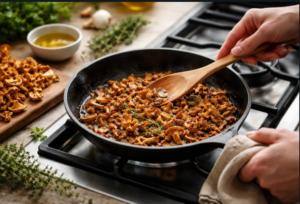
1. The Duxelles: Sauté the minced shallots in butter until translucent. Add the diced Clitopilus prunulus and cook until all moisture has evaporated. Stir in the blanched spinach, thyme, and cream. Season with salt and white pepper. The mixture should be thick and cohesive.
2. Pocket Preparation: Using a sharp paring knife, create a deep pocket in each chicken breast, being careful not to cut all the way through. Season the interior with a pinch of salt.
3. Encapsulation: Stuff the mushroom-spinach mixture into the chicken pockets. Seal the opening with a toothpick or by "stitching" it with a small skewer.
4. The Sear: In a hot skillet with a touch of oil, sear the chicken breasts for 2 minutes per side until golden brown. This Maillard reaction on the surface provides the necessary savory base notes.
5. Roasting: Transfer the skillet to a preheated oven at 180°C. Roast for 12-15 minutes until the chicken reaches an internal temperature of 74°C. Let rest for 5 minutes before slicing.
6. Service: Slice crosswise to reveal the green and white mosaic of the stuffing. Serve with a light velouté or a reduction of the pan juices.
Shop Integration
This stuffed chicken preparation is an ideal vessel for exploring our shop's premium forest range. You can enhance the stuffing by adding the concentrated nuttiness of Boletus edulis (Boletus edulis) or the sweet, floral notes of Marasmius oreades (Marasmius oreades). For a striking visual contrast, garnish the plate with sautéed Cantharellus cibarius (Cantharellus cibarius) or the royal Amanita caesarea (Amanita caesarea). For a sophisticated smoky depth, our Craterellus cornucopioides (Craterellus cinereus) is an excellent addition, while Morchella (Morchella conica) brings a refined honeycomb complexity to the dish.
The Umami Profile
This dish achieves Concentrated Synergistic Umami. The free glutamates in the Miller mushroom are chemically "boosted" by the inosinates in the chicken. Because the stuffing is cooked within the meat, the nucleotide exchange is maximized, creating a rich, lingering savory sensation that is balanced by the oxalates in the spinach, providing a rounded and sophisticated palate experience.
Sommelier’s Choice
Pouilly-Fuissé (Chardonnay): A rich, elegant white wine from Burgundy. Its notes of toasted brioche and hazelnut mirror the farinaceous scent of the Miller mushroom, while its balanced acidity cuts through the creamy stuffing and poultry lipids.
THE ETYMOLOGICAL CHRONICLE
French:Meunier – Identifying the mushroom by the floury scent and white dusty cap, reminiscent of the village miller.
German:Mehlräsling – Combining "Mehl" (flour) with a classic mycological ending to emphasize its primary sensory trait.
Italian:Prugnolo bastardo – A colloquial name referencing its similarity to the spring-growing "True" Prugnolo, despite its autumn appearance.
Spanish:Molinera – A name that connects the forest harvest with the scent of fresh sourdough and the trade of the mill.
To provide the best experiences, we use technologies like cookies to store and/or access device information. Consenting to these technologies will allow us to process data such as browsing behavior or unique IDs on this site. Not consenting or withdrawing consent, may adversely affect certain features and functions.
Functional
Always active
The technical storage or access is strictly necessary for the legitimate purpose of enabling the use of a specific service explicitly requested by the subscriber or user, or for the sole purpose of carrying out the transmission of a communication over an electronic communications network.
Preferences
The technical storage or access is necessary for the legitimate purpose of storing preferences that are not requested by the subscriber or user.
Statistics
The technical storage or access that is used exclusively for statistical purposes.The technical storage or access that is used exclusively for anonymous statistical purposes. Without a subpoena, voluntary compliance on the part of your Internet Service Provider, or additional records from a third party, information stored or retrieved for this purpose alone cannot usually be used to identify you.
Marketing
The technical storage or access is required to create user profiles to send advertising, or to track the user on a website or across several websites for similar marketing purposes.