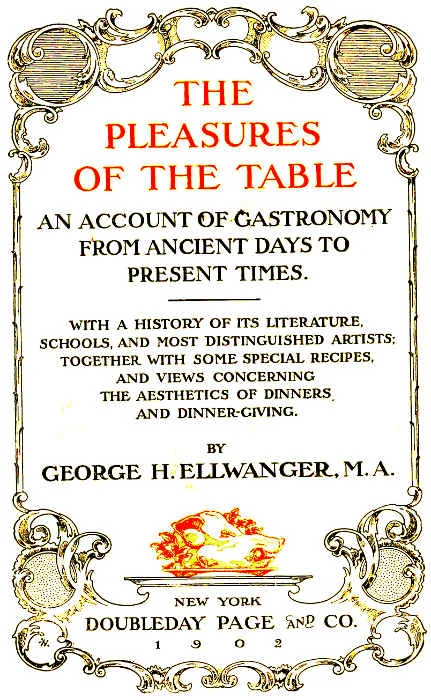
The Pleasures of the Table, authored by George H. Ellwanger in the early 20th century, provides a historical examination of gastronomy, exploring its development, literary history, notable chefs, and the philosophy of culinary enjoyment. The work transitions from traditional instructional cookbooks to a broader cultural analysis, highlighting the aesthetic significance of dining across various historical periods.
Key themes and perspectives in the text include:
Culinary Artistry: The book emphasizes that cooking is a vital skill and a sophisticated art form that has significantly evolved since antiquity.
Health and Nutrition: Ellwanger discusses the intrinsic relationship between nutrition, physical well-being, and the appreciation of food, noting that despite technological advancements, many individuals continue to face diet-related health issues.
Curated Gastronomy: Rather than providing additional technical instructions, the author argues that there is a greater need for a refined collection of the finest historical recipes and culinary insights.
Historical Narrative: The text establishes a foundation for exploring the grandeur of dining traditions, ranging from the practices of antiquity to the cultural evolution of the culinary arts through the ages.
"The Pleasures of the Table" (1902) by George H. Ellwanger is a sophisticated historical account of gastronomy, tracing its evolution from ancient times through the early 20th century. Unlike standard cookbooks, this volume focuses on the history, literature, philosophy, and aesthetics of dining. Ellwanger examines the art of cooking as a cultural cornerstone, exploring the contributions of distinguished chefs, the development of professional cooking schools, and the social significance of the dinner table. It is an essential read for those interested in the heritage of epicurean tastes and the evolution of culinary traditions across civilizations.
To provide the best experiences, we use technologies like cookies to store and/or access device information. Consenting to these technologies will allow us to process data such as browsing behavior or unique IDs on this site. Not consenting or withdrawing consent, may adversely affect certain features and functions.
Functional
Always active
The technical storage or access is strictly necessary for the legitimate purpose of enabling the use of a specific service explicitly requested by the subscriber or user, or for the sole purpose of carrying out the transmission of a communication over an electronic communications network.
Preferences
The technical storage or access is necessary for the legitimate purpose of storing preferences that are not requested by the subscriber or user.
Statistics
The technical storage or access that is used exclusively for statistical purposes.The technical storage or access that is used exclusively for anonymous statistical purposes. Without a subpoena, voluntary compliance on the part of your Internet Service Provider, or additional records from a third party, information stored or retrieved for this purpose alone cannot usually be used to identify you.
Marketing
The technical storage or access is required to create user profiles to send advertising, or to track the user on a website or across several websites for similar marketing purposes.