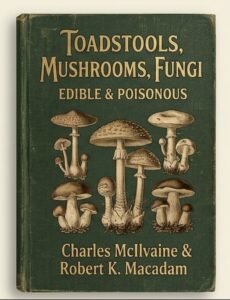
Toadstools, Mushrooms, Fungi, Edible and Poisonous; one Thousand American Fungi; how to Select and Cook the Edible; how to Distinguish and Avoid the Poisonous, With Full Botanic Descriptions
€51.95
“Toadstools, Mushrooms, Fungi, Edible and Poisonous” is a monumental historical reference work by Charles McIlvaine and his co-authors. Originally published as a definitive exploration of North American fungi, this classic text remains an essential piece of mycological history. It provides exhaustive botanical descriptions, guidance on selecting edible species, and critical instructions for identifying and avoiding poisonous varieties. This volume serves as both a scholarly pillar of the knowledge base of civilization and a fascinating look at the early foundations of American mycology.
For any serious student of mycology or collector of natural history, "Toadstools, Mushrooms, Fungi, Edible and Poisonous" is a truly significant volume. Recognized by scholars as culturally and scientifically important, this extensive work stands as a testament to the depth of early American exploration into the fungal kingdom.
What the reader gains:
A Historical Masterpiece: This book offers a window into the evolution of mycological study. It is not merely a guide, but a foundational document that captures decades of research, observation, and classification.
Exhaustive Botanical Detail: Spanning nearly 1,000 pages, the work provides incredibly thorough botanical descriptions. It acts as an encyclopedic record of American fungi, offering a level of depth that is rarely matched in contemporary field guides.
The Practical and the Scholarly: Beyond its academic weight, the authors maintained a focus on the practical needs of the forager. The text provides clear, historically rooted advice on how to distinguish between edible species and their poisonous counterparts—a challenge that has faced foragers for generations.
A Preservation of Knowledge: As a work in the public domain, this edition is part of an ongoing effort to keep vital historical information alive and accessible. By holding this book, you are engaging with a legacy of naturalists who dedicated their lives to cataloging the diversity of the wild.
Reference for the Serious Enthusiast: Whether you are researching the etymology of fungi, looking to understand early identification techniques, or simply wish to own a cornerstone piece of mycological literature, this book is an indispensable addition to your library.
This book is more than a guide; it is a profound journey into the past, offering both the practical wisdom of veteran foragers and the rigorous observations of early scientists. It remains a "must-have" for the bookshelf of any dedicated mycologist or historian of the natural world.
To provide the best experiences, we use technologies like cookies to store and/or access device information. Consenting to these technologies will allow us to process data such as browsing behavior or unique IDs on this site. Not consenting or withdrawing consent, may adversely affect certain features and functions.
Functional
Always active
The technical storage or access is strictly necessary for the legitimate purpose of enabling the use of a specific service explicitly requested by the subscriber or user, or for the sole purpose of carrying out the transmission of a communication over an electronic communications network.
Preferences
The technical storage or access is necessary for the legitimate purpose of storing preferences that are not requested by the subscriber or user.
Statistics
The technical storage or access that is used exclusively for statistical purposes.The technical storage or access that is used exclusively for anonymous statistical purposes. Without a subpoena, voluntary compliance on the part of your Internet Service Provider, or additional records from a third party, information stored or retrieved for this purpose alone cannot usually be used to identify you.
Marketing
The technical storage or access is required to create user profiles to send advertising, or to track the user on a website or across several websites for similar marketing purposes.