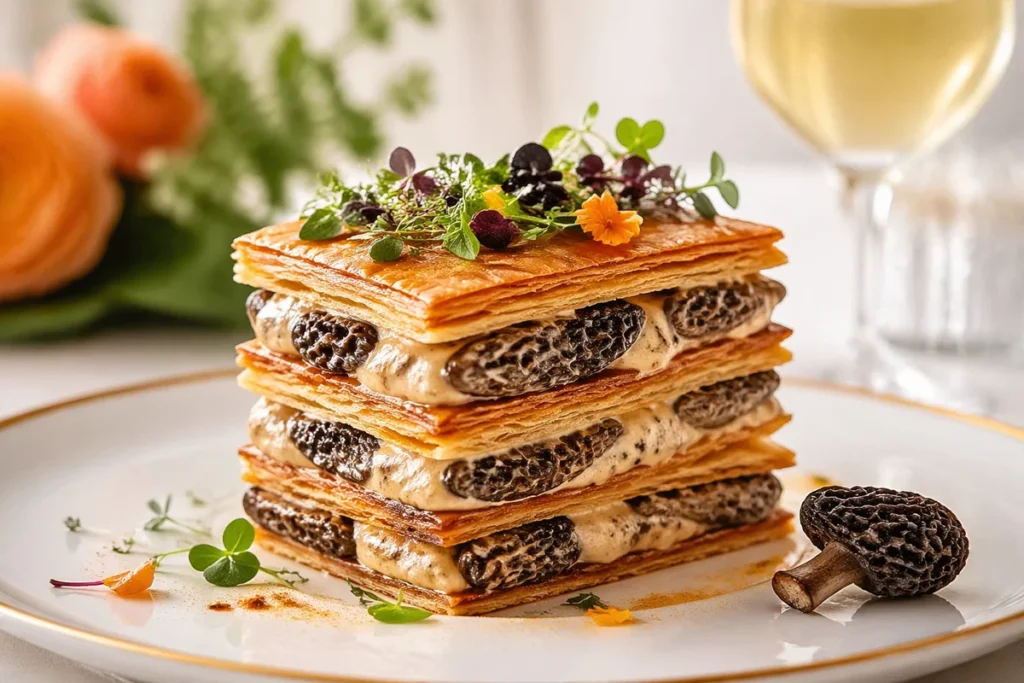
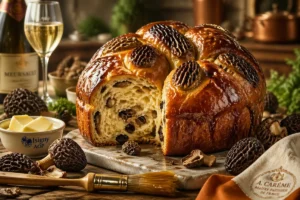
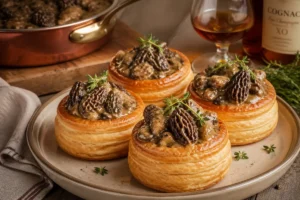
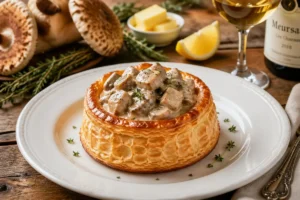
Explore the legendary Morel Mille-feuille Savory Versailles Garden Layers once served in the private retreats of the French Queen using Morchella esculenta for deep-forest intensity.
Sensational Marie Antoinette Heritage The Secret Morel Mille-feuille for Ultimate Perfection
An architectural botanical masterpiece inspired by the "thousand layers" of the Versailles gardens.
Why This Recipe Works
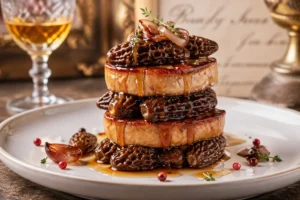
This savory Mille-feuille is a triumph of **Structural Umami Layering**. Its success is based on the vertical alternation of crisp, buttery puff pastry and a velvety mousseline base of Morchella esculenta. Every level is designed to release a different phase of the flavor spectrum—from the initial buttery contact to the deep, progressive umami finish of the fungi. Utilizing the professional 1:10 principle for dried morels, we create an infused cream that acts as the "culinary glue" between layers, ensuring an Incredible Umami intensity that prevents the pastry from overshadowing the delicate mycological identity of the dish.
The Historical Prelude
In the gardens of Versailles, Queen Marie Antoinette sought refuge from the heavy etiquette of the court, preferring lighter and more artistic interpretations of classical French cuisine. While the sweet Mille-feuille was well known, it was this savory version with morels that was served during her "botanical evenings" at the Petit Trianon. The morel, Morchella esculenta, was perceived as the "architect of the forest," whose structure perfectly mimicked the manicured yet wild layers of the royal gardens.
Western European gastronomy regards this dish as a symbol of the transition from Baroque to Classicism in the kitchen. Instead of heavy meat fillings, Marie Antoinette encouraged the use of spring treasures gathered at the peak of their freshness. Pure Umami revives this "Versailles Strategy" for 2026, providing the hidden steps to build the perfect balance between air, butter, and woodland umami. To master this Mille-feuille is to taste the elegance of a bygone era through the lens of modern mycology and Total Perfection.
1 pack All-Butter Puff Pastry (High-quality, pure butter)
200ml Crème Fleurette (heavy whipping cream)
2 Egg Yolks (for the mousseline base)
1 Shallot & 1 Garlic clove, finely minced
50ml Noilly Prat (Dry vermouth for deglazing)
Micro-greens for "Versailles Garden" decoration
Morel Infusion (liquid from rehydration)
The 3 Secret Steps to the Versailles Mille-feuille Mastery:
The Weighted Bake Strategy: Bake the puff pastry between two baking sheets and two layers of parchment paper. This limits the rise and creates exceptionally dense, crispy, and perfectly flat layers capable of supporting the weight of the morel cream—the key to Michelin-standard structural integrity.
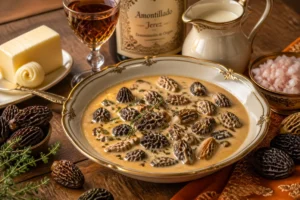
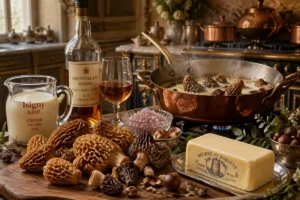
The Double Morel Reduction Secret: Rehydrate the dried morels in 500ml of warm water. Use 100ml of the filtered "Morel Infusion" to reduce with the cream until it becomes as thick as a mousse. This injects an Incredible Umami depth directly into the heart of the filling.
The Vertical Assembly Protocol: Assemble the layers only minutes before serving. Place one whole Morchella esculenta, sautéed in Noilly Prat, on every second layer to provide a textural surprise with each cut, achieving Total Perfection in presentation.
Sensory & Foraging Profile
Botanical Integrity:Morchella esculenta possesses a porosity that allows dairy fats to fill every honeycomb cell of the mushroom. When foraging, look for lighter-colored specimens—they often have a more delicate texture ideal for fine pastry work. Always follow the "Leave No Trace" rule to preserve the royal heritage of our forests.
The Umami Secret
Lipid-Lamination Synergy: The buttery layers in the puff pastry act as a conductor for the fat-soluble aromatic compounds of the morel. When the pastry meets the mushroom mousseline, the Incredible Umami intensity is amplified through the mechanical release of aromatics during the crunch.
The Art of Pairing
This architectural dish requires a wine with elegance and "vertical" acidity. Blanc de Blancs Champagne is the natural choice, corresponding with the crispness of the pastry. Alternatively, a Savennières (Chenin Blanc) from the Loire will highlight the mineral and nutty notes of the Morchella.
Micro-FAQ
Q: Can I use store-bought puff pastry? A: Yes, but ensure it is labeled "All-Butter" (100% butter) to achieve the Michelin standard and Ultimate Perfection.
Q: How do I prevent the pastry from getting soggy? A: The "Secret Strategy" is assembly at the very last moment—it is the only way to maintain the structural crispness of the layers.
Q: How do I identify Morchella esculenta? A: It is hollow from top to base and features characteristic honeycomb pits—the gold standard for botanical authenticity.
The Morel Lexicon: Regional Names for Morchella
The Morel is the undisputed queen of the spring forest. Its honeycomb structure and deep earthy aroma have earned it legendary status in cuisines from the Himalayas to the Appalachian Mountains:
Language
Regional & Folk Names
Cultural Context
English
Morel, Yellow Morel, Sponge Mushroom, Dryland Fish
"Dryland fish" is a popular folk name in the American South.
French
Morille, Morille blonde, Morille ronde
A staple of classic French haute cuisine.
German
Speisemorchel, Rund-Morchel
Highly valued in Alpine culinary traditions.
Bulgarian
Смърчкула, Пумпалка, Корминка, Мрежовка
"Pumpalka" refers to its spinning-top shape.
Romanian
Zbârciog, Ciuciulete, Попеască
"Zbârciog" is the most common term in Romanian folklore.
Russian / Polish
Сморчок (Smorchok) / Smardz jadalny
Considered a sign of the real spring's arrival.
Italian / Spanish
Spugnola / Colmenilla, Morilla
"Spugnola" (Italy) and "Colmenilla" (Spain) refer to the sponge/honeycomb look.
Turkish
Kuzu Göbeği Mantarı
Literally "Lamb's Belly" mushroom, a gourmet export of Turkey.
Japanese / Chinese
Amigasa-take (アミガサタケ) / Yangdujun
In China, it is highly valued for its medicinal properties.
Nordic (SE/NO/DK)
Toppmurkla / Rund morkel
A highly anticipated spring find in Scandinavia.
Scientific identification: Genus: Morchella | Pure Umami Research 2026
To provide the best experiences, we use technologies like cookies to store and/or access device information. Consenting to these technologies will allow us to process data such as browsing behavior or unique IDs on this site. Not consenting or withdrawing consent, may adversely affect certain features and functions.
Functional
Always active
The technical storage or access is strictly necessary for the legitimate purpose of enabling the use of a specific service explicitly requested by the subscriber or user, or for the sole purpose of carrying out the transmission of a communication over an electronic communications network.
Preferences
The technical storage or access is necessary for the legitimate purpose of storing preferences that are not requested by the subscriber or user.
Statistics
The technical storage or access that is used exclusively for statistical purposes.The technical storage or access that is used exclusively for anonymous statistical purposes. Without a subpoena, voluntary compliance on the part of your Internet Service Provider, or additional records from a third party, information stored or retrieved for this purpose alone cannot usually be used to identify you.
Marketing
The technical storage or access is required to create user profiles to send advertising, or to track the user on a website or across several websites for similar marketing purposes.