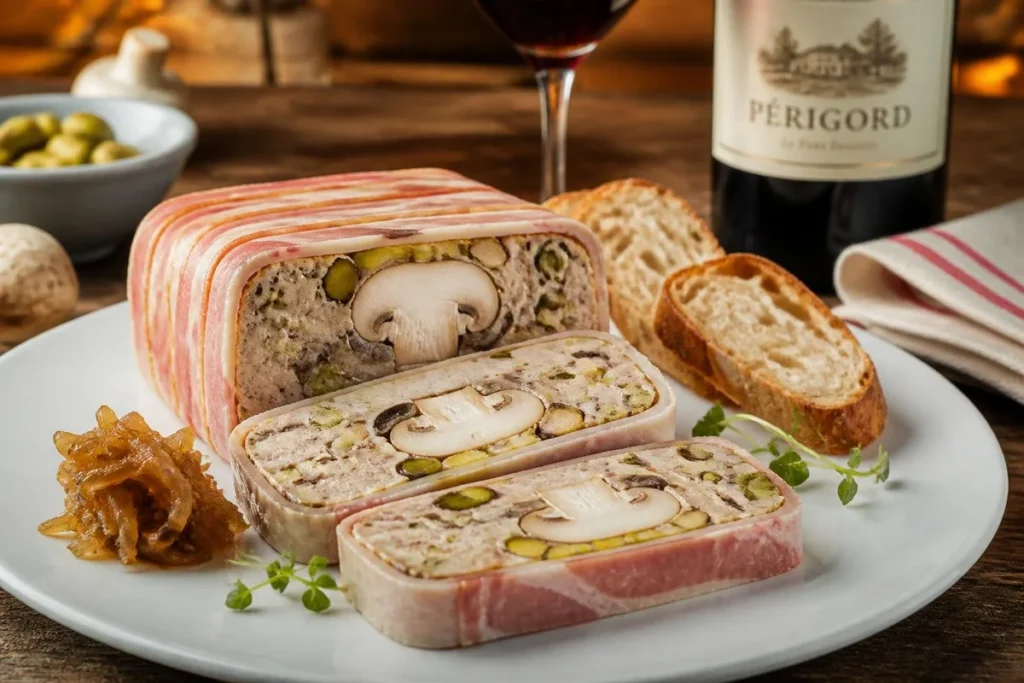
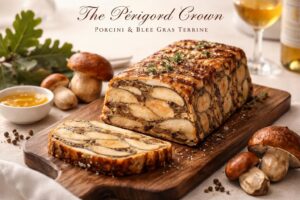
A technical exploration of mycological protein binding and lipid-driven aromatic preservation. This preparation utilizes the delicate structural integrity of Clitopilus prunulus to create a multi-layered terrine, stabilized through slow-thermal coagulation and enriched with the crunch of Sicilian pistachios and the deep earthiness of black truffle.
Miller Mushroom Terrine with Pistachios and Truffle Essence
This technical execution explores the manipulation of Clitopilus prunulus within a classic French Garde Manger framework. By utilizing a low-temperature poaching method (bain-marie), we preserve the volatile 2-acetyl-1-pyrroline compounds—responsible for the mushroom's signature dough-like aroma—while integrating them into a dense, lipid-rich matrix. The addition of Sicilian pistachios provides a chlorophyllic visual contrast and a lignified texture that balances the mushroom's inherent softness.
The Culinary Physics of This Dish
The Miller mushroom is characterized by a high moisture content and a cellular structure that collapses easily under direct heat. To circumvent this, we apply Thermal Coagulation Bonding. By folding the mushrooms into a fine-textured poultry mousseline, the proteins (albumin and myosin) act as a structural scaffold that supports the mushrooms during the slow-cooking process. The Truffle Essence is introduced in the final emulsion phase; the fats in the cream act as a solvent, "trapping" the truffle's thioether aromatics and the Miller's farinaceous esters within the terrine's internal environment, preventing evaporation.
Terroir Narrative
This dish is inspired by the Périgord region of France, the spiritual home of truffles and refined pâtés. In the humid, lime-rich oak forests of the Dordogne, the Miller mushroom is often foraged alongside the early indicators of truffle season. This terrine represents the bridge between the high summer forest floor and the arrival of the dark, earthy treasures of autumn. It is a dish that honors the artisanal tradition of the Charcutier, utilizing wild-foraged fungi as a central protein mimetic.
Prep Time
Cook Time
Complexity
Calories
Region
60 Mins
90 Mins (+12h rest)
Grand Officier
310 kcal
Périgord, France
Master Recipe (1:10 Rule)
600 g Fresh Miller Mushrooms (Clitopilus prunulus) – 300g diced, 300g whole small caps
400 g Skinless chicken breast (chilled to 2°C)
200 ml Double cream (min. 35% fat)
2 Organic egg whites
50 g Peeled Sicilian pistachios (toasted)
10 ml Black truffle essence (high grade)
20 g Sea salt & 2g white pepper
Thin lardo or bacon slices (to line the mold)
The Technique
1. The Mousseline: Process the chilled poultry in a food processor until smooth. Incorporate the egg whites, followed by the cream in a steady stream. The temperature must remain below 4°C to maintain the emulsion. Fold in the truffle essence and seasonings.
2. Mushroom Preparation: Lightly sauté the diced Miller mushrooms in butter to expel 10% of their moisture. Keep the whole caps raw; they will "steam" within the terrine, retaining their pristine white gills.
3. Layering (The Mosaic): Line a terrine mold with lardo. Spread a layer of mousseline, followed by the diced mushrooms and pistachios. Place the whole Miller caps in a central row to create a visual "eye" when sliced.
4. Thermal Management: Cover with parchment and aluminum foil. Place in a bain-marie (water bath) at 140°C. Cook until the internal temperature reaches exactly 68°C.
5. Compression: Remove from the oven, place a weight on top of the terrine, and refrigerate for at least 12 hours. This compression phase is critical for the "clean slice" architecture and flavor maturation.
6. Service: Slice into 1.5cm thick portions. Serve with a toasted sourdough and a light onion jam to complement the farinaceous notes of the mushroom.
Shop Integration
This terrine is an excellent canvas for our boutique selections. You can enhance the mosaic by adding the vibrant orange of Amanita caesarea (Amanita caesarea) or the deep, dark segments of Craterellus cornucopioides (Craterellus cinereus). Our Boletus edulis (Boletus edulis) adds a noble, nutty density, while the Cantharellus cibarius (Cantharellus cibarius) provides a peppery brightness. For a spring-inspired variation, our Morchella (Morchella conica) creates beautiful honeycomb patterns within the mousseline, and Marasmius oreades (Marasmius oreades) can be used to add subtle sweetness to the farce.
The Umami Profile
This dish achieves Stacked Umami Intensity. The Guanylates from the Miller mushrooms are reinforced by the Inosinates from the poultry and the Glutamates from the truffle. The long resting period allows for a process of flavor entrainment, where the different savory compounds meld into a unified, lingering umami finish that is enhanced by the salty lardo lining.
Sommelier’s Choice
Pomerol (Bordeaux): A Merlot-based red with velvety tannins and a distinct "iron" and truffle character. Its earthy complexity harmonizes with the Miller mushrooms and the truffle essence without overpowering the delicate mousseline.
THE ETYMOLOGICAL CHRONICLE
French:Meunier – Referencing the floury appearance and scent, historically associated with the mill workers of rural France.
Italian:Prugnolo bastardo – Noting its appearance in late summer/autumn, often contrasted with the spring-growing Calocybe gambosa.
German:Mehlräsling – Combining "Mehl" (flour) with a suffix for specific mushroom families.
Spanish:Molinera – Identifying the mushroom with the scent of raw dough and the milling of grains.
To provide the best experiences, we use technologies like cookies to store and/or access device information. Consenting to these technologies will allow us to process data such as browsing behavior or unique IDs on this site. Not consenting or withdrawing consent, may adversely affect certain features and functions.
Functional
Always active
The technical storage or access is strictly necessary for the legitimate purpose of enabling the use of a specific service explicitly requested by the subscriber or user, or for the sole purpose of carrying out the transmission of a communication over an electronic communications network.
Preferences
The technical storage or access is necessary for the legitimate purpose of storing preferences that are not requested by the subscriber or user.
Statistics
The technical storage or access that is used exclusively for statistical purposes.The technical storage or access that is used exclusively for anonymous statistical purposes. Without a subpoena, voluntary compliance on the part of your Internet Service Provider, or additional records from a third party, information stored or retrieved for this purpose alone cannot usually be used to identify you.
Marketing
The technical storage or access is required to create user profiles to send advertising, or to track the user on a website or across several websites for similar marketing purposes.