The Historical Prelude: The Alchemist’s Final Course
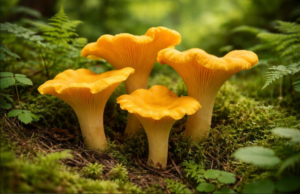
The concept of a "Mushroom Dessert" was once the domain of eccentric royal apothecaries and court alchemists. Historically, in the 18th-century courts of the Black Forest (Schwarzwald), the transition from savory to sweet was often blurred by the use of forest ingredients. While the Williams Pear (originally the Stair Pear) was celebrated for its musky, floral perfume, it was the Yellow Foot Chanterelle (Craterellus lutescens) that provided the missing aromatic link.
Foragers in the humid valleys of Southwestern Germany noticed that when the Yellow Foot was dried near an open hearth, it emitted a scent indistinguishable from ripe apricots and honey. In a stroke of culinary genius, pâtissiers in Baden-Baden began poaching these mushrooms in the same sugary syrups used for pears. They discovered that the mushroom's natural linalool (the same compound found in coriander and lavender) acted as a bridge to the tannins in Dark Chocolate.
This dish represents the birth of Botanical Pastry. It challenges the conventional palate by proving that umami-rich fungi, when treated with the precision of a chocolatier, can elevate a simple fruit dessert into a complex, multi-layered experience. It is a tribute to the "Secret Life of the Forest," where the lines between soil, fruit, and cocoa are erased by molecular affinity.
Narrative Intro: This dish is a "Forest Illusion." Our philosophy for the Mushroom Pear is to treat the Yellow Foot as a "textural fruit." By poaching the mushroom in vanilla-bean syrup, we suppress its savory profile and amplify its stone-fruit esters, allowing it to act as a bridge between the soft pear and the bitter-snap of the chocolate.
Sensory & Foraging Profile: The Moss and Coniferous Terroir
The Craterellus lutescens of the Black Forest grows in neutral-to-acidic mosses beneath towering silver firs. This terroir produces a mushroom with a vibrant orange stem and a high concentration of gamma-octalactone, the specific molecule responsible for "creamy apricot" scents. The hollow stems are remarkably efficient at absorbing poaching liquids, making them the ideal mushroom for dessert applications.
Ethical Harvesting & Professional Protocols: For dessert-grade mushrooms, we follow the "Aromatic Peak" protocol—harvesting only the youngest specimens before their caps fully flatten. We utilize soft-bristle brushes and strictly avoid any contact with soil to ensure the flavor remains purely floral. We leave the older, sporing mushrooms to maintain the genetic diversity of the fir-forest mycelium.
Essential Equipment: The Pastry Lab
Copper Poaching Pan: For even heat distribution during the slow poaching of the pears and mushrooms.
Tempering Marble or Digital Thermometer: Essential for achieving a "Snap" in the dark chocolate garnish.
Fine Microplane: For zesting the dried mushroom or citrus highlights.
Vacuum Sealer (Optional): To "Flash-Poach" the mushrooms, forcing the syrup into the cellular structure for maximum flavor saturation.
Master Recipe: Williams Pear & Yellow Foot
Stage 1: The Vanilla-Honey Infusion
Create a poaching liquid with 500ml water, 200g sugar, 50g Wildflower Honey, and one split Vanilla Bean. Bring to a simmer. This syrup will serve as the base for both the fruit and the fungi.
Stage 2: The Pear Poach
Peel 4 Williams Pears, leaving the stems intact. Poach in the syrup at 80°C for 25 minutes until tender but structural. Remove the pears and set aside to cool.
Stage 3: The Mycological Transformation
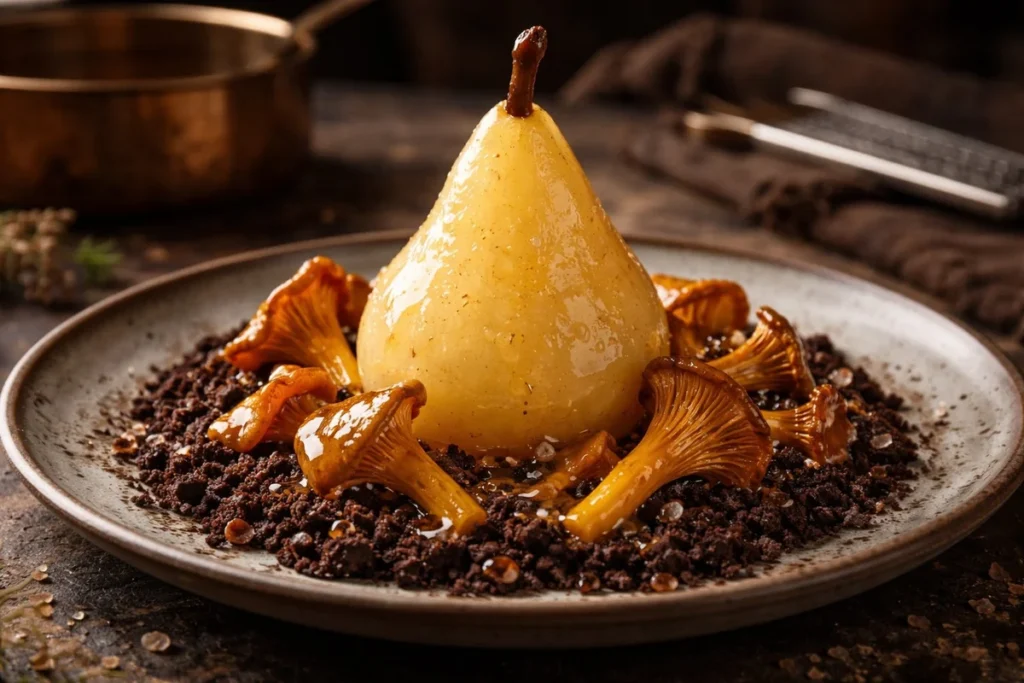
In the same syrup, add 150g of fresh, cleaned Yellow Foot chanterelles. Simmer for 10 minutes. The mushrooms will shrink slightly and absorb the honey and vanilla. Drain and set on parchment paper; they will become translucent and glisten like candied fruit.
Stage 4: The 70% Chocolate “Earth”
Melt 100g of 70% Dark Chocolate (Valrhona or similar). Spread thinly on a silicone mat and freeze. Once hard, crumble into "soil." This provides a bitter, crunchy base that counters the sweetness of the syrup.
Stage 5: The Assembly
Place a pear in the center of the plate over a bed of chocolate earth. Arrange the "candied" Yellow Foot mushrooms around the pear. Drizzle with a reduction of the poaching syrup and a final pinch of Maldon Salt to ignite the chocolate-mushroom synergy.
Substitutions & Variations: The Luxury Palette
The Fruit: Replace pears with White Peaches for a more summer-aligned stone-fruit profile.
The Chocolate: Use Salted Caramel Chocolate for a less bitter, more approachable flavor bridge.
The Mushroom: For an even more exotic finish, use Dehydrated and Ground Yellow Foot as a "dusting" over the final plate.
Pro Technique: The “Syrup Cure”
For the ultimate texture, poach the mushrooms the day before and let them sit in the syrup in the refrigerator for 24 hours. This allows the sugar molecules to fully replace the mushroom's internal moisture (osmosis), resulting in a texture that is identical to a Gummy Bear but with the sophisticated aroma of the Black Forest.
The Umami Secret: Polyphenols and Linalool
The **Dark Chocolate** is loaded with Polyphenols and Pyrazines (roasted notes). The **Yellow Foot** contains Linalool and Beta-Ionone (violet/apricot notes). When these interact with the **Malic Acid** in the pear, they create a "Aromatic Chord"—a harmony where the bitterness of the chocolate and the woodiness of the mushroom vanish into a single, complex sensation of "Deep Fruit."
The Art of Pairing: The Sommelier’s Selection
Sommelier's Choice: A Late-Harvest Riesling (Auslese) from the Mosel. Its high acidity and notes of honeyed apricot are the exact mirror of the poached Yellow Foot.
Non-Alcoholic Alternative:Earl Grey Tea (Hot or Cold). The bergamot in the tea resonates perfectly with the mushroom's linalool and the chocolate's tannins.
Storage & Reheating
Poached pears and "candied" mushrooms can be stored in their syrup for up to 5 days in the refrigerator. **Note:** Do not freeze, as the cellular structure of the pear will collapse. Serve chilled or at room temperature for the best aromatic release.
Ancestral Nutrition
Yellow Foot chanterelles are high in Antioxidants and B-vitamins. Dark chocolate provides Magnesium and Flavonoids. In old European folk medicine, "Sweetened Fungi" were often given to convalescents to stimulate the appetite and provide a "spirit lift" during the dark autumn months.
Micro-FAQ
Q: Won't it taste like "mushroom"? A: No. When the savory compounds (glutamates) are balanced with high sugar and vanilla, the brain focuses on the "fruity" esters of the Yellow Foot rather than the "earthy" ones.
Q: Can I use regular Chanterelles? A: No. Regular chanterelles (Cantharellus cibarius) are too peppery and dense. The Craterellus lutescens is unique because of its hollow stem and thin flesh, which is perfect for poaching.
Q: Why 70% chocolate? A: Lower percentages contain too much milk and sugar, which would drown out the delicate apricot scent of the mushroom.
To provide the best experiences, we use technologies like cookies to store and/or access device information. Consenting to these technologies will allow us to process data such as browsing behavior or unique IDs on this site. Not consenting or withdrawing consent, may adversely affect certain features and functions.
Functional
Always active
The technical storage or access is strictly necessary for the legitimate purpose of enabling the use of a specific service explicitly requested by the subscriber or user, or for the sole purpose of carrying out the transmission of a communication over an electronic communications network.
Preferences
The technical storage or access is necessary for the legitimate purpose of storing preferences that are not requested by the subscriber or user.
Statistics
The technical storage or access that is used exclusively for statistical purposes.The technical storage or access that is used exclusively for anonymous statistical purposes. Without a subpoena, voluntary compliance on the part of your Internet Service Provider, or additional records from a third party, information stored or retrieved for this purpose alone cannot usually be used to identify you.
Marketing
The technical storage or access is required to create user profiles to send advertising, or to track the user on a website or across several websites for similar marketing purposes.