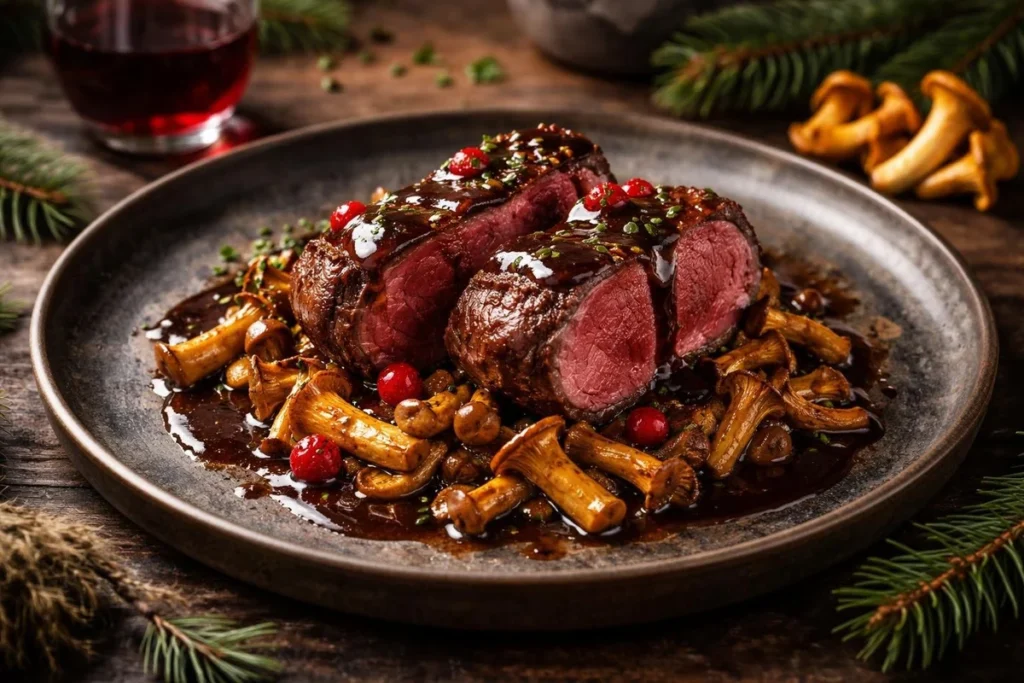
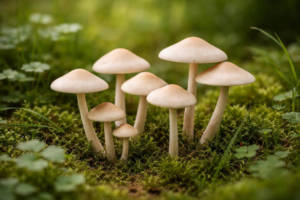
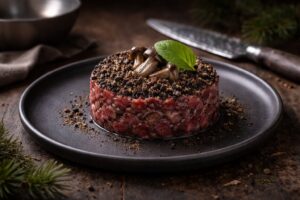
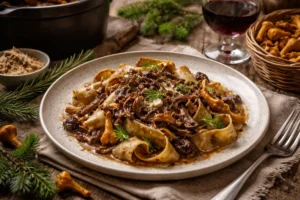
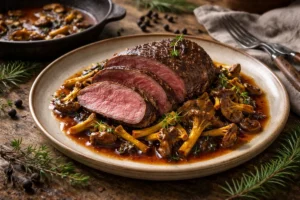
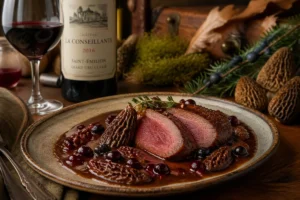
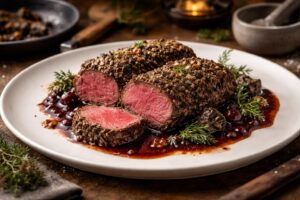
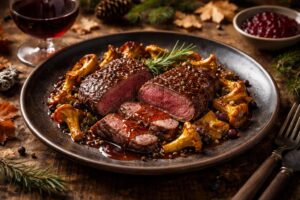
A monumental pairing of wild German venison and Yellow Foot chanterelles in a rich cocoa-infused Grand Veneur sauce. A study in the dark minerals of the Schwarzwald.
In the dense, shadowed heart of the Black Forest (Schwarzwald), the intersection of the hunt and the harvest has long dictated the culinary calendar. The Sauce Grand Veneur—the "Great Hunter's Sauce"—is a cornerstone of classical Germanic and French game cookery. Traditionally, it was a complex reduction of red wine and pepper, thickened with currant jelly and, most importantly, the blood of the animal.
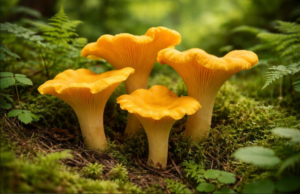
The Yellow Foot Chanterelle (Craterellus lutescens) was the forest's specific answer to the iron-rich intensity of Hirsch (Venison). Unlike the summer Girolle, the Yellow Foot thrives in the late-autumn dampness of the spruce-heavy Black Forest slopes. Historical accounts from the hunting lodges of Baden-Baden suggest that chefs began incorporating the Yellow Foot to provide a "resinous sweetness" that bridged the gap between the gamey meat and the tart redcurrants of the sauce.
By the 20th century, modern masters like Harald Wohlfahrt refined this pairing, replacing the heavy blood-thickening with a technical addition of dark cocoa. This addition mirrored the earthy, dark color of the Yellow Foot and amplified its subtle smoky notes. This dish represents the ultimate "Forest Floor" plate—a technical dialogue between the apex predator of the woods and the golden fungi that flourish in its footsteps.
Narrative Intro: This dish is a study in "The Spectrum of Dark Umami." Our philosophy for the Grand Veneur is to use the Yellow Foot as a mineral stabilizer. While the venison provides a metallic iron hit and the cocoa provides a bitter bass note, the Yellow Foot's apricot aroma acts as a high-frequency contrast that prevents the sauce from becoming overwhelmingly heavy.
Sensory & Foraging Profile: The Spruce-Needle and Humus Terroir
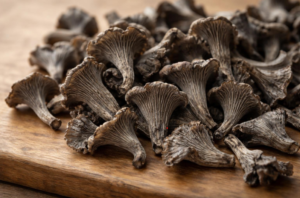
The Craterellus lutescens of the Black Forest is defined by the high acidity of the spruce-needle duff it grows in. This results in a mushroom with a pronounced peppery-smoke scent and a deep, orange-black coloration. The heavy iron content of the Schwarzwald soil imparts a blood-like mineral edge that is unique to this regional variety.
Ethical Harvesting & The "Schwarzwald" Protocol: In the Black Forest, we harvest using the "Two-Finger Snap"—a quick upward motion that leaves the basal mycelium undisturbed. We only harvest clusters found within 1 meter of live spruce trees, as these have the highest aromatic concentration. We leave all "Frost-Bit" specimens (mushrooms that have frozen and thawed) as they serve as vital winter food for the local deer populations.
Essential Equipment: The Game Station
Cast-Iron Skillet: To achieve a hard sear on the venison loin while maintaining a rare center.
Saucepan with Heavy Bottom: For the slow, controlled reduction of the Grand Veneur.
Microplane: For the precision grating of 90% dark cocoa at the final stage.
Fine Mesh Strainer: To ensure the sauce achieves a "Mirror Glaze" (Glaçage) finish.
Master Recipe: Venison & Yellow Foot Grand Veneur
Stage 1: The Venison Sear
Season 600g of Venison Loin (Hirschruecken) with salt and crushed juniper berries. In a hot skillet with a neutral oil, sear the loin for 2 minutes on all sides. Remove and let rest in a warm place (approx 55°C) for at least 15 minutes.
Stage 2: The Mushroom & Marrow Sauté
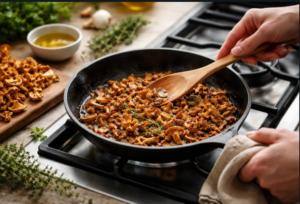
In the same pan, melt 20g of beef marrow or butter. Add 300g of fresh Yellow Foot chanterelles. Sauté over high heat until the edges begin to crisp. The marrow fat will penetrate the hollow stems of the mushrooms. Remove and set aside.
Stage 3: The Grand Veneur Reduction
Deglaze the pan with 200ml of Spätburgunder (Pinot Noir). Reduce by half. Add 300ml of dark game stock and 1 tablespoon of redcurrant jelly. Simmer until the sauce coats the back of a spoon.
Stage 4: The Cocoa Finish (The “Chef’s Secret”)
Remove the sauce from the heat. Whisk in 10g of chilled butter and grate 5g of 90% Dark Cocoa directly into the liquid. This will emulsify the sauce and turn it a deep, glossy black-brown.
Stage 5: The Forest Assembly
Slice the venison into thick medallions. Arrange over a generous mound of the sautéed Yellow Feet. Nap the meat with the Grand Veneur sauce. Garnish with a few fresh lingonberries for an acidic pop.
Substitutions & Variations: The Luxury Palette
The Meat: If venison is unavailable, use Wild Boar or an Aged Ribeye.
The Sweetener: Replace redcurrant jelly with Elderberry syrup for a more floral, Germanic profile.
The Mushroom: For a more intense flavor, use a 50/50 mix of fresh and rehydrated dried Yellow Feet, using the soaking liquid in the sauce reduction.
Pro Technique: The “Marrow-Basting” Method
To achieve the "Hunter's Glaze," baste the venison with melted beef marrow while it rests. This provides a rich, fatty coating that helps the Grand Veneur sauce adhere to the meat, creating a unified sensory experience between the protein and the forest mushrooms.
The Umami Secret: Polyphenols and Myoglobin Coupling
The **Venison** is exceptionally high in Myoglobin (iron-carrying protein). The **Cocoa** and **Red Wine** are rich in Polyphenols. When these meet the **Phenolic compounds** in the Yellow Foot Chanterelle, they form a "Flavor Complex" that tastes significantly darker and "thicker" than the individual ingredients. The cocoa acts as a bridge, masking the metallic iron taste of the blood while highlighting the smoky minerals of the mushroom.
The Art of Pairing: The Sommelier’s Selection
Sommelier's Choice: An Aged Spätburgunder (Pinot Noir) from the Baden region. Its tertiary notes of forest floor and dried cherry are a direct mirror to the dish.
Non-Alcoholic Alternative: A Cold-Pressed Tart Cherry Juice with a hint of Juniper. The acidity and tannic structure mimic a high-end red wine.
Micro-FAQ
Q: Why add cocoa to a meat sauce? A: Cocoa is not used for sweetness here; it provides bitterness, color, and a luxurious "mouthfeel" that traditional flour thickeners cannot replicate.
Q: My venison is tough. What happened? A: You likely skipped the resting period. Rest is non-negotiable for game meat; it allows the muscle fibers to relax and retain their juices.
Q: Can I use regular button mushrooms? A: No. Regular mushrooms lack the resinous and apricot-like compounds necessary to stand up to the venison and cocoa.
To provide the best experiences, we use technologies like cookies to store and/or access device information. Consenting to these technologies will allow us to process data such as browsing behavior or unique IDs on this site. Not consenting or withdrawing consent, may adversely affect certain features and functions.
Functional
Always active
The technical storage or access is strictly necessary for the legitimate purpose of enabling the use of a specific service explicitly requested by the subscriber or user, or for the sole purpose of carrying out the transmission of a communication over an electronic communications network.
Preferences
The technical storage or access is necessary for the legitimate purpose of storing preferences that are not requested by the subscriber or user.
Statistics
The technical storage or access that is used exclusively for statistical purposes.The technical storage or access that is used exclusively for anonymous statistical purposes. Without a subpoena, voluntary compliance on the part of your Internet Service Provider, or additional records from a third party, information stored or retrieved for this purpose alone cannot usually be used to identify you.
Marketing
The technical storage or access is required to create user profiles to send advertising, or to track the user on a website or across several websites for similar marketing purposes.