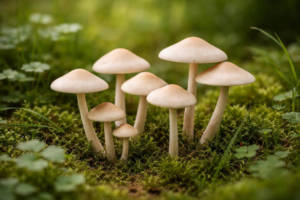
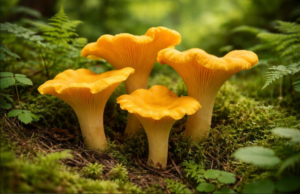
In the rugged terrain where the Pyrenees mountains plunge into the Bay of Biscay, the culinary tradition is defined by the proximity of high-altitude forests to the deep Atlantic. Historically, Basque and Gascon fishermen would trade their catch of Lotte (Monkfish)—then known as the "poor man's lobster"—for the seasonal harvests of the Yellow Foot Chanterelle (Craterellus lutescens) gathered from the humid pine slopes of the Adour valley.
The genius of this pairing lies in the 18th-century French court's influence on the region. The chefs of Pau and Biarritz recognized that Monkfish, with its unique collagen-rich, meaty texture, required a mushroom that wouldn't wilt under the pressure of a high-heat sear. The Yellow Foot, with its peppery apricot profile, was the only fungus capable of cutting through the dense, lobster-like fats of the fish.
By the time Alain Ducasse championed the "Terroir" movement in the late 20th century, the Lotte aux Chanterelles had been elevated to a technical masterpiece. It represents the "Cuisine du Marché" at its peak: a dish where the salt-spray of the Atlantic meets the damp moss of the Pyrenean peaks, held together by the nutty, caramelized embrace of Beurre Noisette.
Narrative Intro: This dish is a study in "The Third Fat." While the monkfish provides the protein and the butter provides the medium, the Yellow Foot provides a "fat-like" aroma of stone fruits. Our philosophy is to use the mushroom as an aromatic bridge, emulsifying the sea-minerals of the fish into the nutty milk solids of the butter to create a unified, golden sauce.
Sensory & Foraging Profile: The Humid Pine and Shale Terroir
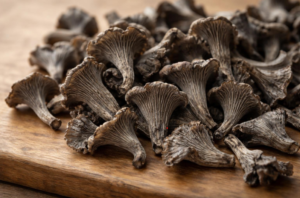
The Craterellus lutescens of the Western Pyrenees thrives in the hyper-humid pine forests influenced by Atlantic mists. This terroir creates a mushroom with a pronounced peppery-apricot scent and a distinctive orange-gold stem. The acidic shale soil of the region imparts a metallic, sharp finish that is essential for balancing fatty fish.
Ethical Harvesting & The "Sea-Mist" Protocol: In the Pyrenees, we harvest only during the "Mist Window"—the early morning hours before the sun burns off the Atlantic fog. This preserves the moisture in the hollow stems. We use hazelwood baskets to allow for spore dispersal and strictly leave the first three clusters encountered to act as "Seed Mothers" for the next season.
Essential Equipment: The Pyrenean Station
Blue Steel Skillet: Essential for the high-temperature sear required to caramelize the monkfish without boiling it in its own juices.
Small Copper Saucier: For the precise temperature control needed to brown butter (Beurre Noisette) without burning the milk solids.
Digital Thermometer: To ensure the monkfish remains at a succulent 52°C internal temperature.
Fish Spatula: To handle the delicate monkfish medallions without tearing the Maillard crust.
Clean 600g of Monkfish loin, ensuring all silver skin is removed. Slice into 4cm thick medallions. Season with sea salt 20 minutes prior to cooking; this "tightens" the flesh and ensures a lobster-like texture.
Stage 2: The Mushroom Activation
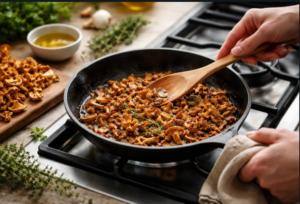
Heat a dry pan. Add 300g of fresh Yellow Foot chanterelles. Cook until their water is released and evaporated. This concentrates the stone-fruit esters. Remove and set aside.
Stage 3: The Beurre Noisette (The Foundation)
In a copper saucier, melt 80g of high-quality butter. Cook over medium heat until the foaming subsides and the butter turns the color of a hazelnut, releasing a toasted aroma. Immediately add the pre-cooked Yellow Feet and a squeeze of lemon to stop the cooking.
Stage 4: The High-Heat Sear
Pat the monkfish bone-dry. In the steel skillet, sear the medallions in a neutral oil at high heat for 3 minutes per side. The exterior should be golden and "snappy."
Stage 5: The Emulsion Garnish
Add 20g of fried capers and a handful of flat-leaf parsley to the Yellow Foot butter. Spoon the bubbling mushroom butter over the rested monkfish. The heat of the butter will complete the "bloom" of the mushroom's fragrance.
Substitutions & Variations: The Luxury Palette
The Fish: If Monkfish is unavailable, use Atlantic Scallops (St. Jacques) or Turbot loin.
The Butter: Use Smoked Butter to amplify the "campfire" notes of the Pyrenean woods.
The Garnish: Add toasted Marcona almonds for a crunchy counterpoint to the soft Yellow Feet.
Pro Technique: The “Arrosage” (Basting)
In the final minute of searing the monkfish, add a tablespoon of the Yellow Foot butter to the pan. Tilt the pan and continuously spoon the foaming mushroom fat over the fish. This ensures the mushroom's fat-soluble aromatics penetrate the protein, creating a unified flavor profile from the core to the crust.
The Umami Secret: Trimethylamine Oxide (TMAO) and Esters
Monkfish contains high levels of TMAO, which breaks down into savory amines during cooking. The Yellow Foot contains Benzyl Esters. When these are seared together in a Beurre Noisette (rich in pyrazines), they form an "Umami Bridge" that tricks the brain into perceiving a highly complex, shellfish-like flavor. This is why this pairing is often described as tasting "more like lobster than lobster itself."
The Art of Pairing: The Sommelier’s Selection
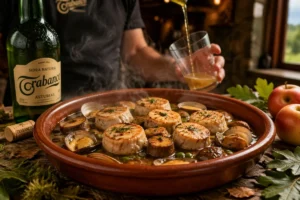
Sommelier's Choice: A Jurançon Sec (Gros Manseng/Petit Manseng). Its bracing acidity and notes of grapefruit and exotic fruits perfectly cut through the butter while echoing the mushroom's apricot scent.
Non-Alcoholic Alternative:Chilled Verjus with a splash of tonic. The sharp, "green" acidity of the unripened grapes balances the nutty butter perfectly.
Micro-FAQ
Q: Why is my monkfish rubbery? A: You likely overcooked it. Monkfish must be served slightly translucent in the center (52-54°C). If it goes beyond 60°C, the collagen fibers tighten into a rubber-like texture.
Q: Can I use Golden Chanterelles? A: You can, but they have a higher water content and are less peppery. The Yellow Foot's robust structure is technically superior for high-heat basting.
Q: My butter burned. What happened? A: Beurre Noisette happens fast. As soon as the milk solids turn the color of a hazelnut, you must add liquid (lemon juice or the mushrooms) to drop the temperature immediately.
To provide the best experiences, we use technologies like cookies to store and/or access device information. Consenting to these technologies will allow us to process data such as browsing behavior or unique IDs on this site. Not consenting or withdrawing consent, may adversely affect certain features and functions.
Functional
Always active
The technical storage or access is strictly necessary for the legitimate purpose of enabling the use of a specific service explicitly requested by the subscriber or user, or for the sole purpose of carrying out the transmission of a communication over an electronic communications network.
Preferences
The technical storage or access is necessary for the legitimate purpose of storing preferences that are not requested by the subscriber or user.
Statistics
The technical storage or access that is used exclusively for statistical purposes.The technical storage or access that is used exclusively for anonymous statistical purposes. Without a subpoena, voluntary compliance on the part of your Internet Service Provider, or additional records from a third party, information stored or retrieved for this purpose alone cannot usually be used to identify you.
Marketing
The technical storage or access is required to create user profiles to send advertising, or to track the user on a website or across several websites for similar marketing purposes.