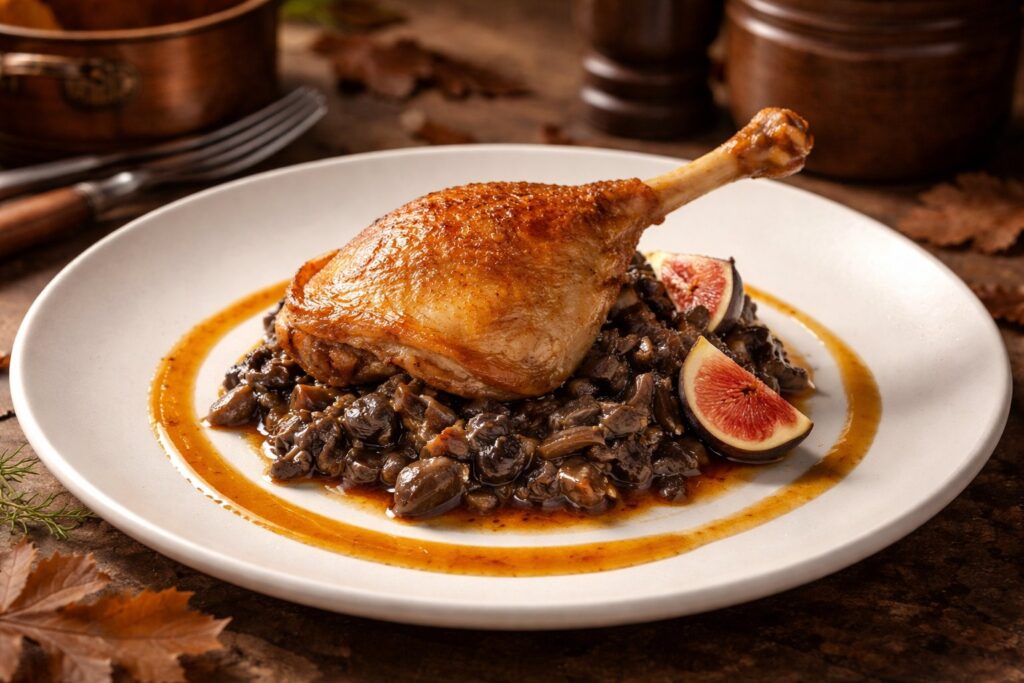
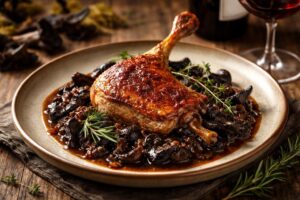
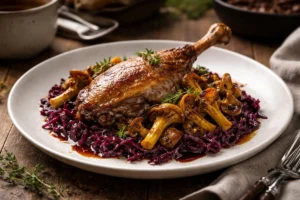
A definitive study in Gascon luxury featuring slow-cooked duck leg, the peppery earth of Cantharellus cinereus, and a sharp, fruit-driven reduction.
Pyrenean Duck Confit
Gray Chanterelle Ragout and the Amber Light of Occitanie
The Historical Prelude: The Preservation Secrets of the Southwest
In the shadow of the Pyrenees, spanning from the Atlantic coast to the Mediterranean, the culinary identity of Gascony is defined by a single word: Confit. Historically, the technique of slow-cooking meat in its own rendered fat was a desperate necessity of the rural peasantry to preserve protein through the long, damp winters. However, by the 18th century, the "Confit de Canard" had migrated from the farmhouse larder to the tables of the French aristocracy, championed by Henry IV—a king who famously hailed from the region and popularized the rustic flavors of the south in the Parisian court.
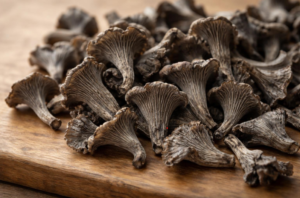
While the duck provided the fat and the salt, the soul of the dish was always found in the forest. The foragers of the Pau and Tarbes regions realized that the "Ghost of the Woods"—the Cantharellus cinereus—was the only fungi capable of standing up to the intense, gamey richness of the duck. The Gray Chanterelle's peppery profile acted as a natural digestive, while its ability to absorb fats without losing its structural integrity made it the ideal candidate for a Ragout.
This specific pairing—Duck, Gray Chanterelle, and Fig—was a hallmark of the Belle Époque era in Biarritz, where grand hotels served this dish to the European elite. The fig gastrique was added as a nod to the Moorish influences that traveled over the Pyrenees from Spain, providing a sharp, acidic counterpoint to the velvet-like fat of the confit. Today, this dish remains the ultimate expression of Pyrenean terroir, requiring a chef to master the balance of fire, time, and the delicate moisture of the forest floor.
Narrative Intro: To prepare a Confit is to enter into a contract with time. Our philosophy for this Pyrenean classic is "Osmotic Balance." We cure the duck to remove moisture, then replace that moisture with aromatic fat. The Gray Chanterelle Ragout serves as the earthy anchor, absorbing the duck's juices while contributing its own mineral "ashy" notes to the plate. This is the flavor of an autumn afternoon in the foothills of the Pyrenees.
Sensory & Foraging Profile: The Oak and Clay Terroir
The Cantharellus cinereus of the Pyrenean foothills is uniquely influenced by the heavy clay soils and the proximity to the Atlantic air. These specimens are often larger and more "fleshy" than their mountain cousins, possessing a musky, truffle-like aroma that intensifies when paired with animal fats. Their color is a deep, bruised charcoal, providing a stunning visual contrast to the golden skin of the duck.
Ethical Harvesting & The "Mistletoe Boundary": Pyrenean foragers follow the "Mistletoe Boundary"—harvesting only in oak groves where the mistletoe grows high in the canopy, a sign of a balanced, mature ecosystem. When gathering Gray Chanterelles, we use a "Dry-Brush" technique, removing all debris in the forest to avoid washing the mushrooms later. Introducing water to a Chanterelle intended for a ragout is considered a culinary sin, as it dilutes the mushroom's ability to absorb the duck fat and wine reduction.
Essential Equipment: The Tools of the Gascon Kitchen
Earthenware Cassole or Dutch Oven: For the low-and-slow thermal inertia required for confit.
Copper Sauté Pan: For the precision glazing of the Gray Chanterelle ragout.
Fine Mesh Chinois: For straining the gastrique to a glass-like finish.
Tongs with Silicone Tips: To handle the fragile, tender duck legs without breaking the skin.
Master Recipe: Pyrenean Duck and Gray Chanterelle
Stage 1: The Salt Cure (Le Salage)
Coat 4 duck legs in a mixture of sea salt, crushed black peppercorns, thyme, and bay leaves. Cure in the refrigerator for 12 hours. This process extracts excess water and seasons the meat to the bone. Rinse and pat thoroughly dry.
Stage 2: The Confit (The Slow Bath)
Submerge the legs in 1 liter of rendered duck fat. Cook at exactly 95°C for 3 to 4 hours until the meat is "spoon-tender" but not falling off the bone. Let the legs cool in the fat to retain maximum succulence.
Stage 3: The Gray Chanterelle Ragout
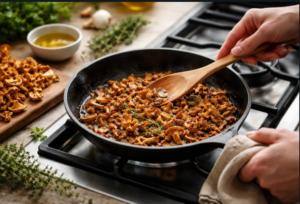
In a copper pan, sauté 300g of Gray Chanterelles in two tablespoons of the duck confit fat. Add a finely minced shallot of Echalion and a splash of Armagnac. Flambé to remove the alcohol, then add 100ml of dark poultry stock. Simmer until the liquid becomes a thick, glossy glaze that coats the mushrooms.
Stage 4: The Fig Gastrique
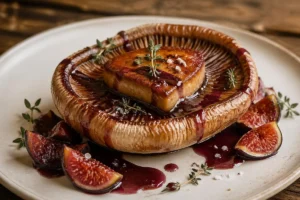
Caramelize 50g of sugar until amber. Deglaze with 100ml of Sherry Vinegar. Add 4 halved fresh figs and reduce by half. Strain through a chinois, keeping the figs for garnish.
Stage 5: The Final Crisp and Assembly
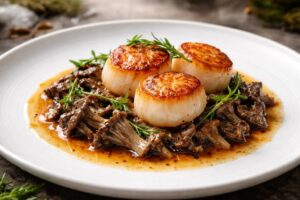
Place the duck legs in a hot skillet, skin-side down, until the skin becomes "parchment-crisp" and golden. Place a generous mound of the Gray Chanterelle ragout in the center of the plate, rest the duck on top, and finish with a circular drizzle of the fig gastrique.
Substitutions & Variations: The High-End Palette
The Fat: If duck fat is scarce, a high-quality rendered goose fat is a traditional and even richer alternative.
The Acid: Instead of figs, use Black Cherries from Itxassou to create a "Black Forest" Pyrenean variation.
The Mushroom: If fresh Gray Chanterelles are out of season, dried Horn of Plenty (*Craterellus cornucopioides*) can be used, provided they are rehydrated in the Armagnac.
Pro Technique: The “Skin-Side” Rest
After crisping the duck skin, let the leg rest skin-side UP on a wire rack for 2 minutes before plating. If you rest it on a flat plate, the steam from the meat will immediately soften the skin you worked so hard to crisp. This "Resting Elevation" is the secret to the audible crunch found in the best bistros of Toulouse.
The Umami Secret: Chitinous Absorption and Maillard Fat
The **Maillard reaction** on the duck skin produces complex nitrogenous compounds. When these meet the **lipid-loving chitin** of the Gray Chanterelle, a unique chemical absorption occurs. The mushroom acts like a biological sponge, trapping the "roasted" flavors of the skin within its own cellular walls. When the diner bites into the mushroom, they experience a "fat-umami" release that is amplified by the mushroom's own **guanylates**, creating a flavor loop that makes the dish feel incredibly rich yet balanced.
The Art of Pairing: The Sommelier’s Selection
Sommelier's Choice: A Madiran (Tannat). This wine is famous for its high tannin content and dark fruit. The tannins act as a "fat-cutter," cleaning the palate between bites of the rich duck, while its earthy finish mirrors the Gray Chanterelle.
Non-Alcoholic Alternative: A Sparkling Pomegranate and Pine Infusion. The tartness and tannin of the pomegranate mimic the structure of a red wine, while the pine notes echo the Pyrenean forest.
Storage & Reheating: Professional Restoration
Duck confit can be stored in its own fat for up to 3 months in a cool cellar (this is the traditional method). To reheat, remove from the fat and crisp in a pan. The **Gray Chanterelle Ragout**, however, should be made fresh. If you must reheat it, add a small splash of stock to restore the glaze's glossiness.
Ancestral Nutrition: The Longevity of the Southwest
The "French Paradox" is often attributed to the diet of the Southwest. Duck fat is surprisingly high in **Monounsaturated Fatty Acids** (similar to olive oil), which support heart health. The Gray Chanterelle provides a massive dose of **Vitamin D** and **B3 (Niacin)**, while the figs add **Fiber and Magnesium**. Historically, this was the "Energy of the Shepherds," providing the sustained caloric density needed for mountain life.
Micro-FAQ
Q: Why did my duck legs become dry? A: You likely cooked them at too high a temperature. Confit is a poach in fat, not a fry. Keep the fat below 100°C.
Q: Can I use the confit fat again? A: Absolutely. Strain it and keep it in the fridge. It is known as "Gascon Gold" and is the best medium for roasting potatoes.
Q: Why Armagnac for the mushrooms? A: Armagnac is the local brandy of the Pyrenees. It has a more rustic, "primal" flavor than Cognac, which complements wild game and forest fungi more effectively.
To provide the best experiences, we use technologies like cookies to store and/or access device information. Consenting to these technologies will allow us to process data such as browsing behavior or unique IDs on this site. Not consenting or withdrawing consent, may adversely affect certain features and functions.
Functional
Always active
The technical storage or access is strictly necessary for the legitimate purpose of enabling the use of a specific service explicitly requested by the subscriber or user, or for the sole purpose of carrying out the transmission of a communication over an electronic communications network.
Preferences
The technical storage or access is necessary for the legitimate purpose of storing preferences that are not requested by the subscriber or user.
Statistics
The technical storage or access that is used exclusively for statistical purposes.The technical storage or access that is used exclusively for anonymous statistical purposes. Without a subpoena, voluntary compliance on the part of your Internet Service Provider, or additional records from a third party, information stored or retrieved for this purpose alone cannot usually be used to identify you.
Marketing
The technical storage or access is required to create user profiles to send advertising, or to track the user on a website or across several websites for similar marketing purposes.