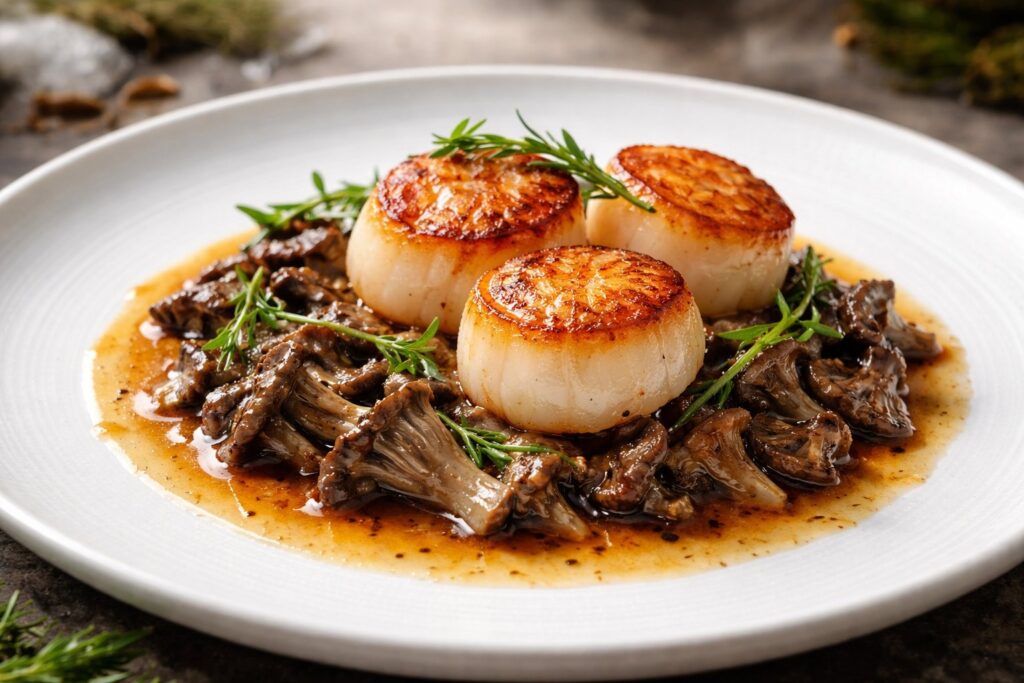
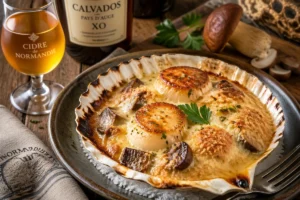
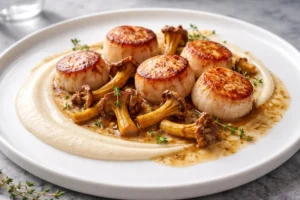
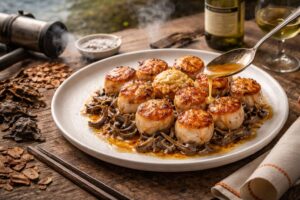
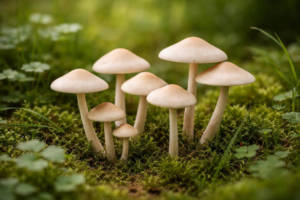
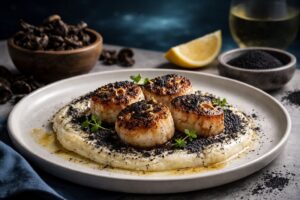
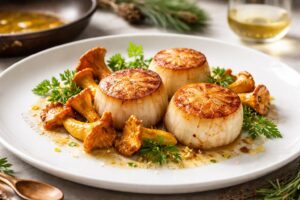
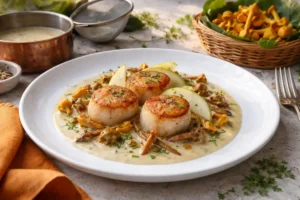
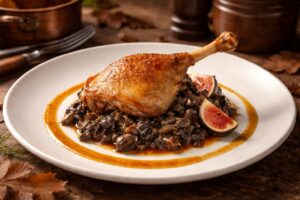
A coastal-forest dialogue from the Atlantic Fringes featuring the mineral snap of Cantharellus cinereus and butter-seared king scallops.
Scallops St. Jacques & Gray Chanterelle
The Atlantic Solstice: Maritime Iodine meets the Ashy Forest Floor
The Historical Prelude: The Pilgrimage and the Autumn Harvest
The Coquille St. Jacques (King Scallop) carries a cultural weight far beyond its culinary value, serving as the iconic symbol of the Camino de Santiago. However, in the damp, mist-laden coastal regions of Brittany and Normandy, the scallop season overlaps with a specific forest phenomenon: the late-autumn emergence of the Cantharellus cinereus. Historically, this pairing was not a creation of high-end restaurants, but a geographical inevitability for the "Sea-Foragers" of the French Atlantic.
In the 18th century, Breton fishermen often traded their catch with the inland foresters who gathered the "Gray Ghost" chanterelles beneath the coastal oaks. The local wisdom suggested that the Gray Chanterelle, with its unique peppery and mineral-forward profile, was the only mushroom capable of highlighting the sweetness of the scallop without the "heavy" earthiness of a porcini. This specific "Surf and Turf" of the forest and sea was a favorite of the Duke of Brittany, who famously demanded that the scallops from the Bay of Saint-Brieuc always be served on a bed of "ashy forest fungi."
By the era of Auguste Escoffier, the recipe was refined into a technical display of Deglaçage. The juices released by the scallops during searing were used to glaze the chanterelles, creating a molecular bridge between the sea's saline minerals and the forest's metallic terpenes. This dish remains the ultimate expression of the Atlantic Fringe terroir—a place where the salt spray of the ocean literally coats the moss where the chanterelles grow, creating a flavor profile that is naturally pre-seasoned by the elements.
Narrative Intro: The Scallop and the Gray Chanterelle share a common secret: the power of the "Cold Sear." Our philosophy is "Thermal Contrast." We sear the scallops to achieve a caramelized, brittle crust while maintaining a translucent, buttery center. This is mirrored by the Gray Chanterelle ragout, which we glaze in Beurre Noisette to match the scallop's sweetness with the mushroom's smoky depth. It is a dish of high-speed chemistry and Atlantic soul.
Sensory & Foraging Profile: The Saline-Oak Terroir
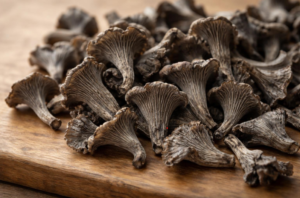
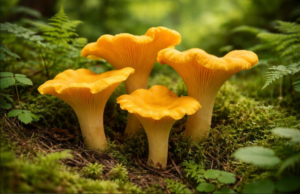
The Cantharellus cinereus found within 10km of the Atlantic coast develops a unique iodine-rich chemical profile. The salty sea air, filtered through the oak canopy, influences the mushroom's moisture content, leading to a firmer, more resilient texture. Their aroma is a sophisticated blend of white pepper, damp slate, and a hint of dried seaweed.
Ethical Harvesting & The "Sea-Mist" Protocol: In Brittany, we harvest only after the morning sea mist has burned off, ensuring the mushrooms are at their peak "internal tension." We use bone-handled knives to avoid metallic oxidation of the mushroom's delicate juices. Every forager is taught to leave the "Mother Patch" in the center of the oak grove untouched, as these older mycelial nodes are essential for the survival of the species against the harsh Atlantic winters.
Essential Equipment: The Atlantic Station
Blue Steel Skillet: Chosen for its rapid heat conduction and superior non-stick properties for searing delicate mollusks.
Silicon-Tipped Offset Tweezers: For the precise placement of individual chanterelles onto the scallop crown.
Fine Mesh Chinois: For straining the Muscadet reduction to a mirror-like finish.
Dehydrated Scallop Roe: To be grated as a "sea-salt" alternative (The Chef's Secret).
Master Recipe: Scallops & Gray Chanterelle Ragout
Stage 1: The Scallop Preparation (The Cryo-Dry)
Select 12 "Dry-Pack" King Scallops. Remove the side muscle. Place them on a rack in the refrigerator for 2 hours uncovered. This dries the surface to a "parchment" state, ensuring a perfect Maillard crust without overcooking the interior.
Stage 2: The Gray Chanterelle Ragout
In a hot pan, sauté 300g of Gray Chanterelles with 20g of Demi-Sel Breton Butter. Add one minced shallot and a splash of Muscadet Sèvre-et-Maine. Reduce until the liquid is a thick glaze. Finish with a tablespoon of crème fraîche to add a silken Atlantic richness.
Stage 3: The Caramelization (The Sear)
Heat your steel skillet until it begins to smoke slightly. Add a touch of neutral grape seed oil. Place the scallops in the pan (clockwise to keep track of time). Sear for exactly 90 seconds per side. Do not move them. The goal is a deep bronze crust that smells of toasted hazelnuts.
Stage 4: The Deglaçage
Remove the scallops and let them rest on a warm plate. Add another knob of butter to the pan. Deglaze the scallop "fond" (the brown bits) with 30ml of the mushroom ragout liquid. This captures the concentrated maritime sugars and fuses them with the mushroom essence.
Stage 5: The Assembly
Place a generous base of the Gray Chanterelle ragout in the center of the plate. Rest three scallops on top. Drizzle the pan reduction around the edge and garnish with a few sprigs of Sea Samphire for a final saline crunch.
Substitutions & Variations: The Luxury Palette
The Wine: If Muscadet is unavailable, use a Chablis; its flinty, Kimmeridgian limestone notes mirror the Atlantic terroir perfectly.
The Fat: For an ultra-luxurious version, use Sea Urchin Butter (Beurre d'Oursin) to glaze the mushrooms.
The Mushroom: If fresh Gray Chanterelles are scarce, use dried Trompette de la Mort rehydrated in clam juice.
Pro Technique: The “Arrosage” Finish
In the final 30 seconds of searing the scallops, add a cold knob of butter and a crushed clove of garlic to the pan. Tilt the pan and spoon the foaming butter over the scallops continuously (arrosage). This cooks the sides of the scallop with convective heat, ensuring they are warmed through to the core without losing the "glassy" texture of the center.
The Umami Secret: Dimethyl Sulfide and Guanylate Synergy
Scallops are high in Dimethyl Sulfide, the compound that creates the characteristic "scent of the sea." Gray Chanterelles contain high levels of Guanylates. When these are combined, they create a "Cross-Kingdom Umami" effect. The maritime sulfur compounds act as a catalyst for the mushroom's savory notes, making the forest flavor feel "cleaner" and the seafood flavor feel "deeper." This is why the pairing feels instinctively harmonious to the human palate.
The Art of Pairing: The Sommelier’s Selection
Sommelier's Choice: A Savennières (Chenin Blanc). This wine, grown near the Loire estuary, has a high acidity and a "wet wool" complexity that can stand up to the richness of the butter while echoing the mushroom's minerals.
Non-Alcoholic Alternative: A Cold-Pressed Apple and Celery Verjus. The tart malic acid and herbal celery notes provide the necessary "snap" to cut through the scallop fat.
Storage & Reheating: Professional Restoration
This dish is a "one-way street." Scallops become rubbery and lose their sweetness if reheated. The Gray Chanterelle ragout, however, can be made 24 hours in advance. To restore, heat it gently in a pan with a splash of Muscadet until the emulsion reforms. Never microwave.
Ancestral Nutrition: The Atlantic Vitalizer
Scallops are an elite source of Vitamin B12 and Magnesium. The Gray Chanterelle provides Vitamin D and Iron. In the Breton tradition, this was known as "The Strength of the Storm"—a meal consumed before the onset of the winter gales to fortify the body with essential minerals and sea-borne proteins.
Micro-FAQ
Q: Why did my scallops stick to the pan? A: The pan wasn't hot enough, or you tried to turn them too early. A properly seared scallop will "release" itself from the steel once the Maillard crust has formed.
Q: Can I use "Wet-Pack" scallops? A: No. Wet-pack scallops are treated with phosphates to retain water. They will boil in the pan instead of searing, and they will taste of chemicals rather than the sea.
Q: Is the Gray Chanterelle better than the Golden for this? A: Yes. The Gray Chanterelle is thinner and more mineral-forward, allowing the scallop's delicate flavor to remain the star of the plate.
The Ashen Lexicon: Global Names for Cantharellus cinereus
The Ashen Chanterelle is a sophisticated relative of the golden chanterelle, prized for its deep, fruity aroma. Its regional names often describe its elegant grey-to-black coloration and trumpet-like hollow stem:
To provide the best experiences, we use technologies like cookies to store and/or access device information. Consenting to these technologies will allow us to process data such as browsing behavior or unique IDs on this site. Not consenting or withdrawing consent, may adversely affect certain features and functions.
Functional
Always active
The technical storage or access is strictly necessary for the legitimate purpose of enabling the use of a specific service explicitly requested by the subscriber or user, or for the sole purpose of carrying out the transmission of a communication over an electronic communications network.
Preferences
The technical storage or access is necessary for the legitimate purpose of storing preferences that are not requested by the subscriber or user.
Statistics
The technical storage or access that is used exclusively for statistical purposes.The technical storage or access that is used exclusively for anonymous statistical purposes. Without a subpoena, voluntary compliance on the part of your Internet Service Provider, or additional records from a third party, information stored or retrieved for this purpose alone cannot usually be used to identify you.
Marketing
The technical storage or access is required to create user profiles to send advertising, or to track the user on a website or across several websites for similar marketing purposes.