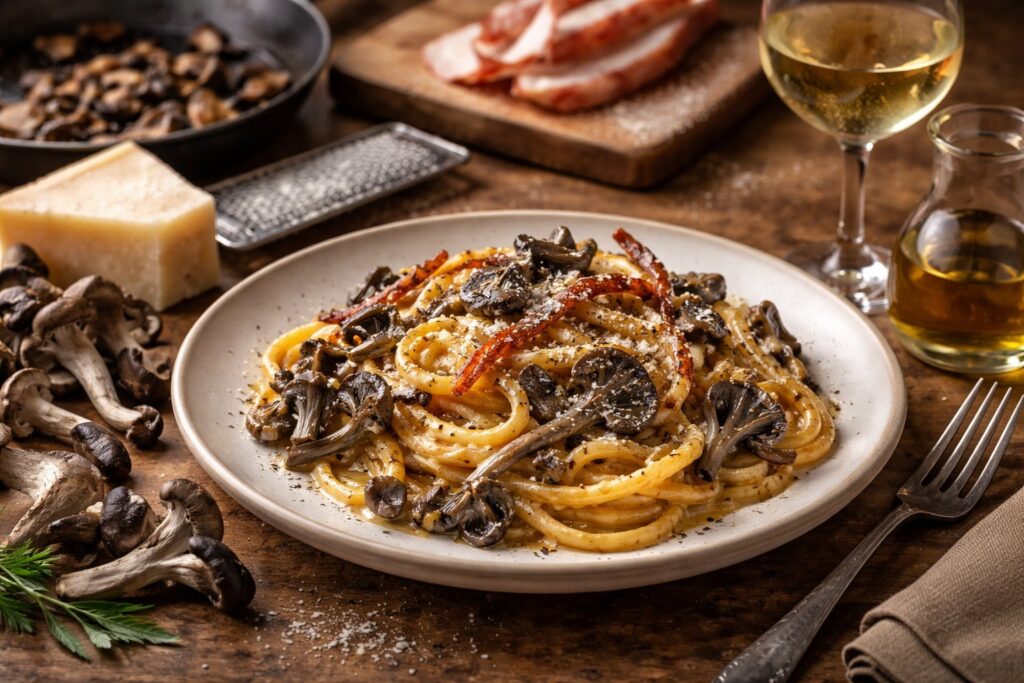
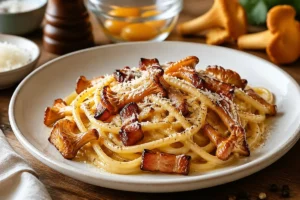
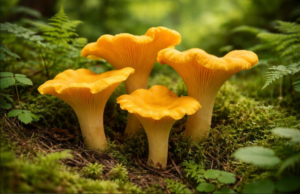
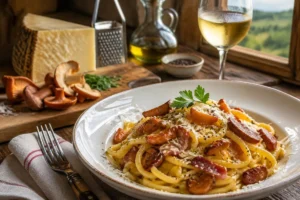
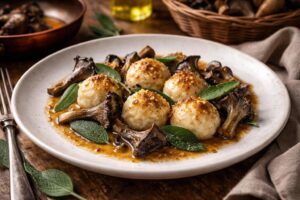
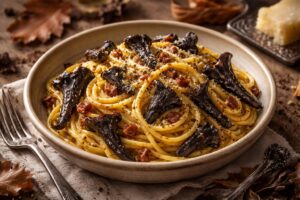
A primal symphony of the forest floor featuring the peppery Cantharellus cinereus and the cured intensity of Italian pork jowl.
Carbonara di Bosco
The Grey Ghost and the Gold of the Roman Campagna
The Historical Prelude: From the Apennine Mines to the Roman Table
The origins of Carbonara are as shrouded in mystery as the forests of the Apennines. While popular legend links the dish to the Carbonari (charcoal burners) of the 19th century, culinary historians often point to the intersection of American military rations and Italian resourcefulness during the post-WWII era. However, the Carbonara di Bosco (Forest Carbonara) is a much older, ancestral variation found in the mountainous regions of Lazio and Abruzzo.
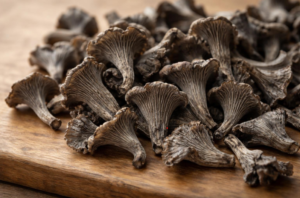
For the foragers who spent their lives in the beech and oak forests, the Cantharellus cinereus (Gray Chanterelle) was known as the "charcoal mushroom" due to its ashy, soot-like appearance. It was a natural companion to the cured meats of the region. Historically, shepherds would carry Guanciale (cured pork jowl) and hard Pecorino Romano into the high altitudes. When the Gray Chanterelles appeared in the late autumn, they were tossed into the rendering pork fat, creating a dish that tasted of woodsmoke, salt, and earth.
By the 1950s, this rustic mountain assembly was adopted by the trattorias of Rome, where it was elevated with the technical "egg-emulsion" technique we recognize today. The Gray Chanterelle is uniquely suited for this role; unlike other mushrooms that release excess water and break the delicate egg sauce, the cinereus maintains its structure and contributes a peppery, truffle-like depth that mimics the traditional heavy application of black pepper. Today, it represents the bridge between the urban refinement of Rome and the wild, mineral reality of the Italian highlands.
Narrative Intro: True Carbonara is an emulsion of fat, starch, and protein. Our philosophy for the "Bosco" variation is "Lipid Infusion." We use the rendered fat from the Guanciale to sear the Gray Chanterelles, effectively "frying" the mushroom's peppery aromatics into the pork oil. This ensures that the forest flavor is not just a garnish, but a molecular part of the sauce that coats every strand of pasta.
Sensory & Foraging Profile: The Limestone and Leaf-Litter Terroir
The Cantharellus cinereus of the central Apennines grows in calcareous, alkaline soils. This environment encourages the development of terpene-rich tissues, giving the mushroom a scent profile that balances cold ash, damp earth, and dried yellow fruits. Their charcoal-grey color provides a striking aesthetic contrast against the golden egg yolks of the sauce.
Ethical Harvesting & The "Shadow Line": In the tradition of the Abruzzo highlands, we harvest only along the "Shadow Line"—the transition zone between the deep forest and the mountain meadows. We use natural fiber brushes to clean the hollow stems, as the Gray Chanterelle's "trumpet" shape acts as a natural funnel for forest debris. We strictly adhere to "Zero-Disturbance" protocols, ensuring the leaf-litter is replaced to maintain the moisture levels required for the mycelium to survive the harsh mountain winds.
Essential Equipment: The Roman Pasta Station
Large Bronze-Die Pasta Pot: To ensure the pasta surface is rough enough to hold the emulsion.
Stainless Steel Mixing Bowl: Used as a bain-marie over the pasta water to temper the eggs.
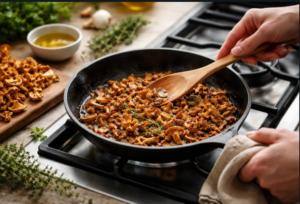
Cast-Iron Skillet: To achieve maximum rendering and browning of the Guanciale.
Microplane Grater: To create a "snow" of Pecorino that dissolves instantly into the sauce.
Master Recipe: Gray Chanterelle Carbonara
Stage 1: The Lipid Extraction
Cut 150g of Guanciale into small strips (batons). Place in a cold cast-iron skillet and gradually increase the heat. Render the fat until the pork is golden and "glassy," but not burnt. Remove the meat and set aside, leaving the liquid gold fat in the pan.
Stage 2: The Searing of the “Grey Ghost”
Add 250g of fresh, dry Gray Chanterelles to the hot Guanciale fat. Increase heat to high. Sauté until the mushrooms are slightly crispy on the edges and have absorbed the pork aromatics. This stage replaces the need for heavy black pepper, as the mushrooms provide their own heat.
Stage 3: The Golden Emulsion
In a stainless steel bowl, whisk 3 large egg yolks and 1 whole egg with 60g of finely grated Pecorino Romano DOP. Whisk until it forms a thick, pale yellow paste. Set this bowl over the pot of boiling pasta water for 30 seconds to warm the proteins without scrambling them.
Stage 4: The Al Dente Marriage
Boil 400g of Spaghettoni (thick spaghetti) until 1 minute before al dente. Reserve 100ml of starchy pasta water. Toss the pasta into the skillet with the mushrooms and fat. Add the reserved water and toss vigorously until the liquid is absorbed and the pasta is glossy.
Stage 5: The “Mantecatura” (The Creaming)
Remove the skillet from the heat entirely. This is critical. Pour in the egg and cheese mixture. Stir rapidly and constantly. The residual heat of the pasta will cook the eggs into a silken, creamy sauce. Fold in the crispy Guanciale and serve immediately on warmed plates.
Substitutions & Variations: The Luxury Palette
The Pork: If Guanciale is unavailable, use a high-quality Pancetta Tesa (cured, not smoked) to maintain the purity of the mushroom flavor.
The Cheese: Use a 50/50 mix of Pecorino Romano and Grana Padano for a milder, creamier sauce that highlights the mushroom's fruitier notes.
The Pasta: Use **Rigatoni**; the hollow tubes perfectly capture the small Gray Chanterelles, ensuring a "mushroom-bomb" in every bite.
Pro Technique: The “Starch Control” Bridge
The secret to a Carbonara that doesn't "break" is the starch concentration in the pasta water. Use 30% less water than usual when boiling the pasta. This creates a hyper-concentrated starch solution. When this "thick" water hits the mushroom fat and then the egg mixture, it acts as a molecular glue, binding the oils to the proteins and creating a permanent, velvety emulsion.
The Umami Secret: Glutamate-Fat Entrapment
The Guanciale is rich in free amino acids, specifically Glutamate. The Gray Chanterelle contains high levels of Guanylate. When these two molecules meet in the presence of animal lipids (pork fat and egg yolks), they create a "synergistic umami" effect that is exponentially stronger than either ingredient alone. The fat acts as a delivery system, coating the taste buds and prolonging the duration of the savory signal to the brain.
The Art of Pairing: The Sommelier’s Selection
Sommelier's Choice: A Frascati Superiore Riserva. This volcanic white wine from the hills around Rome has a mineral, almost salty finish that echoes the Pecorino and the mineral terroir of the Gray Chanterelle.
Non-Alcoholic Alternative: A Warm Juniper and Black Pepper Infusion. The piney notes of juniper mirror the Apennine forests, while the pepper mimics the mushroom's natural heat.
Storage & Reheating: Professional Restoration
Carbonara is a "moment-in-time" dish and should never be stored. Reheating will invariably scramble the eggs. If you have leftovers, the only professional way to "save" them is to make **Frittata di Pasta** the next morning—fry the cold pasta in a pan until the edges are crispy and the center is soft.
Ancestral Nutrition: The Highland Fortification
The Gray Chanterelle is one of the densest sources of Vitamin D and Copper in the fungi world. Egg yolks provide Choline and Lutein, while Guanciale provides B-vitamins. Historically, this "Shepherd's Pasta" was designed to provide the maximum caloric and mineral density for those working in the cold, thin air of the Italian peaks.
Micro-FAQ
Q: Why did my egg sauce turn into scrambled eggs? A: The skillet was too hot when you added the eggs. You must remove the pan from the flame and wait 15 seconds before mixing.
Q: Is cream ever used in an authentic Carbonara di Bosco? A: No. In the Roman and mountain tradition, cream is considered a "cheat" to hide a lack of technique. The creaminess must come solely from the egg and starch emulsion.
Q: Why Guanciale instead of bacon? A: Bacon is usually smoked and made from the belly. Guanciale is cured (not smoked) and comes from the cheek, giving it a much higher fat-to-meat ratio and a deeper "porky" flavor that doesn't overwhelm the mushrooms.
To provide the best experiences, we use technologies like cookies to store and/or access device information. Consenting to these technologies will allow us to process data such as browsing behavior or unique IDs on this site. Not consenting or withdrawing consent, may adversely affect certain features and functions.
Functional
Always active
The technical storage or access is strictly necessary for the legitimate purpose of enabling the use of a specific service explicitly requested by the subscriber or user, or for the sole purpose of carrying out the transmission of a communication over an electronic communications network.
Preferences
The technical storage or access is necessary for the legitimate purpose of storing preferences that are not requested by the subscriber or user.
Statistics
The technical storage or access that is used exclusively for statistical purposes.The technical storage or access that is used exclusively for anonymous statistical purposes. Without a subpoena, voluntary compliance on the part of your Internet Service Provider, or additional records from a third party, information stored or retrieved for this purpose alone cannot usually be used to identify you.
Marketing
The technical storage or access is required to create user profiles to send advertising, or to track the user on a website or across several websites for similar marketing purposes.