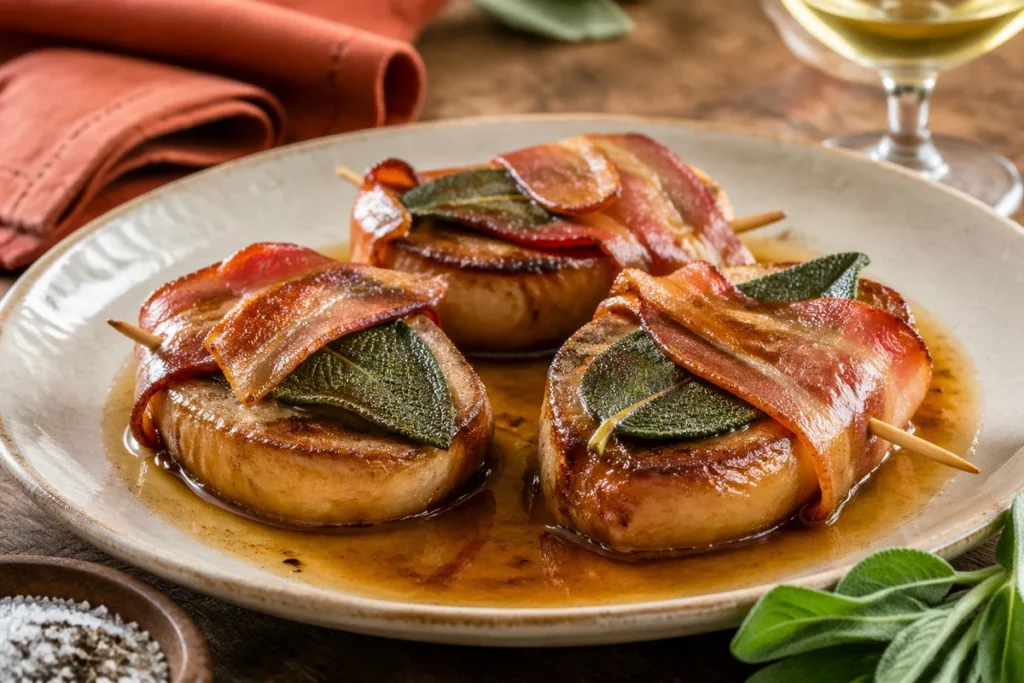
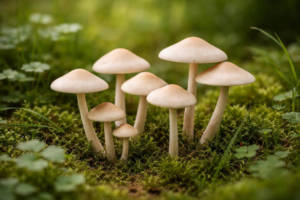
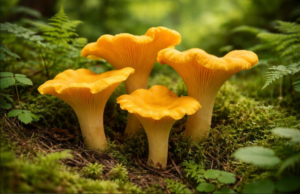
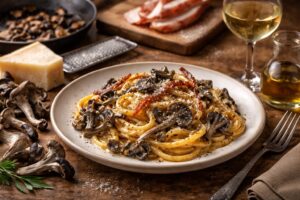
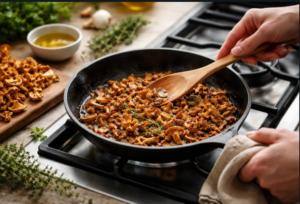
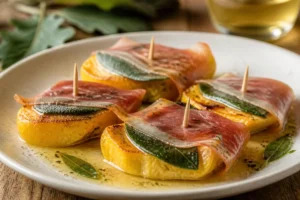
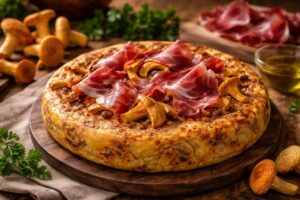
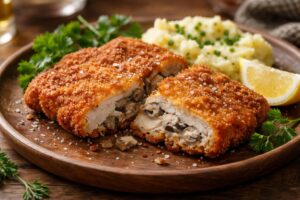
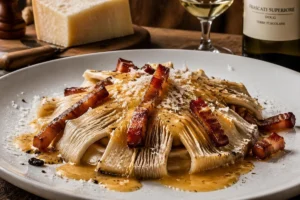
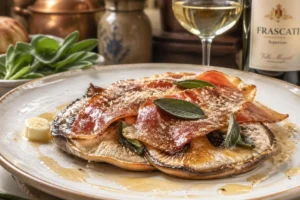
A decadent Roman fusion where thick wild Boletus edulis "steaks" are wrapped in paper-thin Guanciale and fresh sage, then pan-seared in white wine and butter.
Roman Porcini “Saltimbocca”
"Jumps in the Mouth": The Union of Cured Pig, Sage, and Forest Gold
The Historical Prelude: The Trattorias of the Castelli Romani
The name Saltimbocca literally translates to "Jumps in the mouth," a testament to the dish's immediate and aggressive flavor profile. While the traditional version uses veal, the high-altitude trattorias of the Castelli Romani—the volcanic hills surrounding Rome—long ago realized that a thick, meaty slice of Boletus edulis provides a superior canvas for this technique.
The key to Roman luxury lies in the Guanciale (cured pork cheek). Unlike pancetta, guanciale is richer in silkier, more aromatic fats that melt at lower temperatures. When used to wrap a mushroom, it acts as a self-basting "flavor-envelope." Historically, this dish represents the Roman Ottobrata—the legendary October outings where Romans would head to the countryside to feast on the new wine and the fresh autumn porcini. To eat Saltimbocca in Rome is to experience the transition from the scorched heat of the city to the cool, damp embrace of the Lazio forests.
⏱ Time: 25 Minutes
📊 Difficulty: Intermediate / Classic Roman
🔥 Calories: 310 kcal / Serving
🍄 Type: Firm "Button" Porcini
Culinary Philosophy: The Protective Sear
The philosophy of Saltimbocca is Structural Protection. The guanciale serves two purposes: it seasons the mushroom with cured pork fat, and it acts as a thermal barrier, allowing the porcini to steam in its own juices while the exterior achieves a crispy, salty crust. The sage leaf, trapped between the mushroom and the fat, undergoes a rapid "flash-fry," infusing the entire assembly with a pine-like, herbal backbone.
Sensory & Foraging Profile: The Volcanic Terroir
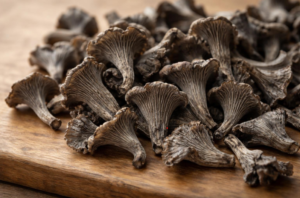
Latin Nomenclature:Boletus edulis (The Roman Porcino). Terroir Analysis: Porcini from the Colli Albani grow in volcanic, potassium-rich soil. This results in a mushroom that is exceptionally dense and has a distinct mineral finish. The volcanic earth imparts a "dryness" to the mushroom flesh that makes it the perfect sponge for the rich, peppery fat of the guanciale.
Selection Protocol: We seek "King Buttons"—young mushrooms with stems nearly as wide as their caps. We slice them vertically through the center to create a 1cm thick "cutlet" that includes both the cap and the stem. This ensures the structural integrity needed to withstand the wrapping and searing process.
Essential Equipment
🔸 Toothpicks: To secure the guanciale and sage to the mushroom "cutlet."
🔸 Heavy Bottomed Skillet: To ensure the guanciale renders its fat slowly and evenly without burning.
🔸 Deglazing Liquid: A dry, volcanic white wine like Frascati Superiore is essential for the traditional pan-sauce.
The Master Recipe: The Roman Union
Stage 1: The “Saltimbocca” Assembly
Place a large, fresh sage leaf on each 1cm-thick Porcini slice. Cover with a paper-thin slice of Guanciale. Secure the assembly by weaving a toothpick through the guanciale, sage, and mushroom. Lightly dust the "mushroom-side" (the side without meat) with 00 flour.
Stage 2: The Fat Render
Place the slices in a cold skillet, guanciale-side down. Turn the heat to medium. This "cold-start" allows the guanciale to render its fat, which will act as the primary cooking medium for the mushroom. Cook until the guanciale is translucent and starting to crisp (approx. 4 minutes).
Stage 3: The White Wine Deglaze
Flip the slices gently and sear the floured mushroom-side for 2 minutes. Increase heat and pour in 100ml of Frascati white wine and a knob of cold butter. Swirl the pan as the liquid reduces to create a "velvet" emulsion.
Stage 4: The Immediate Service
Serve the Porcini immediately while the guanciale is still crisp. Pour the reduction over the top. The toothpick remains in place until the diner removes it—a classic Roman visual tradition.
Chef’s Secret: The “Sage-Oil” Pre-Infusion
If you have 10 minutes to spare, gently warm your olive oil with a few extra sage leaves before starting. This creates a Sage-Infused base that ensures the herbal aroma isn't just on top of the mushroom, but permeates the entire cooking fat, bridging the gap between the cured pork and the earthy fungus.
The Umami Secret: Cured Fat & Spore Synergies
Guanciale is cured with black pepper and occasionally garlic, providing high levels of lipids and peptides. When these encounter the **Glutamates** of the Porcini in the presence of the Malic acid in Frascati wine, the flavor "jumps" as promised. The fat coats the tongue, allowing the volatile sage aromas to be held in the mouth longer, creating a sensory loop of salt, earth, and herb.
The Art of Pairing
Sommelier's Selection: A dry, mineral **Frascati Superiore** or an **Est! Est!! Est!!! di Montefiascone**. These volcanic whites are the historical partners of Roman food, providing the acidity needed to "scrub" the palate of guanciale fat.
Non-Alcoholic: A chilled, sparkling water with a sprig of fresh sage and a slice of lemon.
Micro-FAQ
Q: Can I use bacon instead of guanciale? A: You can, but bacon is smoked and much leaner. Guanciale is unsmoked and mostly fat; it is the fat that makes the dish Roman. If using bacon, add a tablespoon of butter to compensate for the lower fat content.
Q: My mushroom fell apart! A: This happens if the Porcini were too old or "spongy." Always use firm, young buttons for this specific technique to ensure they hold the toothpick.
The Porcini Directory: Global Names for Boletus edulis
The King Bolete, or simply Porcini, is arguably the most recognized wild mushroom in the culinary world. Its linguistic variety reflects its presence in forests from the Alps to the Himalayas:
Language
Regional & Folk Names
Expert Insights
Italian
Porcino, Brisa, Fungo di faggio
"Porcini" (little pigs) is the global trade name.
French
Cèpe de Bordeaux, Gros pied, Polonais
"Cèpe" comes from the Gascon word for trunk/stump.
German
Steinpilz, Herrenpilz, Edelpilz
"Steinpilz" (Stone mushroom) refers to its firm flesh.
To provide the best experiences, we use technologies like cookies to store and/or access device information. Consenting to these technologies will allow us to process data such as browsing behavior or unique IDs on this site. Not consenting or withdrawing consent, may adversely affect certain features and functions.
Functional
Always active
The technical storage or access is strictly necessary for the legitimate purpose of enabling the use of a specific service explicitly requested by the subscriber or user, or for the sole purpose of carrying out the transmission of a communication over an electronic communications network.
Preferences
The technical storage or access is necessary for the legitimate purpose of storing preferences that are not requested by the subscriber or user.
Statistics
The technical storage or access that is used exclusively for statistical purposes.The technical storage or access that is used exclusively for anonymous statistical purposes. Without a subpoena, voluntary compliance on the part of your Internet Service Provider, or additional records from a third party, information stored or retrieved for this purpose alone cannot usually be used to identify you.
Marketing
The technical storage or access is required to create user profiles to send advertising, or to track the user on a website or across several websites for similar marketing purposes.