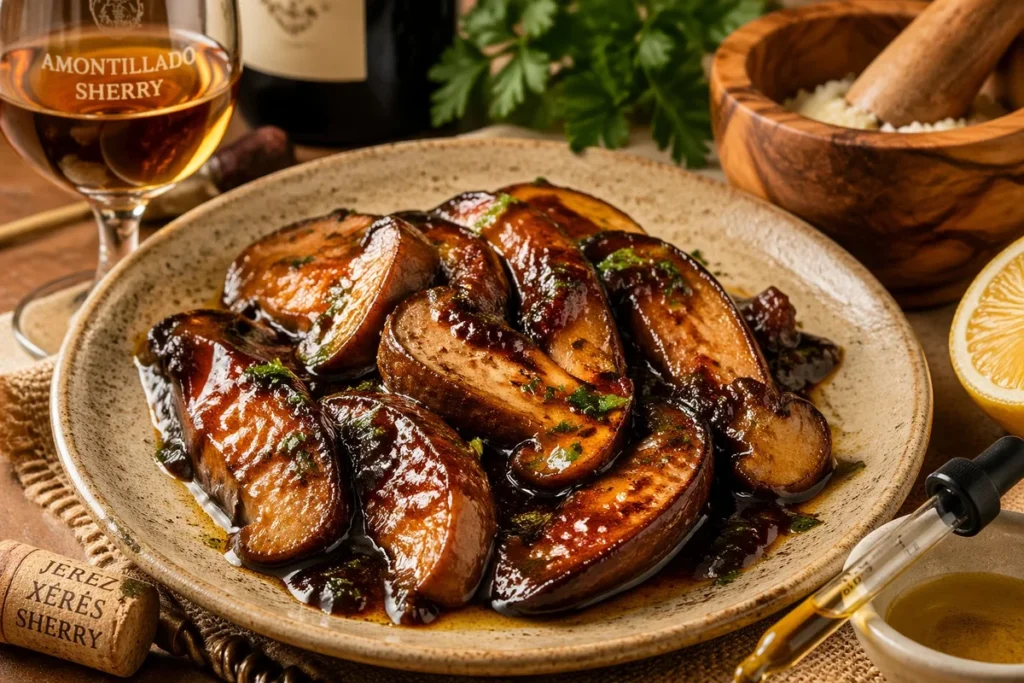
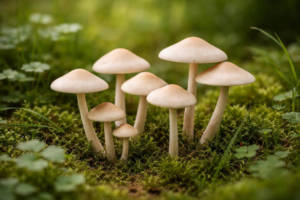
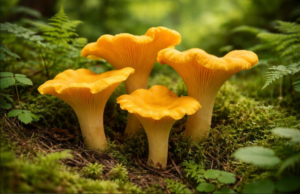
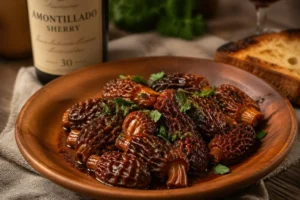
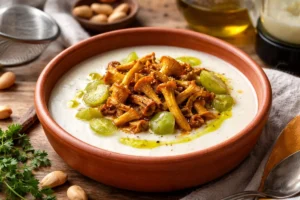
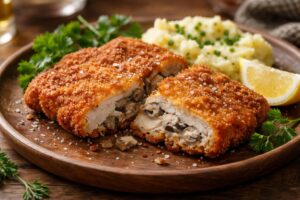
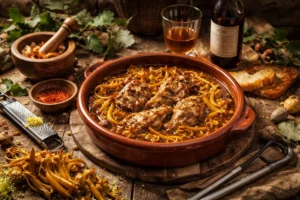
An opulent Southern Spanish preparation featuring thick-cut wild Boletus edulis deglazed with dry Fino Sherry and finished with a dark, syrupy reduction of Pedro Ximénez grapes.
Andalusian “Boletus al Jerez”
The Sherry Triangle: A Dialogue of Flor, Oak, and Autumn Gold
The Historical Prelude: The Alcornocales and the Bodega Kitchen
In the mist-shrouded cork oak forests of the Sierra de Grazalema and Los Alcornocales, the autumn rains bring a sudden bounty of Boletus edulis. Historically, the foragers of these mountains had a unique relationship with the Marco de Jerez (the Sherry Triangle). While the coast focused on the biological aging of wine, the mountain kitchens utilized the "Solera" spirits to preserve and enhance the intense umami of the wild harvest.
This specific preparation, Boletus al Jerez, is a masterclass in balance. It utilizes two opposite ends of the Sherry spectrum: the bone-dry, saline **Fino** and the viscous, ebony-colored **Pedro Ximénez (PX)**. Originally a dish served in the private Tabancos (Sherry bars) of Jerez de la Frontera, it represents the Andalusian obsession with "Contradictory Harmony"—where the sharp acidity of the dry wine cuts the mushroom's fat, while the dark PX reduction provides a caramel-like "earth" note that anchors the dish to the forest floor.
⏱ Time: 30 Minutes
📊 Difficulty: Intermediate / Flavor Extraction
🔥 Calories: 245 kcal / Serving
🍄 Type: Large Andalusian "Boleto"
Culinary Philosophy: The “Biological-Oxidative” Bridge
Andalusian philosophy focuses on Oxidative Reinforcement. Sherry wines are famous for their "Nutty" and "Toasty" profiles—flavors created by the *Flor* yeast and oak aging. These are the exact same aromatic molecules found in the Boletus edulis. By deglazing the mushrooms with Sherry, we aren't just adding liquid; we are "closing the circuit" between the fungus and the wine, resulting in a flavor intensity that feels natural and inevitable.
Sensory & Foraging Profile: The Cork Oak & Heath Terroir
Latin Nomenclature:Boletus edulis (The Andalusian "Boleto"). Terroir Analysis: Andalusian Porcini from the Sierra de Huelva grow in acidic, sandy soils under **Cork Oak (Quercus suber)**. These mushrooms are known for their resilience and a slightly "smoky" skin. The warmth of the southern sun ensures they have a lower water content than northern phenotypes, making them perfect for "Sherry-Searing" without becoming limp.
Selection Protocol: We use "Full-Expansion" caps. For this dish, we want the broad, open caps that have developed their maximum aromatic complexity. We slice them into thick wedges (like orange slices) to provide a substantial surface area for the Sherry lacquer to adhere to.
Essential Equipment
🔸 Stainless Steel Sauté Pan: For rapid evaporation of the wine alcohols.
🔸 Traditional Wood Mortar: For crushing the garlic and sea salt into a "dry paste."
🔸 Glass Pipette: For the precise, drop-by-drop application of the Pedro Ximénez reduction.
The Master Recipe: The Two-Tone Glaze
Stage 1: The Golden Sear
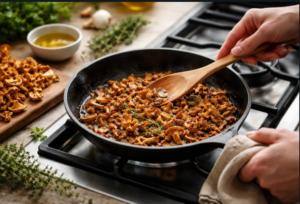
Sauté 500g of thick Porcini wedges in extra virgin olive oil with 2 whole smashed cloves of garlic. Sear over high heat until the mushrooms have a "rust-colored" crust. Season with Flor de Sal from the Bay of Cádiz.
Stage 2: The Biological Strike (Fino)
Deglaze the pan with 100ml of dry Fino Sherry. The wine will hiss and evaporate almost instantly, leaving behind a salty, "nutty" mineral residue that coats the mushroom's exterior and reinforces its internal umami.
Stage 3: The Oxidative Lacquer (PX)
Once the Fino has vanished, add 2 tablespoons of Pedro Ximénez wine. Lower the heat and swirl the pan. The sugar-heavy PX will begin to caramelize, mixing with the mushroom juices and olive oil to create a dark, glossy mahogany lacquer.
Stage 4: The Bitter Contrast
Finish with a handful of fresh flat-leaf parsley and a few drops of fresh lemon juice. The acidity of the lemon is crucial to "re-awaken" the flavors from the heavy sweetness of the PX reduction.
Chef’s Secret: The “Flor” Infusion
If you can find it, use Manzanilla de Sanlúcar instead of standard Fino. Manzanilla is aged by the sea and has a distinct "salty-chamomile" profile that works as a molecular bridge between the earthy Porcini and the raisin-heavy PX, creating a three-dimensional flavor profile that is uniquely Andalusian.
The Umami Secret: Acetaldehyde and Glutamate
Sherry wines are rich in **Acetaldehydes** (produced by the Flor yeast). When these interact with the **Glutamates** in the Porcini and the **Maillard products** created during the sear, they form a "Flavor Matrix." The brain perceives this as a massive spike in savory intensity. The sugar in the PX acts as a "carrier," slowing down the release of these flavors so the taste "echoes" on the palate for nearly 60 seconds.
The Art of Pairing
Sommelier's Selection: A glass of **Amontillado Sherry**. It sits perfectly between the Fino and PX used in the dish, mirroring both the dry salinity and the oxidative nuttiness.
Non-Alcoholic: A chilled infusion of roasted apple skins and a drop of white balsamic vinegar.
Micro-FAQ
Q: Can I use regular balsamic instead of PX? A: You can, but PX is much richer, thicker, and has a specific raisin/fig profile that balsamic lacks. PX is a "wine," not a vinegar, which provides a smoother, less aggressive acidity.
Q: My mushrooms are soggy! A: You likely added the wine too early or used a pan that wasn't hot enough. The Fino must evaporate instantly to prevent the mushrooms from boiling in the liquid.
The Porcini Directory: Global Names for Boletus edulis
The King Bolete, or simply Porcini, is arguably the most recognized wild mushroom in the culinary world. Its linguistic variety reflects its presence in forests from the Alps to the Himalayas:
Language
Regional & Folk Names
Expert Insights
Italian
Porcino, Brisa, Fungo di faggio
"Porcini" (little pigs) is the global trade name.
French
Cèpe de Bordeaux, Gros pied, Polonais
"Cèpe" comes from the Gascon word for trunk/stump.
German
Steinpilz, Herrenpilz, Edelpilz
"Steinpilz" (Stone mushroom) refers to its firm flesh.
To provide the best experiences, we use technologies like cookies to store and/or access device information. Consenting to these technologies will allow us to process data such as browsing behavior or unique IDs on this site. Not consenting or withdrawing consent, may adversely affect certain features and functions.
Functional
Always active
The technical storage or access is strictly necessary for the legitimate purpose of enabling the use of a specific service explicitly requested by the subscriber or user, or for the sole purpose of carrying out the transmission of a communication over an electronic communications network.
Preferences
The technical storage or access is necessary for the legitimate purpose of storing preferences that are not requested by the subscriber or user.
Statistics
The technical storage or access that is used exclusively for statistical purposes.The technical storage or access that is used exclusively for anonymous statistical purposes. Without a subpoena, voluntary compliance on the part of your Internet Service Provider, or additional records from a third party, information stored or retrieved for this purpose alone cannot usually be used to identify you.
Marketing
The technical storage or access is required to create user profiles to send advertising, or to track the user on a website or across several websites for similar marketing purposes.