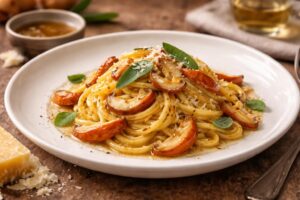
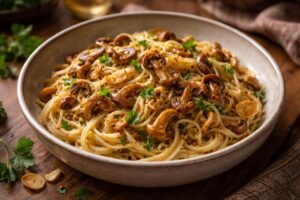
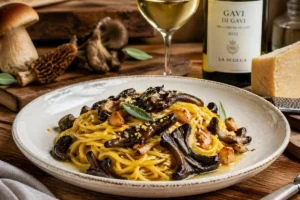
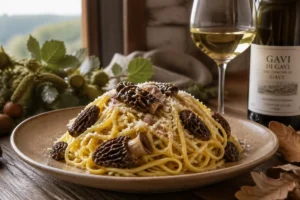
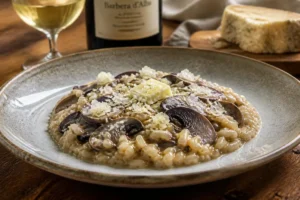
An ultra-luxurious pasta dish featuring hand-cut "Tajarin" (40-egg yolk pasta) and wild Boletus edulis, bound by a creamy emulsion of the rare and ancient Castelmagno AOP cheese.
Porcini & Castelmagno Tajarin
The Piedmontese Masterpiece: 40-Yolks and the King of Mountain Cheeses
The Historical Prelude: The Noble Pasta of the Langhe
In the mist-shrouded hills of the Langhe and Monferrato, culinary excellence is measured in egg yolks. Historically, Tajarin (the local dialect for Tagliolini) was the pasta of celebration. While the commoners ate water-based pasta, the wealthy families of Piedmont commissioned sheets made with up to 40 egg yolks per kilogram of flour, resulting in a strand so thin and rich it appears like golden silk.
The pairing with Castelmagno AOP—a cheese so ancient it was allegedly paid as tribute to the Marquis of Saluzzo in 1277—represents the union of the meadow and the woods. Castelmagno is produced only in three small alpine villages at the head of the Grana Valley. Its sharp, crumbly, and slightly "blue" profile acts as a powerful acidic counterpoint to the buttery, hazelnut-scented Boletus edulis. This dish is the definitive "Grand Finale" of the autumn harvest, capturing the transition from the sunny vineyards to the snowy alpine peaks.
⏱ Time: 90 Minutes (Handmade)
📊 Difficulty: Elite Technical
🔥 Calories: 540 kcal / Serving
🍄 Type: Mountain Wild Porcini
Culinary Philosophy: The “Fat-on-Fat” Architecture
The philosophy of this dish is Luxury through Concentration. We are layering three sources of intense fat: the egg-rich pasta, the high-altitude mountain butter, and the aged Castelmagno cheese. The Porcini act as the "aromatic anchor," their earthiness grounding the heavy dairy notes. The secret is the *Mantecatura*—the final emulsion in the pan where the starchy pasta water and the cheese fat create a sauce that is not cream, but a biological suspension of flavor.
Sensory & Foraging Profile: The Alpine Slate Terroir
Latin Nomenclature:Boletus edulis (The Alpine King). Terroir Analysis: Piedmontese Porcini from the Maritime Alps grow in cold, slate-heavy soils. This stress causes them to develop a much higher concentration of **guanylic acid**, providing a "meatier" taste that can survive the intense acidity of the Castelmagno cheese.
Selection Protocol: For Tajarin, we use "Julienne Slices." We slice both the caps and the stems into thin matchsticks that mirror the shape of the pasta. This ensures that in every fork-roll, you get an equal distribution of silk (pasta) and earth (mushroom).
Essential Equipment
🔸 Brass Pasta Cutter: To create the traditional rough edge that holds the cheese emulsion.
🔸 Large Copper Skillet: For superior heat control during the delicate cheese melting process.
🔸 Cheese Grater (Fine): Castelmagno must be grated finely to ensure it dissolves without becoming "stringy."
The Master Recipe: The Piedmontese 40-Yolk
Stage 1: The Tajarin Dough
Mix 500g of 00 flour with exactly 20 egg yolks (adjusting for the traditional "40 per kg" ratio). Knead for 20 minutes until the dough is stiff and elastic. Roll it paper-thin and hand-cut into strands of 2mm width.
Stage 2: The Mushroom Base
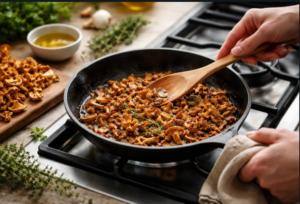
Sauté 400g of julienned Porcini in 60g of high-quality mountain butter with a single clove of smashed garlic. Season with sea salt and black pepper. The mushrooms should be soft and butter-saturated, but not browned.
Stage 3: The Rapid Boil
Boil the Tajarin in salted water for only 90–120 seconds. They are extremely delicate. Reserve 100ml of the golden, starchy pasta water.
Stage 4: The Mantecatura
Add the pasta and the reserved water to the mushroom pan. Turn off the heat and add 100g of finely grated Castelmagno AOP. Toss vigorously. The cheese will melt into the starchy water and butter, creating a thick, ivory-colored glaze that clings to the pasta.
Chef’s Secret: The “Cold-Cheese” Rule
Castelmagno cheese is prone to separating (oiling off) if exposed to direct heat over 65°C. Always add the cheese **after** removing the pan from the flame. The residual heat of the pasta and the mushroom butter is exactly enough to create a silken emulsion without the proteins tightening into clumps.
The Umami Secret: The Tyrosine-Heme Interaction
Aged Castelmagno is famous for its **Tyrosine** crystals—tiny white granules of concentrated protein. When these meet the **Glutamates** in the Alpine Porcini and the **Lecithin** in the 40-egg-yolk pasta, they trigger a "Complex Umami" response. The result is a flavor that is perceived not as a sauce, but as a rich, savory "nectar" that fills the palate and lingers for minutes.
The Art of Pairing
Sommelier's Selection: A **Barolo** or **Barbaresco** (Nebbiolo). The high tannins and "tar and roses" aroma of these wines are the only things capable of standing up to the sheer richness of 40-yolk pasta and Castelmagno.
Non-Alcoholic: A chilled infusion of roasted hazelnut skins and dry black tea.
Micro-FAQ
Q: Can I use Parmigiano instead of Castelmagno? A: You can, but you will lose the unique "herbal-blue" complexity that makes this dish specifically Piedmontese. Castelmagno has a wildness that matches the forest mushroom better than the cleaner Parmigiano.
Q: Why so many egg yolks? A: The yolks provide the "silkiness" and the structural strength to cut the pasta so thin. It also gives the dish its legendary golden color, symbolizing the wealth of the Piedmontese autumn.
To provide the best experiences, we use technologies like cookies to store and/or access device information. Consenting to these technologies will allow us to process data such as browsing behavior or unique IDs on this site. Not consenting or withdrawing consent, may adversely affect certain features and functions.
Functional
Always active
The technical storage or access is strictly necessary for the legitimate purpose of enabling the use of a specific service explicitly requested by the subscriber or user, or for the sole purpose of carrying out the transmission of a communication over an electronic communications network.
Preferences
The technical storage or access is necessary for the legitimate purpose of storing preferences that are not requested by the subscriber or user.
Statistics
The technical storage or access that is used exclusively for statistical purposes.The technical storage or access that is used exclusively for anonymous statistical purposes. Without a subpoena, voluntary compliance on the part of your Internet Service Provider, or additional records from a third party, information stored or retrieved for this purpose alone cannot usually be used to identify you.
Marketing
The technical storage or access is required to create user profiles to send advertising, or to track the user on a website or across several websites for similar marketing purposes.