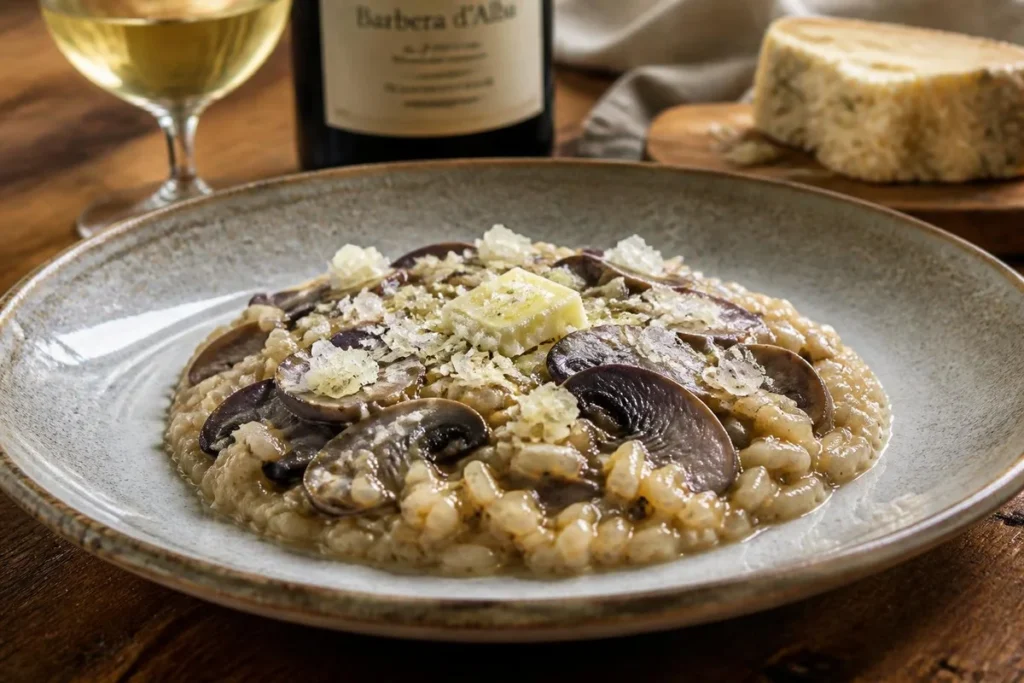
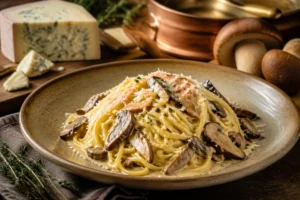
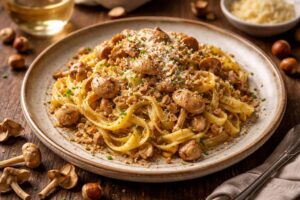
A high-starch technical execution where the non-brittle texture of Russula cyanoxantha is preserved through the emulsification phase of a classic Piedmontese risotto. The dish utilizes the Mantecatura technique to bond the mushroom's glutamate with the sharp, crystalline structure of aged Castelmagno cheese, creating a profound interplay of textures and mountain-born umami.
Piedmontese Russula and Castelmagno Risotto
A high-starch technical execution where the non-brittle texture of Russula cyanoxantha is preserved through the emulsification phase of a classic Piedmontese risotto. The dish utilizes the Mantecatura technique to bond the mushroom's glutamate with the sharp, crystalline structure of aged Castelmagno cheese, creating a profound interplay of textures and mountain-born umami.
The Culinary Physics of This Dish
The Russula cyanoxantha is essential here because, unlike most Russulas, it does not disintegrate during the constant mechanical agitation required for risotto. During the 18-minute simmer, the flexible gills remain intact, while the cap releases its nucleotides into the starch suspension. The addition of Castelmagno DOP—a semi-hard, crumbly cheese from the Cuneo province—introduces a high concentration of calcium lactate crystals and fatty acids that emulsify with the rice starch (amylopectin), creating a "manteca" that perfectly coats the meaty mushroom slices.
Terroir Narrative
This recipe is a tribute to the Val Maira in Piedmont, Italy, where the Charcoal Burner thrives in the cool shade of ancient chestnut and oak forests. In the local cucina povera, which evolved into high gastronomy, the "Colombina" is sought for its mild, hazelnut-like finish. By pairing it with Castelmagno—a cheese produced only in three small alpine villages—we create a dish that tells the story of the vertical landscape, from the forest floor to the high mountain pastures.
Prep Time
Cook Time
Complexity
Calories
Region
20 Mins
25 Mins
Grand Officier
420 kcal
Piedmont, Italy
Master Recipe (1:10 Rule)
350 g Carnaroli Rice (The "King of Rices")
400 g Russula cyanoxantha (Sliced into 5mm strips)
1.2 l Golden chicken or mushroom broth (Sustained at 95°C)
80 g Castelmagno DOP cheese (Crumbled)
60 g Cold cultured butter (Cubed)
100 ml Gavi di Gavi or dry Italian white wine
1 Small white onion (Micro-diced)
5 g Fine sea salt
The Technique
1. The Tostatura: In a wide, heavy pan, dry-toast the rice until the grains are hot to the touch. Add a splash of olive oil and the onion, cooking until translucent but not browned.
2. Deglazing: Pour in the wine. The steam will release the initial starch. Stir until the liquid has completely evaporated.
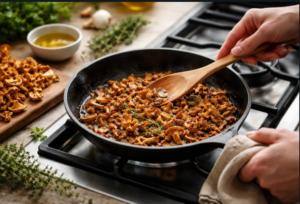
3. Mushroom Integration: Add the Russula cyanoxantha. Unlike other recipes where mushrooms are sautéed separately, here they are added early so their essence becomes part of the rice's hydration process.
4. The Gradual Hydration: Add the broth one ladle at a time. Maintain a constant simmer and stir frequently. The friction between the grains is what creates the creamy emulsion.
5. The Mantecatura: When the rice is al dente, remove from the heat. This is the most critical technical step. Add the cold butter and the crumbled Castelmagno. Vigorously shake the pan and stir (the all'onda movement) to incorporate air and create a glossy, waving texture.
6. Resting: Cover the pan for 60 seconds before serving. This allows the temperature to equalize and the flavors of the "Charbonnier" to fully expand.
Shop Integration
The earthy elegance of a Russula risotto can be further transformed by the ingredients in our boutique. Incorporate our Boletus edulis (Boletus edulis) for a deeper, more traditional Italian "Risotto ai Funghi," or use Marasmius oreades (Marasmius oreades) for a lighter, more floral interpretation. For a striking visual contrast, garnish with sautéed Cantharellus cibarius (Cantharellus cibarius) or the rare Amanita caesarea (Amanita caesarea). During the colder months, the addition of our Craterellus cornucopioides (Craterellus cinereus) adds a layer of truffle-like complexity, while Morchella (Morchella conica) offers a sophisticated spring variation.
The Umami Profile
This dish represents a Triple-Umami-Threat: the Guanylate from the Charcoal Burner, the Glutamate from the aged Castelmagno, and the Inosinate from the slow-simmered broth. The rice acts as the structural carrier, delivering these molecules in a high-viscosity emulsion that coats the palate, significantly increasing the duration of the savory perception.
Sommelier’s Choice
Barbera d'Alba: A high-acid red wine from Piedmont. Its vibrant cherry notes and lack of heavy tannins provide a perfect counterpoint to the richness of the butter and the sharp, pungent character of the Castelmagno.
THE ETYMOLOGICAL CHRONICLE
French:Russule charbonnière – A name echoing the varied gray, blue, and purple tones of the cap, similar to cooling embers.
Italian:Colombina maggiore – Meaning "The Great Dove," referring to the gentle, soft-colored skin of the cap.
German:Frauentäubling – A poetic name meaning "Lady's Little Dove," signifying the mushroom's non-brittle, flexible nature.
Spanish:Carbonera – Associated with the charcoal makers who worked the same forests where this species is most abundant.
To provide the best experiences, we use technologies like cookies to store and/or access device information. Consenting to these technologies will allow us to process data such as browsing behavior or unique IDs on this site. Not consenting or withdrawing consent, may adversely affect certain features and functions.
Functional
Always active
The technical storage or access is strictly necessary for the legitimate purpose of enabling the use of a specific service explicitly requested by the subscriber or user, or for the sole purpose of carrying out the transmission of a communication over an electronic communications network.
Preferences
The technical storage or access is necessary for the legitimate purpose of storing preferences that are not requested by the subscriber or user.
Statistics
The technical storage or access that is used exclusively for statistical purposes.The technical storage or access that is used exclusively for anonymous statistical purposes. Without a subpoena, voluntary compliance on the part of your Internet Service Provider, or additional records from a third party, information stored or retrieved for this purpose alone cannot usually be used to identify you.
Marketing
The technical storage or access is required to create user profiles to send advertising, or to track the user on a website or across several websites for similar marketing purposes.