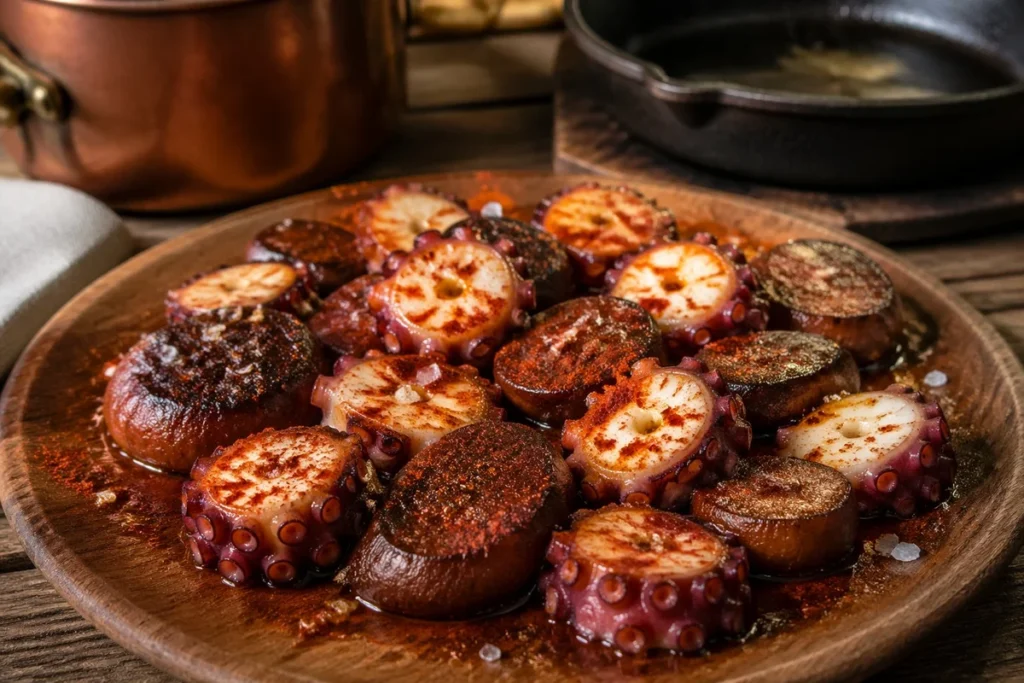
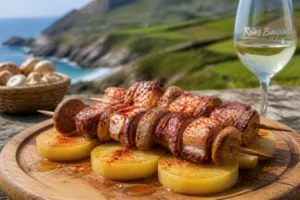
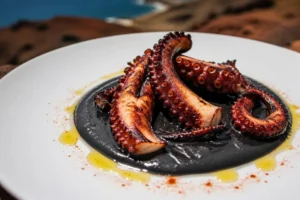
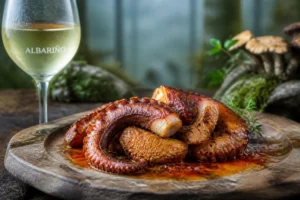
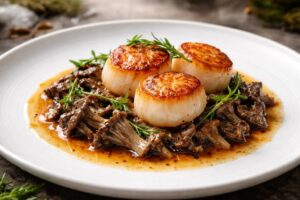
A stunning maritime-forest fusion featuring tender Atlantic octopus and thick-cut wild Boletus edulis, finished with extra virgin olive oil and the legendary smoked paprika of La Vera.
Galician Pulpo & Boletus
The Atlantic Fringe: Where Ocean Tentacles Meet Mycelial Roots
The Historical Prelude: The Fair of San Froilán
In the lush, rain-drenched province of Galicia, the culinary heart beats to the rhythm of the Pulpeiras (octopus cooks). Historically, the Pulpo a la Gallega (octopus with paprika) was a dish of the inland fairs, where dried octopus from the coast was traded for the bounty of the mountains. During the autumn festivities of San Froilán in Lugo, the tradition evolved to include the Boletus edulis, which thrives in the damp oak and chestnut forests of the Galician interior.
The inclusion of Pimentón de la Vera (smoked paprika) is the soulful bridge of this dish. The smoke from the paprika mimics the traditional wood-fired copper cauldrons used to boil the octopus, while its earthy heat anchors the delicate, saline sweetness of the cephalopod to the deep, nutty umami of the mushroom. This is a "Working Class Luxury"—a dish that relies on the mastery of texture over expensive garnishes.
⏱ Time: 90 Minutes
📊 Difficulty: Intermediate / High-Flavor
🔥 Calories: 320 kcal / Serving
🍄 Type: Dense Galician "Cepo"
Culinary Philosophy: The “Gelatin-Chitin” Synchronicity
Galician philosophy centers on Structural Alignment. An octopus tentacle and a Porcini stem share a remarkably similar "bite" when prepared correctly. The goal is to cook the octopus until it reaches a buttery, gelatinous state, and then sear the Porcini to a point where its exterior is crisp but its interior remains tender. When served together, the diner should experience a seamless transition between the sea-creature and the land-fungus.
Sensory & Foraging Profile: The Granite & Rain Terroir
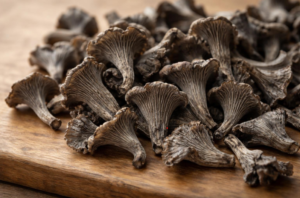
Latin Nomenclature:Boletus edulis (The Galician "Cepo"). Terroir Analysis: Galicia's granite-heavy soil and acidic rain produce Porcini that are particularly high in minerals. Growing under Pedunculate Oak (Quercus robur), these mushrooms develop a dark, almost black cap and a stem that is incredibly dense. This density is crucial—it allows the mushroom to be seared alongside the octopus without disintegrating.
Selection Protocol: We seek "Jumbo Stems." In Galicia, the stem is often sliced into rounds (medallions) that perfectly mimic the appearance of sliced octopus tentacles, creating a visual pun on the plate that delights the senses.
Essential Equipment
🔸 Traditional Copper Pot (Optional): For boiling the octopus (the copper helps the skin stay intact and vibrant).
🔸 Cast-Iron Plancha: For the final high-heat sear of both ingredients.
🔸 Wooden Platter (Plato de Madera): The traditional Galician serving vessel, which absorbs excess olive oil and maintains the ideal temperature.
The Master Recipe: The Atlantic Fusion
Stage 1: The “Scaring” of the Octopus
Dip a whole 1.5kg octopus into boiling water three times (the "scaring" or asustar) to curl the tentacles and set the skin. Then, simmer for 45–50 minutes until tender. Let it rest in its own cooking water for 20 minutes before slicing into 1cm rounds.
Stage 2: The Mushroom Medallions
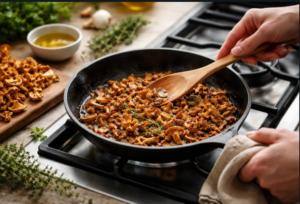
Clean 500g of large Porcini. Slice the stems into rounds of the same thickness as the octopus. Sauté them in a very hot pan with olive oil and a smashed garlic clove until they are deep mahogany on both sides.
Stage 3: The Smoke & Fire
Toss the sliced octopus into the pan with the mushrooms for the last 2 minutes. The goal is to "char" the edges of the octopus while it absorbs the mushroom fat. Add a generous tablespoon of Pimentón de la Vera (Dulce or Picante).
Stage 4: The Finishing Touch
Arrange on the wooden platter. Drizzle with the finest Galician Extra Virgin Olive Oil and a sprinkle of Flor de Sal. The oil will mix with the paprika and mushroom juices to create a natural, smoky "jus."
Chef’s Secret: The “Cooking Water” Deglaze
Do not throw away the octopus cooking water! It is a concentrated gelatinous brine. Just before removing the mushrooms and octopus from the pan, add 2 tablespoons of this "Sea Liquor." It will deglaze the pan and create a glossy, sticky emulsion that binds the smoked paprika to both the mushroom and the octopus, providing a professional "glaze" effect.
The Umami Secret: The Mycelial-Marine Interaction
Octopus is rich in **Glycine** and **Glutamate**, while Porcini are masters of **Guanylate**. In the world of sensory science, this is the "Umami Trifecta." The smokiness of the pimentón acts as a catalyst, lowering the threshold for these savory molecules to be detected by the brain. The result is a dish that tastes "meatier" than steak, despite being a combination of seafood and fungus.
The Art of Pairing
Sommelier's Selection: A crisp, mineral **Albariño** from Rías Baixas or a **Godello** from Valdeorras. The high acidity and saline finish of Galician white wines are the only perfect match for the richness of octopus and mushrooms.
Non-Alcoholic: A chilled, sparkling mineral water with a squeeze of charred lemon.
Micro-FAQ
Q: How do I know the octopus is tender? A: Use a toothpick. If it enters the thickest part of the tentacle without resistance (like butter), it is ready. If you feel a "snap," it needs more time.
Q: My paprika burned! A: Paprika has a high sugar content and burns easily. Always add it at the very end and ensure there is enough olive oil or liquid in the pan to protect it from direct heat.
The Porcini Directory: Global Names for Boletus edulis
The King Bolete, or simply Porcini, is arguably the most recognized wild mushroom in the culinary world. Its linguistic variety reflects its presence in forests from the Alps to the Himalayas:
Language
Regional & Folk Names
Expert Insights
Italian
Porcino, Brisa, Fungo di faggio
"Porcini" (little pigs) is the global trade name.
French
Cèpe de Bordeaux, Gros pied, Polonais
"Cèpe" comes from the Gascon word for trunk/stump.
German
Steinpilz, Herrenpilz, Edelpilz
"Steinpilz" (Stone mushroom) refers to its firm flesh.
To provide the best experiences, we use technologies like cookies to store and/or access device information. Consenting to these technologies will allow us to process data such as browsing behavior or unique IDs on this site. Not consenting or withdrawing consent, may adversely affect certain features and functions.
Functional
Always active
The technical storage or access is strictly necessary for the legitimate purpose of enabling the use of a specific service explicitly requested by the subscriber or user, or for the sole purpose of carrying out the transmission of a communication over an electronic communications network.
Preferences
The technical storage or access is necessary for the legitimate purpose of storing preferences that are not requested by the subscriber or user.
Statistics
The technical storage or access that is used exclusively for statistical purposes.The technical storage or access that is used exclusively for anonymous statistical purposes. Without a subpoena, voluntary compliance on the part of your Internet Service Provider, or additional records from a third party, information stored or retrieved for this purpose alone cannot usually be used to identify you.
Marketing
The technical storage or access is required to create user profiles to send advertising, or to track the user on a website or across several websites for similar marketing purposes.