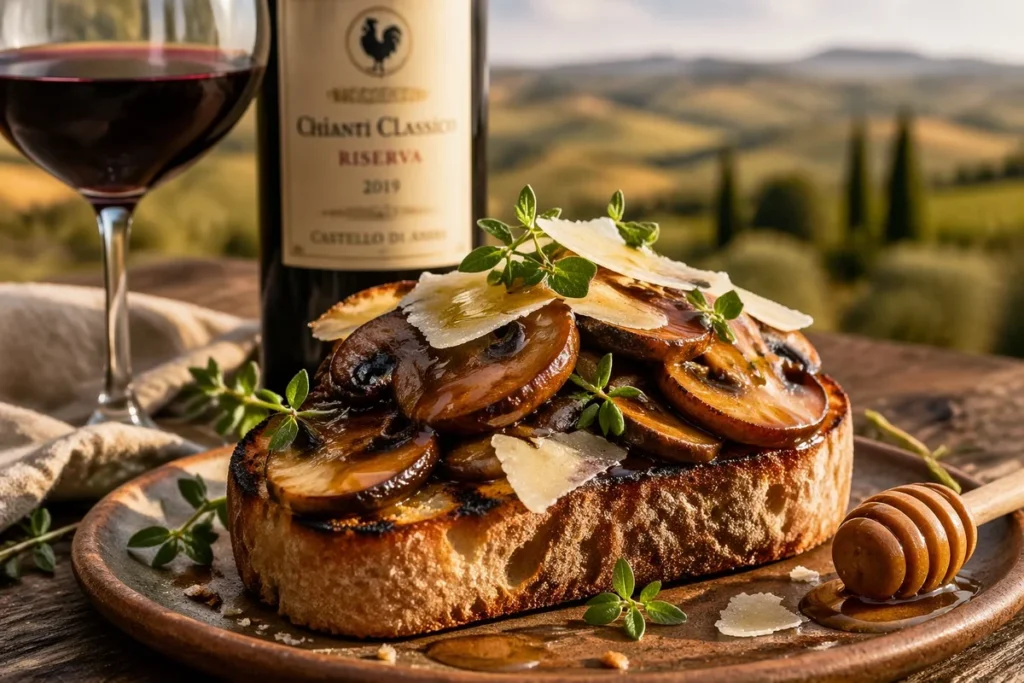
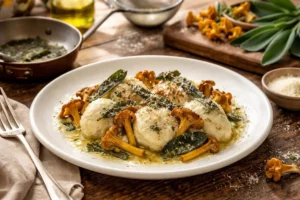
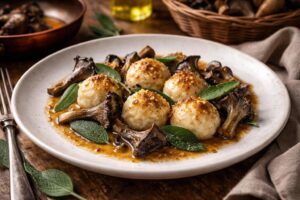
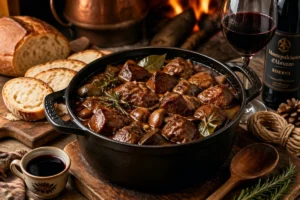
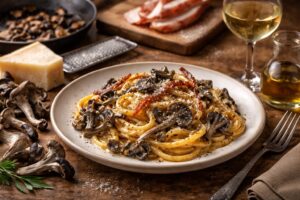
A sophisticated Italian appetizer featuring butter-seared wild Boletus edulis and melted Pecorino Toscano DOP, finished with a drizzle of bitter chestnut honey on artisanal sourdough.
Tuscan Porcini & Pecorino Crostini
The Golden Hills of Val d'Orcia: A Symphony of Sheep, Soil, and Sun
The Historical Prelude: The Merenda of the Tuscan Shepherd
In the rolling landscapes of the Maremma and the Val d'Orcia, the culinary identity is forged from the transumanza—the ancient seasonal migration of sheep. Historically, the Tuscan shepherd's diet was built around Pecorino (sheep's milk cheese) and the sourdough bread baked in communal stone ovens. During the autumn months, the shepherds shared the forest fringes with foragers seeking the Porcino Toscano.
The addition of Chestnut Honey (Miele di Castagno) is a regional masterstroke. In Tuscany, chestnut trees are the primary host for many wild Porcini, and their dark, bitter honey acts as a "molecular mirror" for the mushroom's flavor. This Crostino was traditionally served as a Merenda (afternoon snack) but was later adopted by the noble villas of Florence and Siena as an elegant antipasto that perfectly represents the Tuscan triad: the pastoral, the wild, and the artisanal.
⏱ Time: 25 Minutes
📊 Difficulty: Easy / High-Impact
🔥 Calories: 280 kcal / Serving
🍄 Type: Firm Tuscan Porcini
Culinary Philosophy: The “Fat-on-Fat” Architecture
Tuscan philosophy is centered on Ingredient Purity. We do not use complex sauces. Instead, we use the "Layering of Fats" technique: the vegetable fat of the olive oil, the animal fat of the sheep's cheese, and the fungal "lipids" of the Porcini. The goal is a vertical stack where each layer maintains its temperature and integrity—the bread must be hot and crunchy, the cheese just beginning to weep, and the mushrooms seared and succulent.
Sensory & Foraging Profile: The Clay & Chestnut Terroir
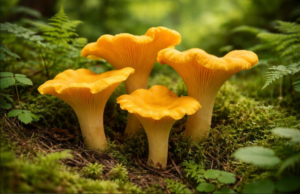
Latin Nomenclature:Boletus edulis (The Porcino d'Autunno). Terroir Analysis: Tuscany's clay-rich soils (the *Crete Senesi*) produce Porcini that are particularly dense with a low water content. When growing under **Sweet Chestnut (Castanea sativa)**, they develop a distinct, almost tannic skin and a creamier interior. This structural density allows the mushroom to hold its shape perfectly when perched atop a toasted crostino.
Selection Protocol: We prioritize "Slicing Specimens"—medium-sized mushrooms with ivory-white pores. The stems are sliced into rounds and the caps into fans. This provides two different textural experiences: the "meatiness" of the stem and the "velvet" of the cap.
Essential Equipment
🔸 Cast-Iron Grill Pan: To achieve the traditional "char-marks" on the Tuscan bread.
🔸 Cheese Plane: For consistent, paper-thin shavings of Pecorino that melt instantly.
🔸 Honey Dipper: To ensure the chestnut honey is applied in a fine, controlled thread.
The Master Recipe: The Tuscan Stack
Stage 1: The Pane Toscano
Cut thick slices of sourdough bread (ideally Pane Sciocco, the saltless bread of Tuscany). Rub with a clove of garlic and grill until charred on both sides. Drizzle immediately with "New Season" extra virgin olive oil.
Stage 2: The Porcini Sauté
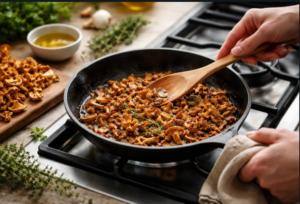
Sauté 300g of sliced Porcini in a mix of butter and olive oil with a sprig of Nepitella (wild Tuscan calamint) or thyme. Season with sea salt only at the very end to prevent the mushrooms from releasing too much water. They should be golden-brown and fragrant.
Stage 3: The Pecorino Fusion
While the mushrooms are still piping hot, place thin shavings of Pecorino Toscano DOP (Stagionato) onto the grilled bread. The residual heat of the toast will soften the cheese but not melt it completely.
Stage 4: The Final Gloss
Pile the hot Porcini onto the cheese. Finish with a precise drizzle of Chestnut Honey and a few cracks of black pepper. The honey should act as a glossy lacquer that binds the mushrooms to the cheese.
Chef’s Secret: The “Nepitella” Bridge
In Tuscany, Porcini are almost always paired with Nepitella. This wild herb tastes like a cross between mint and oregano. If you cannot find it, use fresh oregano mixed with a tiny amount of minced mint. This "herb-bridge" provides a cooling, camphor-like top note that cuts through the heavy fat of the Pecorino and the bitterness of the chestnut honey.
The Umami Secret: The Tyrosine-Honey Reaction
Aged Pecorino contains **Tyrosine** crystals. When these protein-rich crystals meet the **Glutamates** of the Porcini and the **Enzymes** in raw honey, they trigger a "Tri-Umami" response. The honey's natural sugars temporarily coat the bitterness of the cheese, allowing the savory mushroom flavor to expand across the palate before the bitter chestnut finish cleanses the tongue for the next bite.
The Art of Pairing
Sommelier's Selection: A **Chianti Classico Riserva** or a **Vino Nobile di Montepulciano**. The Sangiovese grape's natural acidity and cherry notes are the classic foil for the saltiness of the Pecorino.
Non-Alcoholic: A warm, unsweetened infusion of roasted barley (Caffè d'Orzo).
Micro-FAQ
Q: Can I use regular honey? A: You can, but wildflower honey is often too sweet. Chestnut honey is preferred for its bitter, woody profile which mimics the forest floor. If using regular honey, add a tiny pinch of sea salt to it.
Q: My bread got soggy! A: This means the mushrooms were not seared at a high enough temperature or the bread was sliced too thin. Tuscan bread must be thick and "crusty" to act as a proper thermal barrier.
The Porcini Directory: Global Names for Boletus edulis
The King Bolete, or simply Porcini, is arguably the most recognized wild mushroom in the culinary world. Its linguistic variety reflects its presence in forests from the Alps to the Himalayas:
Language
Regional & Folk Names
Expert Insights
Italian
Porcino, Brisa, Fungo di faggio
"Porcini" (little pigs) is the global trade name.
French
Cèpe de Bordeaux, Gros pied, Polonais
"Cèpe" comes from the Gascon word for trunk/stump.
German
Steinpilz, Herrenpilz, Edelpilz
"Steinpilz" (Stone mushroom) refers to its firm flesh.
To provide the best experiences, we use technologies like cookies to store and/or access device information. Consenting to these technologies will allow us to process data such as browsing behavior or unique IDs on this site. Not consenting or withdrawing consent, may adversely affect certain features and functions.
Functional
Always active
The technical storage or access is strictly necessary for the legitimate purpose of enabling the use of a specific service explicitly requested by the subscriber or user, or for the sole purpose of carrying out the transmission of a communication over an electronic communications network.
Preferences
The technical storage or access is necessary for the legitimate purpose of storing preferences that are not requested by the subscriber or user.
Statistics
The technical storage or access that is used exclusively for statistical purposes.The technical storage or access that is used exclusively for anonymous statistical purposes. Without a subpoena, voluntary compliance on the part of your Internet Service Provider, or additional records from a third party, information stored or retrieved for this purpose alone cannot usually be used to identify you.
Marketing
The technical storage or access is required to create user profiles to send advertising, or to track the user on a website or across several websites for similar marketing purposes.