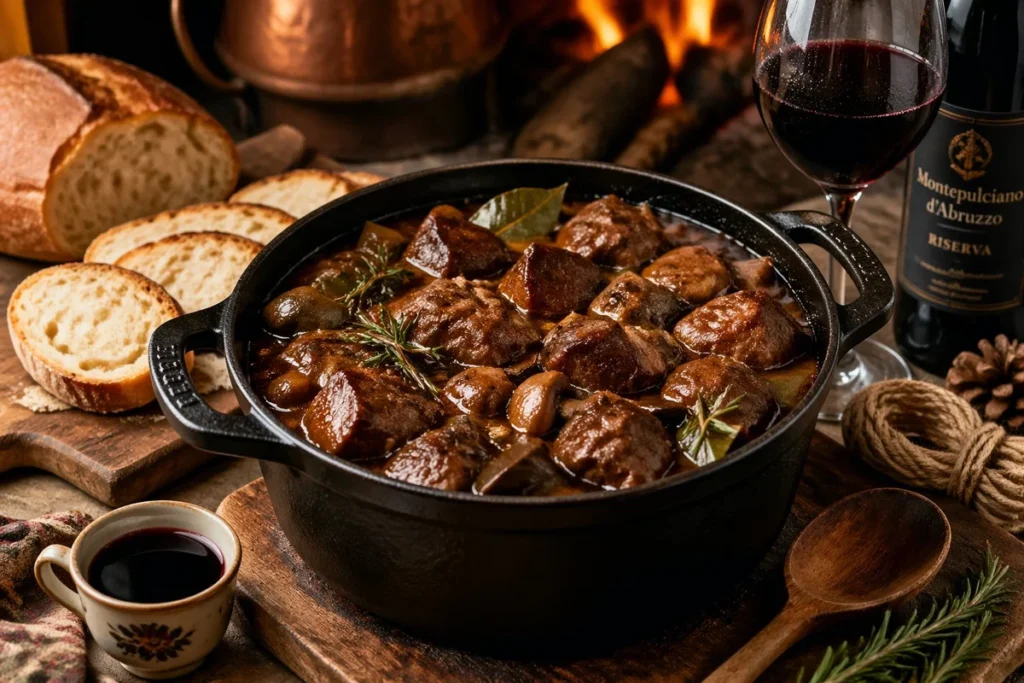
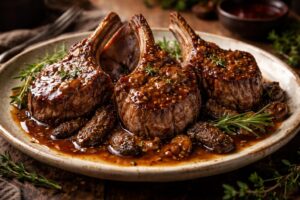
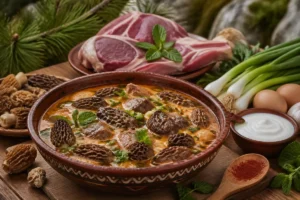
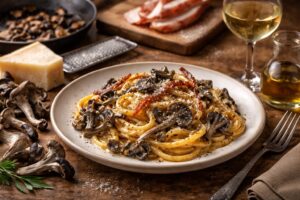
A soul-warming mountain stew featuring tender chunks of pasture-raised Abruzzese lamb braised with wild Boletus edulis, rosemary, and a splash of Montepulciano d'Abruzzo wine.
Abruzzese Porcini & Lamb Spezzatino
The Shepherd's Pot: Wild Peaks, Ancient Pastures, and Autumn Fungi
The Historical Prelude: The Transumanza and the Majella Woods
In the rugged heart of the **Apennines**, the region of **Abruzzo** has for millennia been defined by the Transumanza—the seasonal migration of massive sheep herds. Historically, the Spezzatino (from spezzare, to break into pieces) was a communal dish prepared by shepherds in copper pots over open mountain fires. While lamb provided the sustenance, the Boletus edulis foraged from the slopes of the Majella massif provided the luxury.
This dish is a testament to the "Old World" Abruzzese palate. Unlike the refined sauces of the North, the Spezzatino is thick, rustic, and heavily perfumed with wild herbs like rosemary and bay leaf. The Porcini are not just a garnish; they act as a "forest sponge," absorbing the savory juices of the lamb. Historically, this meal was served with crusty Pane di Genzano to ensure not a single drop of the mushroom-lamb emulsion was wasted.
⏱ Time: 2.5 Hours
📊 Difficulty: Intermediate / Slow-Braise
🔥 Calories: 460 kcal / Serving
🍄 Type: Firm Abruzzese "Funghe"
Culinary Philosophy: The Lipid-Mycelial Fusion
Abruzzese philosophy centers on Time as an Ingredient. Lamb contains complex connective tissues and fats that require long, slow heat to transform into gelatin. Porcini contains chitin and water. By searing the lamb first and adding the Porcini at specific intervals, we create a sauce where the mushroom's umami is literally "welded" to the meat's proteins.
Sensory & Foraging Profile: The Beech & Limestone Terroir
Latin Nomenclature:Boletus edulis (The Abruzzese phenotype). Terroir Analysis: Porcini from the Gran Sasso grow in high-altitude, limestone-rich soils under Beech and Turkey Oak. These mushrooms are known for their resilience and "earthy-bitter" skin. The limestone soil imparts a mineral backbone to the fungi that perfectly balances the high-iron, slightly "gamey" profile of pasture-raised Abruzzese lamb.
Selection Protocol: We use "Full-Grown Buttons." The caps should be firm and the stems bulbous. In a Spezzatino, we cut the mushrooms into large, 3cm chunks. If the pieces are too small, they will disappear during the long braise; we want the mushroom to have as much "presence" as the meat.
Essential Equipment
🔸 Heavy Cast-Iron Cocotte or Dutch Oven: Essential for maintaining the steady, low temperature required for a perfect braise.
🔸 Wooden Spoon: For the soffritto phase and to gently stir the stew without breaking the tender lamb.
🔸 Kitchen Twine: To tie the rosemary and bay leaves into a bouquet garni for easy removal.
The Master Recipe: The Mountain Spezzatino
Stage 1: The Maillard Foundation
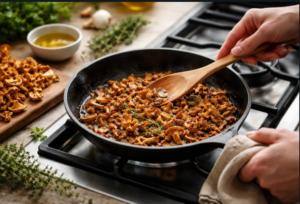
Pat dry 800g of lamb shoulder (cut into 4cm cubes). In a hot Dutch oven with olive oil, sear the lamb in batches until a deep brown crust forms. Remove the meat. This crust is the source of the stew's color and depth.
Stage 2: The Forest Soffritto
In the same pot, add 1 diced onion, 1 carrot, and 1 celery stalk. Cook until soft. Add 500g of large-cut Porcini and sauté for 5 minutes. The mushrooms will deglaze the pot with their own juices, picking up the lamb's flavor from the bottom of the pan.
Stage 3: The Montepulciano Deglaze
Pour in 200ml of Montepulciano d'Abruzzo (a robust, tannic red). Scrape the bottom of the pot. Return the lamb to the pot and add 400ml of light meat stock, 2 sprigs of rosemary, and 2 bay leaves.
Stage 4: The Low-and-Slow Simmer
Cover and simmer over very low heat for 1.5 to 2 hours. The lamb should be fork-tender and the sauce should be thick and glossy. Remove the herbs. Finish with a handful of fresh parsley and a drizzle of raw olive oil. Serve with polenta or grilled bread.
Chef’s Secret: The “Porcini-Peperoncino” Kick
Abruzzo is famous for its love of Peperoncino (dried chili). To give the Spezzatino a true mountain finish, add a single small, whole dried chili to the oil during the soffritto phase. The heat shouldn't be overwhelming; it should act as a "high-frequency" note that vibrates against the "low-frequency" umami of the lamb and Porcini, making the flavors feel more alive.
The Umami Secret: Collagen & Guanylate Synergies
Lamb shoulder is rich in **Collagen**, which breaks down into **Gelatin** during slow cooking. Gelatin is an incredible flavor carrier. When the **Guanylates** from the Porcini are released into this gelatinous sauce, they "stretch" the flavor profile. This is why a mushroom stew tastes better the next day—the molecules have had time to form a stable, savory lattice within the gelatin.
The Art of Pairing
Sommelier's Selection: A glass of **Montepulciano d'Abruzzo Riserva**. The wine's dark fruit and earthy tannins mirror the forest notes of the Porcini and the iron of the lamb.
Non-Alcoholic: A warm, unsweetened pomegranate and black tea infusion.
Micro-FAQ
Q: Can I use beef instead of lamb? A: You can, but beef lacks the specific "mountain" character and the fatty-acid profile that makes the Porcini pop in this regional recipe. If using beef, use a cut like chuck or short rib.
Q: My Porcini became too soft. A: This happens if the mushrooms are cut too small or if they were "spongy" (old). Always use firm, fresh buttons for stews and keep the pieces large to maintain their textural identity.
To provide the best experiences, we use technologies like cookies to store and/or access device information. Consenting to these technologies will allow us to process data such as browsing behavior or unique IDs on this site. Not consenting or withdrawing consent, may adversely affect certain features and functions.
Functional
Always active
The technical storage or access is strictly necessary for the legitimate purpose of enabling the use of a specific service explicitly requested by the subscriber or user, or for the sole purpose of carrying out the transmission of a communication over an electronic communications network.
Preferences
The technical storage or access is necessary for the legitimate purpose of storing preferences that are not requested by the subscriber or user.
Statistics
The technical storage or access that is used exclusively for statistical purposes.The technical storage or access that is used exclusively for anonymous statistical purposes. Without a subpoena, voluntary compliance on the part of your Internet Service Provider, or additional records from a third party, information stored or retrieved for this purpose alone cannot usually be used to identify you.
Marketing
The technical storage or access is required to create user profiles to send advertising, or to track the user on a website or across several websites for similar marketing purposes.