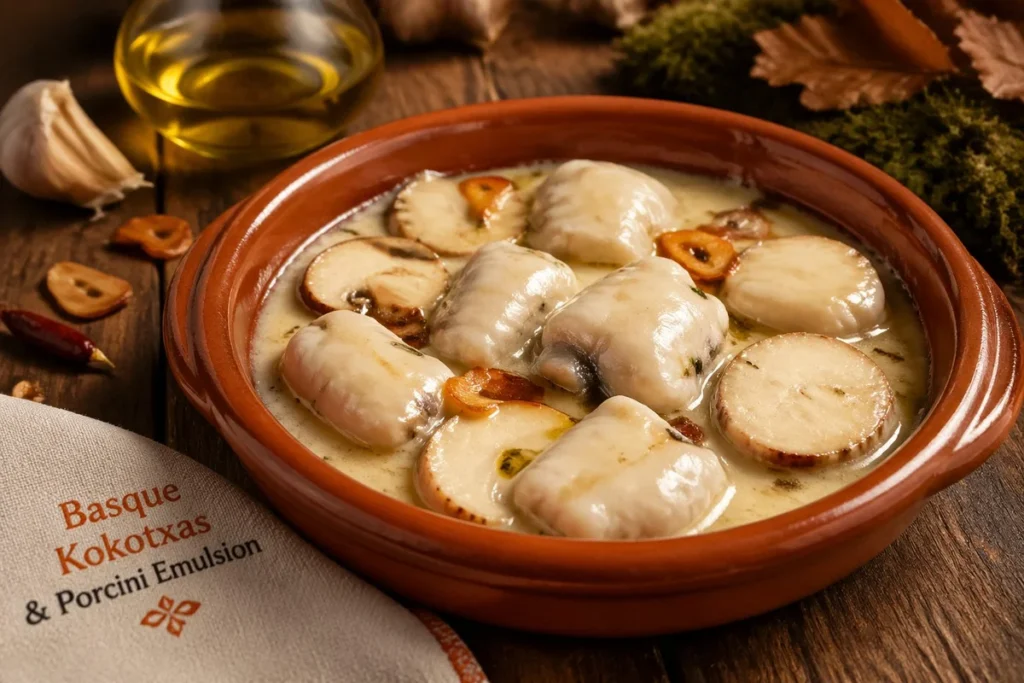
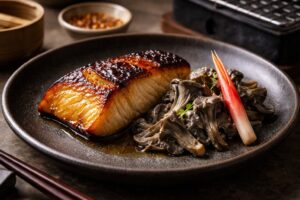
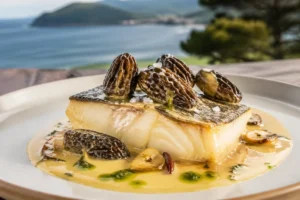
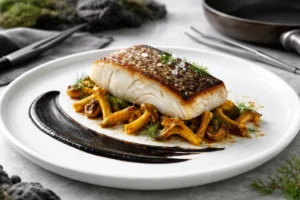
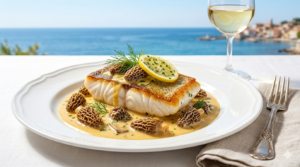
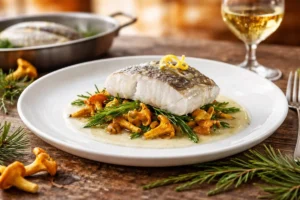
A legendary Basque preparation featuring Kokotxas (the gelatinous throat of hake or cod) and wild Boletus edulis, unified by a delicate, pale emulsion created from fish collagen and mushroom-infused olive oil.
Basque “Kokotxas” & Porcini Emulsion
The Velvet of the Bay: A Study in Collagen, Chitin, and the Pil-Pil
The Historical Prelude: The Secret of the Hake’s Throat
In the Gastronomic Societies of San Sebastián and Bilbao, there is no ingredient more revered than the Kokotxa. Historically, this small, V-shaped muscle from the throat of the Hake (Merluza) or Cod was considered a waste product. However, Basque fishermen discovered that this specific cut is the most gelatinous part of the fish. When gently swirled in olive oil, it releases its collagen to create a thick, pale sauce known as Pil-Pil.
The inclusion of Boletus edulis (locally Onddo Zuri) transforms this maritime classic into a "Mount-and-Sea" (Mendi eta Itxas) masterpiece. The Porcini provides a woody, nutty contrast to the clean, saline velvet of the fish. This dish is the ultimate test of a Basque chef's patience—it requires no flour, no cream, and no thickening agents—only the mechanical movement of the pan and the perfect synchronization of sea collagen and forest umami.
⏱ Time: 30 Minutes
📊 Difficulty: Elite Technical / Emulsion
🔥 Calories: 290 kcal / Serving
🍄 Type: Firm "Cylindrical" Porcini
Culinary Philosophy: The “Pil-Pil” Physics
Basque philosophy centers on Mechanical Emulsification. We are not "cooking" a sauce; we are creating a suspension. The Pil-Pil technique involves swirling the pan in a circular motion at a specific temperature (approx. 60-70°C). If it is too hot, the collagen proteins break; if it is too cold, the oil won't emulsify. The Porcini are poached in the oil first to "flavor the solvent" before the fish is added.
Sensory & Foraging Profile: The Cantabrian Beech Terroir
Latin Nomenclature:Boletus edulis (The Basque "Onddo"). Terroir Analysis: Porcini from the Gipuzkoa province grow in acidic, mossy soils under Common Beech. These mushrooms have a high concentration of **1-octen-3-ol**, which creates an aroma reminiscent of a damp forest. This "dampness" is the perfect olfactory partner for the gelatinous, "wet" texture of the Kokotxas.
Selection Protocol: We use only the ivory-white stems of the Porcini. The stems are cut into discs of the exact same size as the Kokotxas. In the final emulsion, the white mushrooms and the white fish become visually indistinguishable, leaving the diner to discover the difference through texture alone.
Essential Equipment
🔸 Clay Cazuela: The traditional vessel. The porous clay holds a steady, gentle heat that is critical for the Pil-Pil emulsion.
🔸 Fine-Mesh Strainer: Used by modern Basque chefs to "whisk" the oil and collagen more efficiently.
🔸 Temperature Probe: To ensure the oil never exceeds 75°C, preserving the silken texture.
The Master Recipe: The Emulsion of the Bay
Stage 1: The Aromatic Oil
In a cazuela with 150ml of extra virgin olive oil, gently "confi" 3 sliced cloves of garlic and a small piece of dried chili until the garlic is golden. Remove them. The oil is now seasoned.
Stage 2: The Porcini Infusion
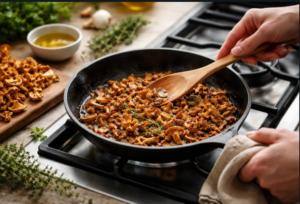
Add 300g of sliced Porcini stems to the warm oil. Cook at a very low simmer for 5 minutes. The mushroom juices will begin to mix with the oil. Remove the mushrooms and set aside.
Stage 3: The Kokotxa Collagen
Add 400g of Hake Kokotxas (skin-side up) to the oil. Cook for 2 minutes over extremely low heat. You will see small white bubbles of collagen escaping the fish. This is your "glue."
Stage 4: The Pil-Pil Dance
Remove the cazuela from the heat. Start moving it in a continuous, slow circular motion. As the oil cools slightly, it will begin to thicken and turn into a pale, ivory cream. Return the Porcini to the pan, swirl one last time to coat, and serve immediately.
Chef’s Secret: The “Sieve” Shortcut
If you are struggling to get the emulsion to form using only the "swirl" method, take a small fine-mesh tea strainer and use it to "whisk" the oil and fish juices in a circular motion around the Kokotxas. The mesh helps to break the oil into micro-droplets, binding them to the collagen much faster than pan-swirling alone.
The Umami Secret: Collagen and Chitin
This dish is a study in Biopolymer Interaction. The **Collagen** from the fish and the **Chitin** from the Porcini create a unique mouthfeel that triggers a "Satiety Signal" in the brain. Even though the dish is physically light, the density of the emulsion and the savory **Glutamates** of the mushroom create an experience of extreme culinary weight and luxury.
The Art of Pairing
Sommelier's Selection: A high-end, barrel-aged **Rioja Blanco (Viura)**. The subtle oak and vanilla notes of the wine complement the nuttiness of the Porcini and the creamy texture of the Pil-Pil.
Non-Alcoholic: A chilled, still mineral water with a single drop of high-quality truffle oil.
Micro-FAQ
Q: What if I can't find Kokotxas? A: You can use thick pieces of Cod Fillet (skin-on). The skin is where the collagen is; you will need to cook it skin-side down to release the "glue" needed for the sauce.
Q: My sauce "broke" (turned back into oil). A: This usually means it got too hot. Add a teaspoon of cold water or a splash of cold mushroom stock and whisk vigorously off the heat to bring the emulsion back together.
To provide the best experiences, we use technologies like cookies to store and/or access device information. Consenting to these technologies will allow us to process data such as browsing behavior or unique IDs on this site. Not consenting or withdrawing consent, may adversely affect certain features and functions.
Functional
Always active
The technical storage or access is strictly necessary for the legitimate purpose of enabling the use of a specific service explicitly requested by the subscriber or user, or for the sole purpose of carrying out the transmission of a communication over an electronic communications network.
Preferences
The technical storage or access is necessary for the legitimate purpose of storing preferences that are not requested by the subscriber or user.
Statistics
The technical storage or access that is used exclusively for statistical purposes.The technical storage or access that is used exclusively for anonymous statistical purposes. Without a subpoena, voluntary compliance on the part of your Internet Service Provider, or additional records from a third party, information stored or retrieved for this purpose alone cannot usually be used to identify you.
Marketing
The technical storage or access is required to create user profiles to send advertising, or to track the user on a website or across several websites for similar marketing purposes.