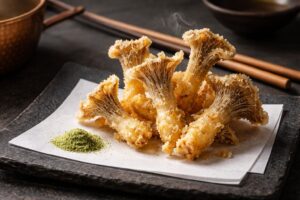
A masterclass in umami layering from the fog-swept coasts of Hokkaido, featuring the peppery Cantharellus cinereus and the buttery, fermented depth of Saikyo Miso.
Miso Black Cod & Gray Chanterelle
The Hokkaido Harmony: Fermented Gold and the Ashen Trumpet
The Historical Prelude: The Monastic Trade and the Forest Spirit
The pairing of Gindara (Black Cod) with Miso is a cornerstone of Japanese high-cuisine, famously popularized in the West by the Nobu school. However, the integration of wild forest fungi into this maritime ritual dates back to the Muromachi period in Northern Japan. In the cool, volcanic forests of Hokkaido, Buddhist monks and foragers discovered that the Gray Chanterelle (often referred to as the "peppery ghost") acted as a natural flavor stabilizer for the rich, oily fish caught in the Pacific.
Historically, the Gray Chanterelle was dried and powdered by mountain ascetics to be used as a "forest salt." When this was applied to fish preserved in Saikyo Miso (a sweet, white miso from Kyoto), a unique chemical synergy occurred. The mushroom's inherent pepperiness cut through the cod's heavy omega-3 lipids, while the miso's fermentation deepened the mushroom's subtle smokiness.
By the Edo period, this preparation was served in the Ryokans (inns) of the North as a winter delicacy. The "Ashy Trumpet" chanterelle was seen as a bridge between the physical world (the substantial fish) and the spirit world (the ethereal, dark mushroom). Today, this dish remains a technical benchmark for Washoku chefs, requiring a precise balance between the sweetness of fermentation and the raw, mineral edge of the wild harvest.
Narrative Intro: Black Cod is a fish defined by its "melt." Our philosophy for the Gray Chanterelle accompaniment is "Structural Punctuation." We use a quick, high-heat flash-sear on the mushrooms to create a crisp, smoky shell that disrupts the buttery texture of the cod. It is a dish of high-definition contrasts: dark and light, sweet and peppery, sea-fat and forest-ash.
Sensory & Foraging Profile: The Volcanic and Maritime Terroir
The Cantharellus cinereus found in the coastal ranges of Northern Japan grows in ash-rich, volcanic soils. This environment imparts a distinctive metallic finish and a scent profile of toasted sesame, wet wood, and apricot skin. Their dark, ashen color is a direct result of the high mineral content of the volcanic humus.
Ethical Harvesting & The "Sea-Mist" Protocol: In Hokkaido, we harvest only when the coastal fog is thick enough to "veil" the forest floor. This moisture ensures the Gray Chanterelle's hollow stem remains flexible. We use ceramic knives to harvest, as the high iron content in the mushroom can react with carbon steel, altering the subtle peppery flavor. We leave the central "cluster hub" untouched to ensure the subterranean mycelium can survive the sub-zero Hokkaido winters.
Essential Equipment: The Japanese Station
Bincho-tan Charcoal Grill: For the ultimate smoky finish that mimics the mushroom's natural aroma.
Non-Reactive Glass Tray: For the 72-hour miso marination process.
Bamboo Steamer: To gently "warm" the mushrooms before the final sear, preserving their internal moisture.
Cooking Chopsticks (Saibashi): For the delicate manipulation of the cod's fragile flakes.
Master Recipe: Miso Black Cod & Gray Chanterelles
Stage 1: The Maceration (The 72-Hour Cure)
Mix 100g Saikyo Miso, 50ml Mirin, and 50ml Sake. Whisk over low heat until smooth. Cool completely. Submerge 4 Black Cod fillets in the paste and refrigerate for 3 days. This breaks down the proteins and infuses the fish with a deep, fermented sweetness.
Stage 2: The Mushroom Preparation
Clean 200g of Gray Chanterelles. In a small bowl, whisk 10ml of Toasted Sesame Oil with a pinch of Shichimi Togarashi (Japanese 7-spice). Toss the mushrooms lightly. The pepper in the spice blend will act as a mirror to the mushroom's natural chemistry.
Stage 3: The Imperial Broil
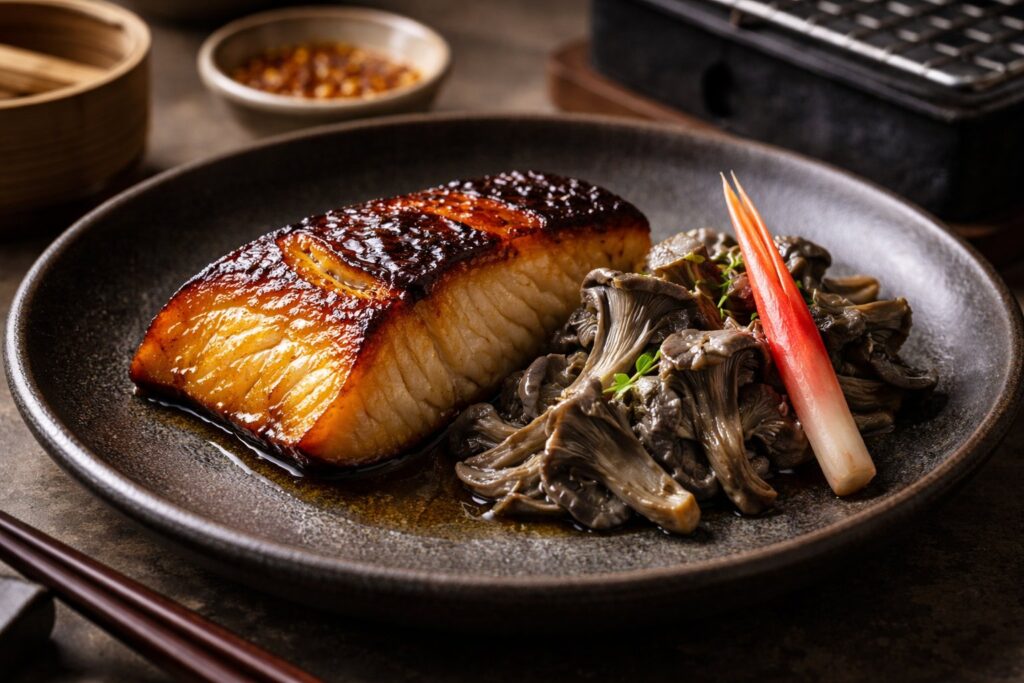
Wipe excess miso off the cod. Place under a high broiler (or on the Bincho-tan). Cook for 6–8 minutes until the miso caramelizes into dark, "burnt sugar" patches and the fish begins to flake. The internal temperature should be exactly 50°C.
Stage 4: The Flash-Sear
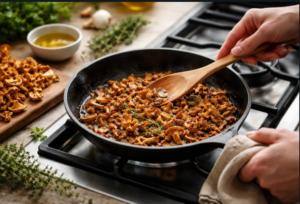
While the fish rests, heat a steel pan until it reaches its smoke point. Drop the mushrooms in. Sear for only 45 seconds. You want them to "sing"—a slight sizzle that indicates the chitin is crisping while the interior remains moist.
Stage 5: The Assembly
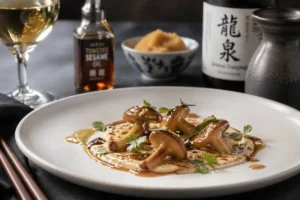
Place the cod on a dark stoneware plate. Arrange the Gray Chanterelles in a "nest" beside the fish. Garnish with a single Hajikami Shoga (pickled ginger sprout) to provide a sharp, acidic snap that cleanses the palate between the miso and the mushroom.
Substitutions & Variations: The Luxury Palette
The Fish: If Black Cod is unavailable, use Patagonian Toothfish or a very fatty **Chilean Sea Bass**.
The Miso: Use Red Miso (Aka Miso) for a saltier, more robust flavor if serving in a rustic mountain style.
The Mushroom: For an ultra-luxurious version, add a few slices of Dried Matsutake to the mushroom flash-sear.
Pro Technique: The “Sake-Mist” Finish
As the Gray Chanterelles hit the hot pan, spray them with a fine mist of Junmai Sake from an atomizer. The alcohol evaporates instantly, creating a "steam-sear" that locks in the peppery aromatics and adds a subtle, floral sweetness that bridges the gap between the fish and the forest.
The Umami Secret: Glutamate-Terpene Entrapment
The Miso is a powerhouse of Free Glutamates. The Gray Chanterelle contains high levels of Guanylates. When these meet the **Volcanic Terpenes** of the mushroom, a "synergistic umami" occurs that is 8x stronger than either ingredient alone. The fat in the Black Cod acts as a "carrier molecule," trapping these flavors and holding them on the tongue for an extended finish (known in Japan as Kokumi).
The Art of Pairing: The Sommelier’s Selection
Sommelier's Choice: A Kimoto-style Sake. Its higher acidity and slight "earthy" funk are the perfect match for the fermented miso and the wild mushrooms.
Non-Alcoholic Alternative: A Warm Genmaicha (Roasted Rice Tea). The nutty, toasted notes of the rice echo the "ashen" profile of the Gray Chanterelle.
Micro-FAQ
Q: Why 72 hours for the cod? A: This is the time required for the miso enzymes to partially "digest" the fish proteins, creating the legendary buttery texture. Anything less is just a glaze.
Q: Can I use Golden Chanterelles? A: No. Their fruity, apricot-like profile clashes with the salty/sweet miso. The Gray Chanterelle's peppery-smoke profile is the only one that works technically here.
Q: Is Black Cod the same as regular Cod? A: No. Black Cod (Sablefish) has significantly more fat and a much silkier texture. Regular Atlantic cod will dry out under this treatment.
The Ashen Lexicon: Global Names for Cantharellus cinereus
The Ashen Chanterelle is a sophisticated relative of the golden chanterelle, prized for its deep, fruity aroma. Its regional names often describe its elegant grey-to-black coloration and trumpet-like hollow stem:
To provide the best experiences, we use technologies like cookies to store and/or access device information. Consenting to these technologies will allow us to process data such as browsing behavior or unique IDs on this site. Not consenting or withdrawing consent, may adversely affect certain features and functions.
Functional
Always active
The technical storage or access is strictly necessary for the legitimate purpose of enabling the use of a specific service explicitly requested by the subscriber or user, or for the sole purpose of carrying out the transmission of a communication over an electronic communications network.
Preferences
The technical storage or access is necessary for the legitimate purpose of storing preferences that are not requested by the subscriber or user.
Statistics
The technical storage or access that is used exclusively for statistical purposes.The technical storage or access that is used exclusively for anonymous statistical purposes. Without a subpoena, voluntary compliance on the part of your Internet Service Provider, or additional records from a third party, information stored or retrieved for this purpose alone cannot usually be used to identify you.
Marketing
The technical storage or access is required to create user profiles to send advertising, or to track the user on a website or across several websites for similar marketing purposes.