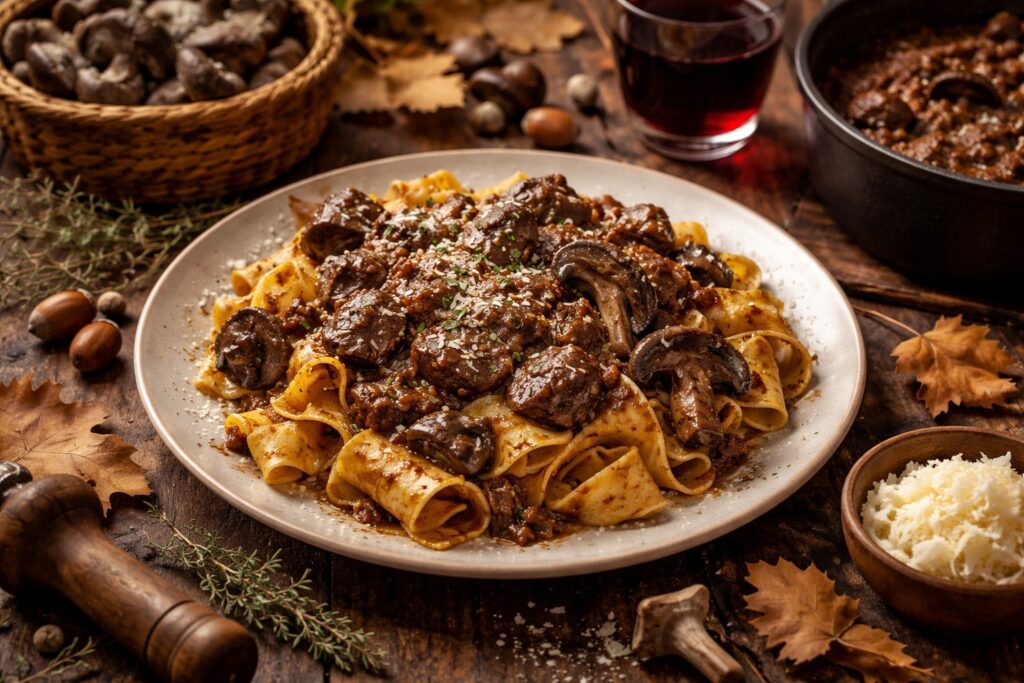
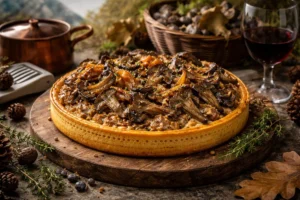
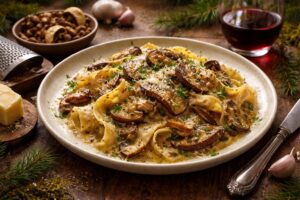
A primal, dark-hued masterpiece from the Bulgarian Balkan Mountains, marrying the peppery Cantharellus cinereus with the intense, iron-rich depth of wild game.
Wild Boar & Gray Chanterelle Ragù
The Balkan Cauldron: Ancient Oaks and the "Black Gold" of the Stara Planina
The Historical Prelude: The Hunter’s Hearth in the Balkan Heartland
In the dense, fog-wrapped forests of the Balkan Mountains (Stara Planina), the transition from autumn to winter is marked by two essential events: the wild boar hunt and the final harvest of the Gray Chanterelle. While Mediterranean ragùs rely on tomato and bright herbs, the traditional Bulgarian "Forest Ragù" is a darker, more brooding affair, rooted in the preservation of moisture and heat.
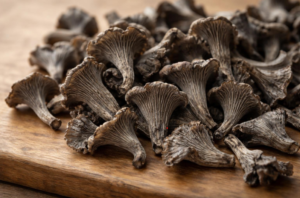
Historically, the Gray Chanterelle was the "secret weapon" of Balkan mountain villages. Known locally for its peppery resilience, it was added to slow-simmering game pots because it could withstand 4 to 6 hours of cooking without disintegrating. The Wild Boar (Gliver), having spent the summer gorging on acorns and wild roots, provides a fat profile that is uniquely capable of absorbing the smoky, ashen aromatics of the mushroom.
By the 19th century, as the Ottoman influence met European culinary techniques, the dish was refined. The addition of wide, hand-cut Pappardelle—reminiscent of the traditional Bulgarian Yufka but with Italian structural integrity—created a canvas for the heavy sauce. This dish is not merely a meal; it is a thermal fortification, a culinary record of the ancient oak and beech stands that have defined Balkan life for millennia.
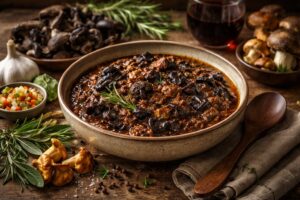
Narrative Intro: This ragù is a study in "Dark Umami." Our philosophy for the Gray Chanterelle is "Pigment Extraction." By braising the mushrooms directly with the game, we allow their ashy pigments and peppery oils to dye the meat and the sauce a deep, earthy brown. The result is a sauce that doesn't just sit on the pasta—it infuses it, creating a unified sensory experience of the forest floor.
Sensory & Foraging Profile: The Oak-Silt and Humus Terroir
The Cantharellus cinereus of the Balkan ranges grows in thick, nitrogen-rich leaf litter. This specific environment results in a mushroom with a metallic, flinty finish and a scent profile that evokes dried tobacco, cold hearth-ash, and wild peppercorns. Their texture is hollow but remarkably sturdy.
Ethical Harvesting & The "Acorn Rule": In the Bulgarian tradition, foragers only harvest Gray Chanterelles in patches where the oaks have dropped their acorns. This ensures the soil is at its peak acidity. We use hand-carved linden-wood baskets to allow the spores to drop through the weave as we move through the forest. We strictly observe the "Mycelial Veil"—leaving the first three centimeters of the mushroom cluster undisturbed to protect the delicate network from the early Balkan frosts.
Essential Equipment: The Game Station
Cast-Iron Dutch Oven: To maintain the slow, even thermal mass required for breaking down wild boar collagen.
Wooden Pestle: For hand-grinding the juniper and peppercorns to release volatile oils.
Bronze-Die Pasta Cutter: For creating the wide (2.5cm) Pappardelle necessary to carry the heavy ragù.
Tallow-Seasoned Pan: To sear the meat at extremely high temperatures before the braise.
Master Recipe: Balkan Wild Boar & Gray Chanterelle Ragù
Stage 1: The Game Sear
Cut 600g of Wild Boar Shoulder into 2cm cubes. Sear in a screaming-hot Dutch oven with rendered pork fat until a deep, dark crust forms. This "Maillard Layer" is the foundation of the ragù's color.
Stage 2: The Forest Mirepoix
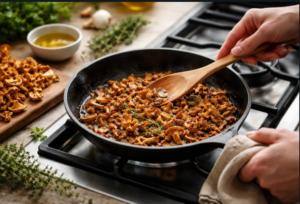
Add 2 finely diced onions, 1 carrot, and 1 stalk of celery to the pot. Once softened, add 300g of whole Gray Chanterelles. Sauté until the mushrooms have released their liquid and it has evaporated back into a glossy glaze on the meat.
Stage 3: The Wine & Spice Infusion
Deglaze with 300ml of Mavrud (a heavy, tannic Bulgarian red wine). Add 3 crushed juniper berries, 1 bay leaf, and 2 cloves of garlic. Reduce the wine by half to concentrate the fruit sugars and tannins.
Stage 4: The Long Braise
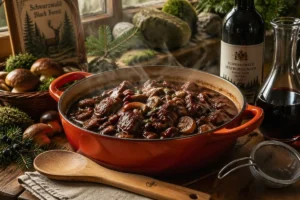
Add 500ml of dark beef or game stock. Cover and place in a 140°C oven for 3.5 hours. The boar should be "fork-tender," and the Gray Chanterelles should have merged with the sauce to create a thick, nearly black consistency.
Stage 5: The “Mantecatura” with Pasta
Boil the Pappardelle until 1 minute before al dente. Toss directly into the Dutch oven with the ragù. Add a knob of butter and a handful of aged Kashkaval or Pecorino. Stir vigorously until the sauce binds to the wide ribbons of pasta.
Substitutions & Variations: The Luxury Palette
The Meat: If wild boar is unavailable, use Venison or high-quality Ibérico Pork Shoulder to maintain the requisite fat content.
The Wine: Replace Mavrud with a Syrah or Barolo; you need a wine with high tannins to bridge the gap between the game and the mushroom minerals.
The Finish: Add a teaspoon of Unsweetened Cocoa Powder at the end of the braise to deepen the color and amplify the mushroom's smoky notes.
Pro Technique: The “Bone Marrow” Emulsion
For a truly professional Balkan finish, roast two beef marrow bones separately and whisk the rendered marrow into the ragù in the final 10 minutes. The marrow provides a "velvet" coating to the Gray Chanterelles, softening their peppery edge and creating a luxurious mouthfeel that balances the lean wild boar fibers.
The Umami Secret: Chitinous Solubilization
The Gray Chanterelle is high in Chitin, which typically stays firm. However, during a 4-hour braise in an acidic medium (red wine), these fibers begin to partially break down into Chitosans, which act as natural thickeners. This is why the ragù achieves a "sticky," lip-smacking quality without the need for flour or cornstarch. The mushroom literally becomes the sauce's structural skeleton.
The Art of Pairing: The Sommelier’s Selection
Sommelier's Choice: A Melnik 55 or a Châteauneuf-du-Pape. The spicy, leathery notes of these wines are the only things robust enough to walk alongside the wild boar and the smoky chanterelles.
Non-Alcoholic Alternative: A Fermented Black Garlic and Beetroot Reduction. The earthy sweetness and "funk" mirror the ragù's complexity.
Storage & Reheating: Professional Restoration
Like all ragùs, this dish is superior on the second day. The mushroom pigments continue to migrate into the meat fibers overnight. Reheat gently in a pan with a splash of beef stock to loosen the emulsion. Do not boil aggressively, as this will break the delicate fat-starch bond.
Micro-FAQ
Q: My wild boar is tough. What happened? A: Game is lean; if the temperature was too high or the time too short, the collagen hasn't melted. Give it another hour at 140°C.
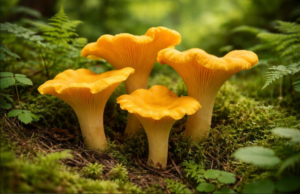
Q: Can I use Golden Chanterelles? A: You can, but they will turn to mush and their fruity flavor will clash with the game. The Gray Chanterelle is technically superior here for its "smoky-peppery" profile.
Q: Why no tomatoes? A: Tomato acidity can mask the subtle metallic minerals of the Gray Chanterelle. This is a Ragù Bianco (or rather, Ragù Nero), focused purely on the forest terroir.
The Ashen Lexicon: Global Names for Cantharellus cinereus
The Ashen Chanterelle is a sophisticated relative of the golden chanterelle, prized for its deep, fruity aroma. Its regional names often describe its elegant grey-to-black coloration and trumpet-like hollow stem:
To provide the best experiences, we use technologies like cookies to store and/or access device information. Consenting to these technologies will allow us to process data such as browsing behavior or unique IDs on this site. Not consenting or withdrawing consent, may adversely affect certain features and functions.
Functional
Always active
The technical storage or access is strictly necessary for the legitimate purpose of enabling the use of a specific service explicitly requested by the subscriber or user, or for the sole purpose of carrying out the transmission of a communication over an electronic communications network.
Preferences
The technical storage or access is necessary for the legitimate purpose of storing preferences that are not requested by the subscriber or user.
Statistics
The technical storage or access that is used exclusively for statistical purposes.The technical storage or access that is used exclusively for anonymous statistical purposes. Without a subpoena, voluntary compliance on the part of your Internet Service Provider, or additional records from a third party, information stored or retrieved for this purpose alone cannot usually be used to identify you.
Marketing
The technical storage or access is required to create user profiles to send advertising, or to track the user on a website or across several websites for similar marketing purposes.