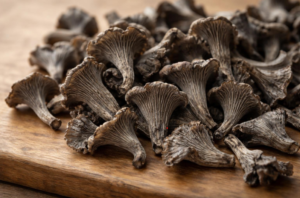
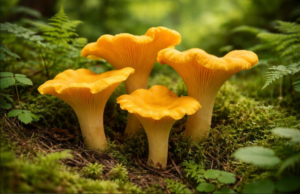
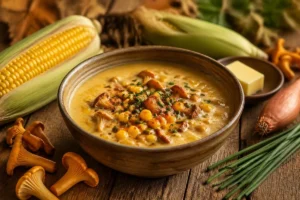
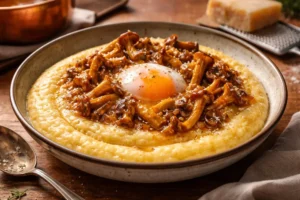
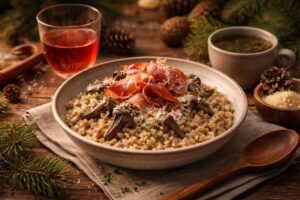
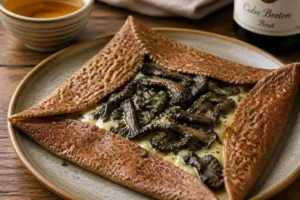
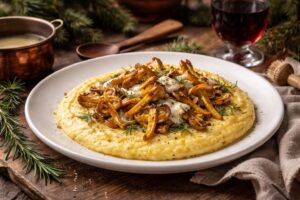
A rugged, high-altitude symphony from the Northern Italian Alps featuring the peppery Cantharellus cinereus and buckwheat-infused polenta.
Gray Chanterelle & Polenta Taragna
The Buckwheat Highlands and the Slate-Colored Spores of the Dolomites
The Historical Prelude: The Iron-Wrought Sustenance of the Alps
Polenta Taragna is the visceral soul of the Lombardian and Trentino Alps. Named after the tarell (the long wooden stick used to stir the copper pot), this dish represents a historical defiance against the monoculture of yellow corn. By blending cornmeal with buckwheat (grano saraceno), the mountain people created a darker, nuttier, and more mineral-dense foundation for their meals.
In the Dolomites, the late-autumn harvest of the Cantharellus cinereus (Gray Chanterelle) was traditionally the final fresh "protein" of the year before the deep snows arrived. Known locally as Finferli Grigi, these mushrooms were prized for their ability to harmonize with the "bitter-earth" profile of the buckwheat. Historically, the woodcutters of the Val di Fiemme would slow-cook these mushrooms in the same heavy copper cauldrons used for the polenta, infusing the grain with the mushroom's peppery, ashen essence.
By the 19th century, the dish was refined through the addition of Casera and Bitto cheeses—fat-rich Alpine dairy that emulsifies with the starch to create a texture that is neither liquid nor solid, but "stretched." The Gray Chanterelle, with its unique metallic terpenes, acts as the perfect chemical counterpoint to the heavy dairy fats. Today, this dish is the ultimate expression of the Alpine Vertical Terroir, where the minerals of the dolomitic rock pass through the buckwheat roots and the mushroom mycelium to meet in a single, steaming copper bowl.
Narrative Intro: Alpine cooking is a study in "Thermal Mass." Our philosophy for the Gray Chanterelle and Polenta is "Starch-Fat Suspension." We don't just serve mushrooms on top of polenta; we fold the mushroom's concentrated "forest-liquor" into the buckwheat grain, ensuring that the smoky, peppery notes are suspended in every microscopic pocket of melted cheese. It is a dish that provides an internal furnace for the body.
Sensory & Foraging Profile: The Conifer and Limestone Terroir
The Cantharellus cinereus found in the Northern Italian Alps grows in the calcareous debris beneath spruce and fir trees. This high-altitude environment produces a mushroom with a denser cell structure and a more pronounced "cold-smoke" aroma than lowland varieties. Their color often mimics the slate-grey of the Dolomite peaks themselves.
Ethical Harvesting & The "Frost-Line" Protocol: In the Trentino tradition, foragers wait for the first "Dry Frost" to harvest. This sudden cold concentrates the trehalose (mushroom sugar) within the Gray Chanterelle, providing a subtle sweetness that balances its peppery heat. We use walnut-wood brushes to clean the trumpet-shaped caps, ensuring the forest's micro-ecosystem is not contaminated by synthetic fibers. We strictly avoid harvesting on south-facing slopes during the midday sun to ensure the mushrooms retain their maximum "turgor pressure"—the internal water tension that makes them snap when bitten.
Essential Equipment: The Alpine Kitchen
Paiolo di Rame: A heavy, unlined copper pot, essential for the even heat distribution required to cook buckwheat without burning.
Tarell (Wooden Stirrer): A long stick to maintain the "circular momentum" of the polenta.
Cast-Iron Skillet: For the high-heat searing of the Gray Chanterelles to achieve a "charred-wood" finish.
Cheese Plane: To create ultra-thin ribbons of Alpine cheese for rapid melting.
Master Recipe: Gray Chanterelle & Polenta Taragna
Stage 1: The Buckwheat Hydration
Bring 1.5 liters of salted water to a boil in the copper pot. Slowly rain in 300g of Polenta Taragna mix (70% yellow corn, 30% buckwheat). Whisk constantly for 5 minutes to prevent lumps, then switch to the wooden stick. Lower heat to a whisper and stir every 10 minutes for 1 hour. This slow hydration is what unlocks the nutty buckwheat flavor.
Stage 2: The Searing of the “Grey Trumpets”
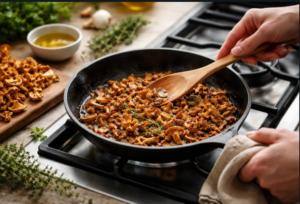
While the polenta cooks, heat 30ml of clarified butter in a cast-iron skillet. Add 400g of Gray Chanterelles. Do not stir for the first 2 minutes; allow the mushrooms to develop a crisp, smoky crust. Add a clove of crushed garlic and a sprig of mountain rosemary. Deglaze with a splash of Grappa to unlock the fat-soluble aromatics.
Stage 3: The Cheese Emulsion
When the polenta is thick and pulls away from the sides of the pot, add 150g of cold, cubed butter and 200g of Valtellina Casera DOP (or Gruyère). Stir vigorously in one direction. The cheese should melt into "strings" (filare), indicating a perfect fat-to-starch ratio.
Stage 4: The Fusion
Fold half of the seared Gray Chanterelles directly into the polenta. The residual heat of the grain will extract the remaining mushroom essences. The polenta will take on a beautiful, marbled ashen-gold color.
Stage 5: The Presentation
Pour the polenta into a large wooden board or deep bowls. Top with the remaining crispy chanterelles and a dusting of black pepper. The dish must be served at "lava temperature" to maintain the cheese's elasticity.
Substitutions & Variations: The Luxury Palette
The Cheese: Use Fontina d'Aosta for a softer, more "barnyard" funk that highlights the mushroom's earthiness.
The Fat: For an extreme Alpine experience, use rendered Lardo di Colonnata to sauté the mushrooms.
The Liquid: Replace 20% of the water in the polenta with Whole Alpine Milk for a creamier, dessert-like richness.
Pro Technique: The “Crusta” Restoration
The thin layer of polenta that sticks to the bottom of the copper pot is the most prized part of the dish. Do not soak the pot! Scrape these "chips" out and serve them on top of the mushrooms. They provide a toasted, popcorn-like umami that bridges the gap between the smooth grain and the peppery fungi.
The Umami Secret: Casein-Terpene Bonding
The **Casein** proteins in Alpine cheeses have been aged to a point where they are highly reactive with the **Terpenes** (specifically limonene and pinene) found in the Gray Chanterelle. When heated together, these molecules form a temporary bond that the tongue perceives as a "third flavor"—neither cheese nor mushroom, but a deep, resonant savory signal. The buckwheat provides the **Fagopyrin** which acts as a bitter "frame" for this umami explosion, making it feel more complex and less cloying.
The Art of Pairing: The Sommelier’s Selection
Sommelier's Choice: A Lagrein (Alto Adige). This dark, velvety red wine has notes of bitter chocolate and forest berries that perfectly match the buckwheat and the smoky chanterelle.
Non-Alcoholic Alternative: A Warm Pine-Needle and Honey Tea. The resinous notes of the pine mimic the forest terroir and cut through the richness of the cheese.
Storage & Reheating: Professional Restoration
Polenta Taragna will solidify into a brick when cold. Do not try to re-melt it. Instead, slice the cold polenta, pan-fry it in butter until the edges are crispy, and top with fresh sautéed Gray Chanterelles. This "Second-Day Polenta" (Polenta Fritta) is arguably more flavorful than the original, as the starches have undergone retrogradation, increasing their umami profile.
Ancestral Nutrition: The Mountain Forge
Gray Chanterelles are an elite source of B-Vitamins and Manganese. Buckwheat provides Rutin, a powerful antioxidant for cardiovascular health in high altitudes. Historically, this meal was the "Fuel of the Dolomites," providing the slow-release carbohydrates and dense fats needed for 12-hour shifts in the mountain timber mines.
Micro-FAQ
Q: Why is my polenta gritty? A: You didn't cook it long enough. Buckwheat takes a minimum of 45-60 minutes to fully soften. Patience is the technical requirement here.
Q: Can I use instant polenta? A: No. Instant polenta is pre-cooked and lacks the starch structure needed to emulsify with the cheese and the mushroom liquor. It will result in a grainy, separated mess.
Q: Why do my Gray Chanterelles taste like pepper? A: That is their natural defense mechanism and their greatest culinary asset. In the Alps, we call this the "Peppery Ghost"—it is what makes them superior to the golden variety for heavy grain dishes.
To provide the best experiences, we use technologies like cookies to store and/or access device information. Consenting to these technologies will allow us to process data such as browsing behavior or unique IDs on this site. Not consenting or withdrawing consent, may adversely affect certain features and functions.
Functional
Always active
The technical storage or access is strictly necessary for the legitimate purpose of enabling the use of a specific service explicitly requested by the subscriber or user, or for the sole purpose of carrying out the transmission of a communication over an electronic communications network.
Preferences
The technical storage or access is necessary for the legitimate purpose of storing preferences that are not requested by the subscriber or user.
Statistics
The technical storage or access that is used exclusively for statistical purposes.The technical storage or access that is used exclusively for anonymous statistical purposes. Without a subpoena, voluntary compliance on the part of your Internet Service Provider, or additional records from a third party, information stored or retrieved for this purpose alone cannot usually be used to identify you.
Marketing
The technical storage or access is required to create user profiles to send advertising, or to track the user on a website or across several websites for similar marketing purposes.