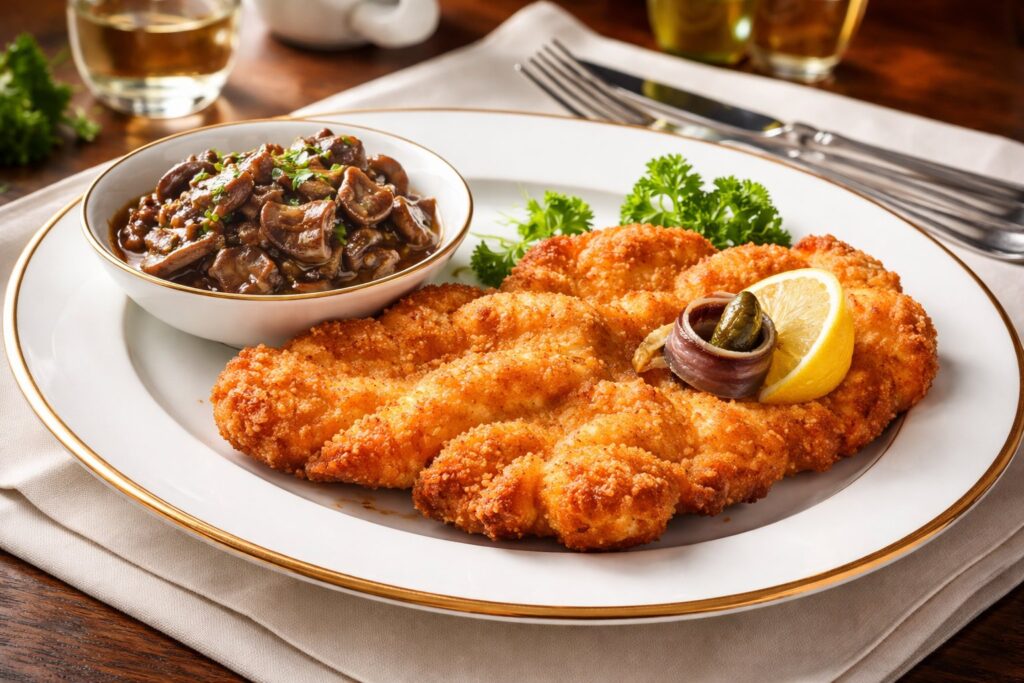
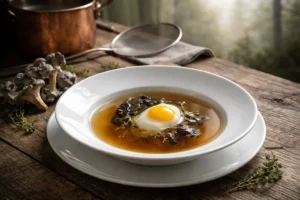
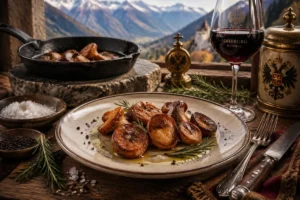
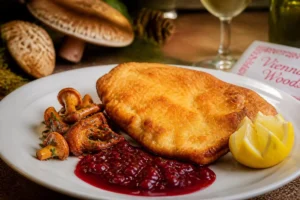
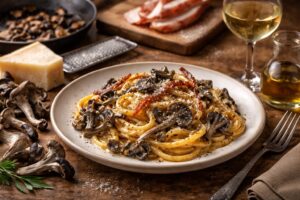
A technical study in Austrian crispness featuring the iconic veal schnitzel and the mineral-rich Cantharellus cinereus in a white wine reduction.
Wiener Schnitzel & Gray Chanterelles
Imperial Crispness and the Peppery Echo of the Wienerwald
The Historical Prelude: The Emperor’s Gold and the Hunter’s Bounty
The Wiener Schnitzel is the undisputed monarch of Austrian cuisine. Legend credits Field Marshal Radetzky for bringing the concept of breaded veal from Italy to the Habsburg court in 1857, though similar preparations existed in the Vienna culinary manuscripts far earlier. While the Schnitzel itself was a symbol of imperial luxury, the choice of its accompaniment was often dictated by the seasonal harvest of the Wienerwald (the Vienna Woods).
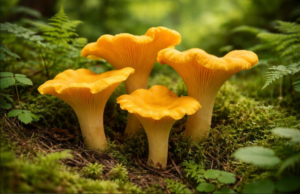
Historically, the Cantharellus cinereus (Gray Chanterelle) was the preferred companion for the Schnitzel among the Austrian hunting aristocracy. Unlike the more common golden chanterelle, the "Gray" was praised for its technical compatibility with the breaded meat. Austrian chefs discovered that the peppery, mineral finish of the Gray Chanterelle, when braised in the sharp, acidic white wines of the Wachau region, provided a vital "sensory reset." This acidity cuts through the richness of the lard-fried breading, elevating the dish from a heavy tavern meal to a sophisticated imperial feast.
By the late 19th century, the "Schnitzel mit Grauen Pfifferlingen" became a staple in Vienna's high-end Beisls. The ashy color of the mushrooms provided a striking visual contrast to the golden, wavy crust of the veal. Today, this preparation is considered the ultimate test of an Austrian chef's ability to balance dry-crisp textures with velvety, wine-based emulsions.
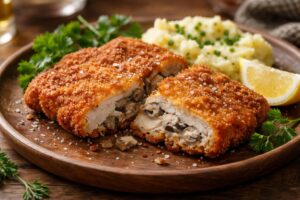
Narrative Intro: A perfect Wiener Schnitzel must "soufflé"—the breading must detach from the meat to form golden waves. Our philosophy for the Gray Chanterelle accompaniment is "Acidity as a Cleanser." We braise the mushrooms in a reduction of Riesling and shallots to create a bright, mineral-rich sauce that prevents "palate fatigue" from the fried proteins. It is a dialogue between the fat of the plains and the acid of the mountain forest.
Sensory & Foraging Profile: The Loess and Danube Mist Terroir
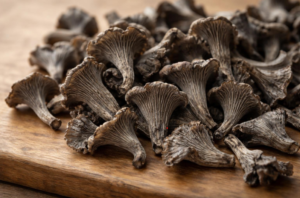
The Cantharellus cinereus of the Vienna Woods grows in loess-rich, silty soils. This terroir produces a mushroom with a pronounced peppery heat and a scent of dried apricots and cold smoke. Their texture is slightly more fibrous than their alpine cousins, allowing them to withstand the braising process without losing their structural definition.
Ethical Harvesting & The "Imperial Sweep": In the Austrian tradition, foragers use soft-bristle boar-hair brushes to clean the mushrooms in situ. We harvest only those specimens that have reached a "trumpet diameter" of at least 3cm, ensuring that younger fungi remain to maintain the forest's ecological balance. We strictly avoid harvesting near the Danube's floodplains to ensure the mushrooms remain free of excess alluvial moisture, which is critical for a clean braise.
Essential Equipment: The Viennese Station
Meat Mallet (Smooth-Faced): To butterfly and flatten the veal to a precise 4mm thickness without tearing the fibers.
Deep Steel Skillet: Essential for the "swimming" fry technique required for the breading to soufflé.
Fine Sieve: To ensure the flour for the breading is aerated and free of clumps.
Small Saucier: For the high-reduction mushroom braise.
Butterfly 4 veal escalopes (topside). Pound them between sheets of plastic wrap until they are 4mm thick and even. Lightly salt both sides. This thinness allows the meat to cook in the same time it takes for the breading to turn golden.
Stage 2: The Soufflé Breading
Standard breading procedure (flour, whisked egg with a drop of oil, and fine breadcrumbs). **CRITICAL:** Do not press the breadcrumbs into the meat. They must sit loosely on the surface so that steam can escape during frying, lifting the breading away from the veal.
Stage 3: The Gray Chanterelle Braise
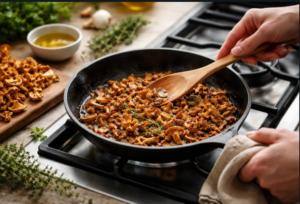
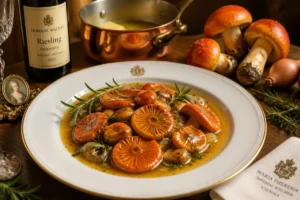
Sauté 1 finely minced shallot in butter. Add 300g of Gray Chanterelles. Once they release their liquid, deglaze with 100ml of Dry Austrian Riesling. Reduce by half. Add 50ml of veal stock and a teaspoon of cold butter to emulsify. Finish with fresh parsley.
Stage 4: The Imperial Fry
Heat enough Clarified Butter (Ghee) or lard in a skillet so the Schnitzel can "swim." Heat to 170°C. Lay the veal in and shake the pan constantly in a circular motion. Spoon the hot fat over the top of the meat. This "waves" the breading. Fry for 2 minutes per side until deep golden.
Stage 5: The Assembly
Drain the Schnitzel on a wire rack (not paper) to maintain crispness. Serve the braised Gray Chanterelles in a separate small bowl or to the side of the meat. Garnish the Schnitzel with a traditional lemon slice and a single anchovy fillet wrapped around a caper.
Substitutions & Variations: The Luxury Palette
The Fat: For a more rustic, historical flavor, use Pork Lard for frying the Schnitzel.
The Wine: Replace Riesling with a Grüner Veltliner for a more herbaceous, white-pepper finish in the mushroom sauce.
The Mushroom: If Gray Chanterelles are unavailable, use Black Trumpets (Craterellus cornucopioides) for an even deeper, more dramatic visual contrast.
Pro Technique: The “Wave-Motion” Fry
The secret to a Michelin-level Schnitzel is the constant movement of the pan. By swirling the hot fat over the top of the breading, you create a temperature differential that causes the natural moisture in the meat to turn to steam instantly. This steam "inflates" the breading like a balloon, creating the signature wavy, crisp texture that defines the Wiener Schnitzel.
The Umami Secret: Tartaric Acid and Nucleotide Synergy
The Tartaric Acid in the Austrian white wine acts as a solvent for the Guanylates found in the Gray Chanterelle. This increases the "perceived saltiness" of the dish without adding sodium. Furthermore, the Maillard Reaction products in the fried breading provide a base of pyrazines that the mushroom's smoky phenols can latch onto, creating a unified flavor profile that bridges the gap between the field and the forest.
The Art of Pairing: The Sommelier’s Selection
Sommelier's Choice: A Riesling Smaragd from the Wachau. Its high acidity and petrol-mineral notes are the only thing capable of standing up to the fried breading while highlighting the mushroom's terroir.
Non-Alcoholic Alternative: A Chilled Sparkling Verjus. The sharp grape-acid provides the necessary "bite" to cut through the butter.
Storage & Reheating: Professional Restoration
A Schnitzel should never be stored; the breading will absorb moisture from the meat and become "soggy." If you must reheat, use an air-fryer at 200°C for 3 minutes to restore the "soufflé" crispness. The mushroom braise can be stored for 24 hours and reheated in a pan with a splash of fresh wine to brighten the acidity.
Ancestral Nutrition: The Imperial Tonic
The Gray Chanterelle is a rare source of Vitamin D and Iron. Veal provides high-quality Heme Iron and Zinc. Historically, this dish was considered the "Emperor's Recovery Meal," designed to provide the highest density of bioavailable minerals and proteins in a single, easily digestible sitting.
Micro-FAQ
Q: Why is my breading falling off? A: You likely didn't shake the pan enough or the fat wasn't hot enough. The breading needs to set instantly to maintain its shape.
Q: Can I use pork? A: In Austria, that is called Schnitzel Wiener Art (Vienna style). Only veal can be called Wiener Schnitzel. Pork has more moisture and may lead to a flatter breading.
Q: Why are the mushrooms gray? A: That is their natural, ashy pigment. Do not attempt to "brighten" them; their color is a hallmark of their sophisticated, smoky flavor profile.
The Ashen Lexicon: Global Names for Cantharellus cinereus
The Ashen Chanterelle is a sophisticated relative of the golden chanterelle, prized for its deep, fruity aroma. Its regional names often describe its elegant grey-to-black coloration and trumpet-like hollow stem:
To provide the best experiences, we use technologies like cookies to store and/or access device information. Consenting to these technologies will allow us to process data such as browsing behavior or unique IDs on this site. Not consenting or withdrawing consent, may adversely affect certain features and functions.
Functional
Always active
The technical storage or access is strictly necessary for the legitimate purpose of enabling the use of a specific service explicitly requested by the subscriber or user, or for the sole purpose of carrying out the transmission of a communication over an electronic communications network.
Preferences
The technical storage or access is necessary for the legitimate purpose of storing preferences that are not requested by the subscriber or user.
Statistics
The technical storage or access that is used exclusively for statistical purposes.The technical storage or access that is used exclusively for anonymous statistical purposes. Without a subpoena, voluntary compliance on the part of your Internet Service Provider, or additional records from a third party, information stored or retrieved for this purpose alone cannot usually be used to identify you.
Marketing
The technical storage or access is required to create user profiles to send advertising, or to track the user on a website or across several websites for similar marketing purposes.