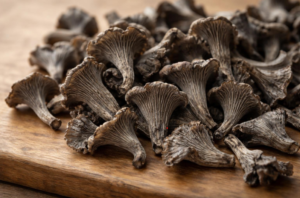
In the mist-heavy plains of the Veneto, the transition from summer's corn to winter's fungi is a sacred culinary timeline. Historically, Polenta was the "L'oro dei poveri" (gold of the poor), but in the hands of Venetian masters, it became a canvas for the forest's most aromatic treasures. As the cold air settles over the pre-Alpine hills, the Yellow Foot Chanterelle (Craterellus lutescens) makes its final appearance of the year.
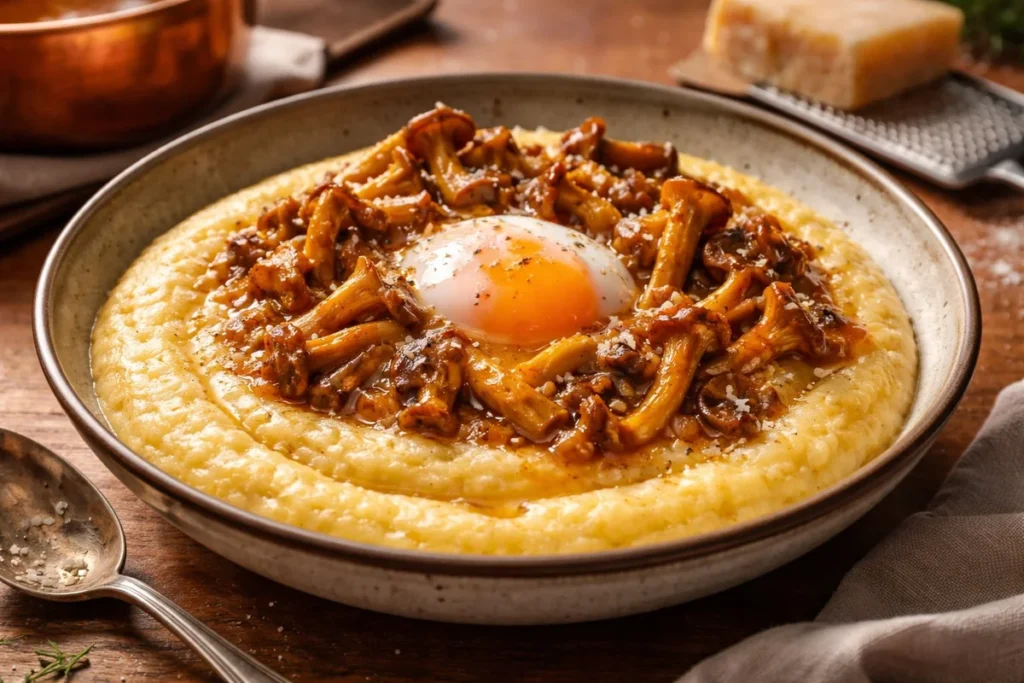
The brilliance of this pairing lies in Chromatic Harmony. The golden hue of the stone-ground corn, the bright orange of the mushroom stems, and the deep yellow of a farm-fresh egg yolk create a visual "sunrise" in the middle of winter. Italian chefs discovered that the lactic sweetness of butter-laden polenta acts as a perfect acoustic chamber, amplifying the delicate apricot and white pepper notes of the Yellow Foot.
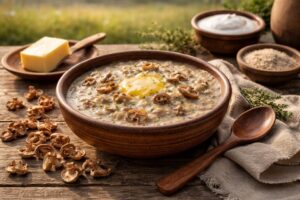
By the 19th century, the addition of a Poached Egg transformed this from a side dish into a technical masterpiece of textures. The liquid yolk acts as a spontaneous "mother sauce," binding the grainy corn and the hollow, succulent mushrooms into a single, silken experience.
Narrative Intro: This dish is an "Edible Glow." Our philosophy for the Truffled Polenta is to use the egg yolk as a "fat-bridge." The yolk's lecithin captures the volatile apricot esters of the Yellow Foot and the earthy musk of the truffle, anchoring them to the palate long after the first bite.
Sensory & Foraging Profile: The Humid Pine and Limestone Terroir
The Craterellus lutescens of the Venetian foothills thrives in limestone-rich, alkaline soils covered by pine and spruce needles. This terroir imparts a cleaner, more floral finish to the mushroom, with less of the "metallic" undertone found in peat-grown specimens. The mushrooms remain exceptionally tender and flexible, making them ideal for folded into a soft, creamy polenta.
Ethical Harvesting & Professional Protocols: In the Alpine foothills, we follow the "Solar-Sync" protocol—harvesting only in the late afternoon when the mushrooms have reached their peak temperature, maximizing their aromatic "throw." We utilize soft-bristle goat-hair brushes and strictly leave the mycelial "hubs" (where clusters are densest) to ensure the network remains robust against the coming winter snows.
Essential Equipment: The Emulsion Station
Copper Polenta Pot (Paiolo): Essential for the slow, even conductive heat required to hydrate corn starches without scorching.
Fine Mesh Sieve: For "raining" the cornmeal into the water to ensure a lump-free suspension.
Slotted Spoon: For the precision handling of the 4-minute poached egg.
Microplane: For the final, airy dusting of 24-month Parmigiano-Reggiano.
Master Recipe: Truffled Polenta & Yellow Foot
Stage 1: The Slow-Hydrated Polenta
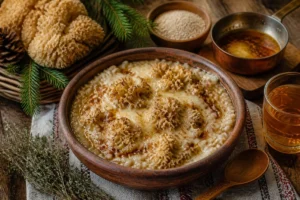
Rain 200g of Stone-Ground Cornmeal into 1L of simmering salted water. Whisk constantly for 5 minutes, then switch to a wooden spoon. Cook over low heat for 40 minutes. Finished polenta should be "porous" and pull away from the sides of the pot.
Stage 2: The Forest Sauté
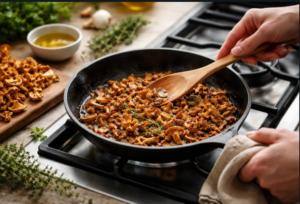
In a hot pan with clarified butter, sauté 300g of Yellow Foot chanterelles. Once they release their apricot aroma, deglaze with a splash of Marsala or white wine. The sweetness of Marsala provides a bridge to the corn's natural sugars.
Stage 3: The Creamy Mantecatura
Beat 50g of cold butter, 50g of grated Parmigiano-Reggiano, and a teaspoon of Truffle Oil (or fresh shavings) into the polenta. The texture should be silken and slowly flowing (all'onda).
Stage 4: The 64°C Poached Egg
Poach 2 extra-large eggs in barely simmering water with a dash of vinegar for 4 minutes. The white must be set, but the yolk must remain a liquid "golden orb."
Stage 5: The Final Assembly
Spoon the polenta into shallow bowls. Create a well in the center for the poached egg. Surround the egg with a generous mound of the sautéed Yellow Foot mushrooms. Finish with a final crack of white pepper and a drizzle of the mushroom pan juices.
Substitutions & Variations: The Luxury Palette
The Grain: Use White Cornmeal for a more delicate, floral profile that emphasizes the truffle.
The Fat: Replace butter with Mascarpone for an ultra-creamy, dessert-like richness.
The Mushroom: For an intense "Double-Forest" hit, add a handful of Dried Yellow Foot ground into the poaching water of the polenta.
Pro Technique: The “Marsala Glaze”
When deglazing the mushrooms with Marsala, let the liquid reduce until it becomes a syrupy glaze that coats the mushrooms. This concentrated "sugar-acid" film acts as a flavor-trap, ensuring the mushroom's delicate apricot scent isn't lost when mixed into the heavy, buttery polenta.
The Umami Secret: Lecithin and Volatile Fixation
The **Egg Yolk** is rich in Lecithin, a powerful emulsifier. The **Yellow Foot** contains Linalool (apricot) and Beta-Ionone. In a hot dish, these aromatics usually evaporate quickly. However, the lecithin in the runny yolk "grabs" these volatile molecules, creating an **Aromatic Suspension**. This is why the flavor of the mushroom seems to "explode" only once the yolk is broken and mixed in.
The Art of Pairing: The Sommelier’s Selection
Sommelier's Choice: A Soave Classico or a rich Chardonnay from Alto Adige. The buttery notes of the wine mirror the polenta, while the floral acidity cuts through the yolk.
Non-Alcoholic Alternative:Warm Oat Milk Latte with a pinch of Turmeric. The creaminess and earthy turmeric resonate with the corn and truffle profile.
Storage & Reheating
Polenta becomes firm as it cools. **Pro Tip:** If you have leftovers, pour the polenta into a rectangular tin to set. The next day, slice and fry the polenta cakes in butter until crispy. **Warning:** The poached egg must be cooked and eaten immediately; do not attempt to store or reheat.
Ancestral Nutrition
Corn polenta is naturally Gluten-Free and provides Complex Carbohydrates. Yellow Foot chanterelles are a rare source of Vitamin D2 and Potassium. In Venetian tradition, this meal was the "Winter Sun," believed to give the body the warmth and sustained energy needed to combat the damp Adriatic fog.
Micro-FAQ
Q: Why does polenta take 40 minutes? A: It takes that long for the tough corn starches to fully hydrate and gelatinize, turning the texture from "gritty" to "velvety."
Q: Can I use instant polenta? A: Technically yes, but you will lose the deep, toasted-corn flavor and the structural integrity that makes the pairing with wild mushrooms successful.
Q: Is truffle oil "fake"? A: Most commercial truffle oils use 2,4-dithiapentane (a synthetic aroma). For a professional result, use a high-quality truffle butter or fresh shavings to match the authenticity of the wild chanterelles.
To provide the best experiences, we use technologies like cookies to store and/or access device information. Consenting to these technologies will allow us to process data such as browsing behavior or unique IDs on this site. Not consenting or withdrawing consent, may adversely affect certain features and functions.
Functional
Always active
The technical storage or access is strictly necessary for the legitimate purpose of enabling the use of a specific service explicitly requested by the subscriber or user, or for the sole purpose of carrying out the transmission of a communication over an electronic communications network.
Preferences
The technical storage or access is necessary for the legitimate purpose of storing preferences that are not requested by the subscriber or user.
Statistics
The technical storage or access that is used exclusively for statistical purposes.The technical storage or access that is used exclusively for anonymous statistical purposes. Without a subpoena, voluntary compliance on the part of your Internet Service Provider, or additional records from a third party, information stored or retrieved for this purpose alone cannot usually be used to identify you.
Marketing
The technical storage or access is required to create user profiles to send advertising, or to track the user on a website or across several websites for similar marketing purposes.