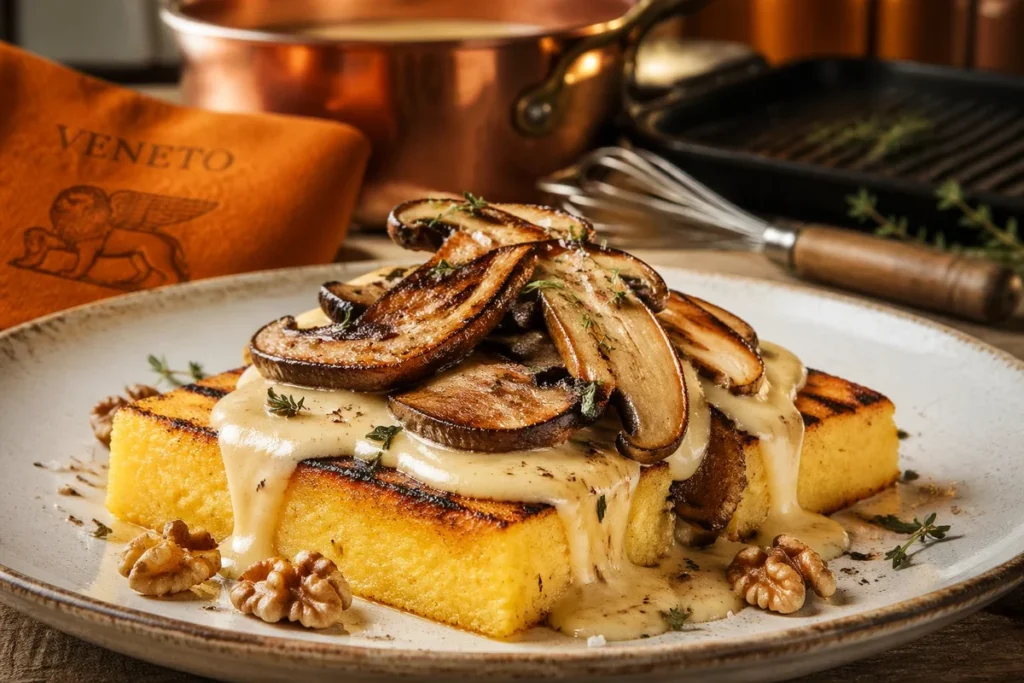
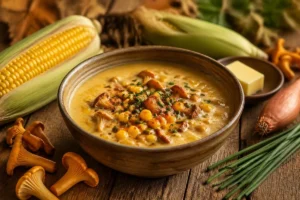
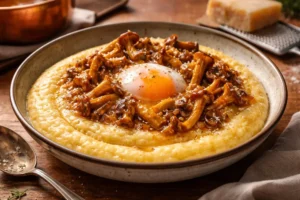
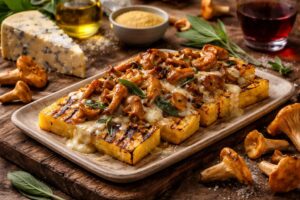
A sophisticated Northern Italian dish featuring charred, wood-grilled slabs of artisanal yellow polenta topped with butter-seared Boletus edulis and a silken fonduta of aged Asiago d'Allevo.
Venetian Grilled Polenta & Porcini
The Golden Plains of Veneto: A Dialogue of Corn, Cave, and Canopy
The Historical Prelude: The Granary of the Serenissima
In the territory of the Venetian Republic, specifically the foothills of the Altopiano di Asiago, corn (maize) arrived in the 16th century and forever changed the culinary landscape. Historically, Polenta was the lifeblood of the rural population. While the coastal Venetians feasted on spices and seafood, the mountain communities mastered the art of the Boletus edulis and the long-aged cheeses of the alpine pastures.
The Asiago Fonduta is a modern refinement of the traditional "Polenta e Schiz." Historically, the cheese was melted directly on top of the polenta slices over an open fire. By the 19th century, this had evolved into a sophisticated fonduta (cream emulsion), which provided a silken bridge between the smoky, grilled corn and the iron-rich intensity of the mountain Porcini. To eat this dish in the Veneto is to experience the "Verticality of Flavor"—from the flat, sun-drenched cornfields of the Po Valley to the dark, high-altitude spruce forests of the Dolomites.
⏱ Time: 45 Mins + Cooling
📊 Difficulty: Intermediate / Traditional
🔥 Calories: 360 kcal / Serving
🍄 Type: Meaty Alpine Porcini
Culinary Philosophy: The “Triple-Golden” Contrast
Venetian philosophy centers on Textural Juxtaposition. We have three shades of "gold": the yellow, charred corn; the pale, creamy cheese; and the bronze-seared mushroom. The goal is to maximize the surface area of the polenta to create a crisp "skin" that can support the heavy, liquid weight of the fonduta and the fatty mushrooms without becoming soggy.
Sensory & Foraging Profile: The Spruce & Limestone Terroir
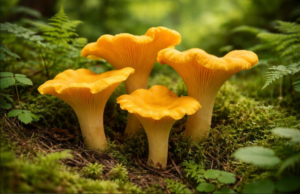
Latin Nomenclature:Boletus edulis (The Venetian "Brisa"). Terroir Analysis: Porcini from the Belluno Dolomites grow in limestone-heavy, mineral-rich soils under Norway Spruce. This results in a mushroom with a distinct "resinous" aftertaste and a higher concentration of **guanylic acid**. This "meatiness" is essential to stand up to the sharp, piquant notes of the aged Asiago cheese.
Selection Protocol: We use "Large-Stem" specimens. The stems are sliced into 1cm thick medallions, which are grilled alongside the polenta to achieve a smoky, wood-fired char that echoes the traditional mountain lodges (rifugi).
Essential Equipment
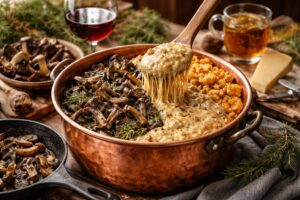
🔸 Copper Paiolo (Optional): The traditional round-bottomed pot for cooking polenta, ensuring even heat and a perfect "crust."
🔸 Grill Pan or Charcoal Grill: To achieve the essential "smoke-lines" on the polenta and mushrooms.
🔸 Balloon Whisk: To ensure the fonduta remains a stable, silken emulsion.
The Master Recipe: The Venetian Hearth
Stage 1: The Polenta Foundation
Cook 250g of coarse-ground yellow cornmeal in 1 liter of salted water for 40 minutes, stirring constantly. Pour onto a flat tray (2cm thickness) and let it cool until completely firm. Cut into rectangles or triangles.
Stage 2: The Asiago Fonduta
In a double boiler, melt 150g of grated Asiago d'Allevo (Mezzano) with 100ml of heavy cream and 1 egg yolk. Whisk constantly at a low temperature (below 70°C) until you have a smooth, velvet sauce. Keep warm.
Stage 3: The Wood-Char Sear
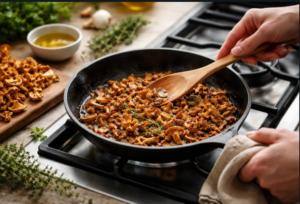
Brush the polenta slices and 400g of thick-cut Porcini with olive oil. Grill over high heat for 3 minutes per side until charred and crispy on the outside but soft in the middle. Season the mushrooms with sea salt and a touch of wild mountain thyme.
Stage 4: The Final Assembly
Place two grilled polenta slabs on a plate. Generously pour the Asiago fonduta over them. Pile the grilled Porcini on top. Garnish with a few toasted walnuts for an extra layer of "autumn crunch."
Chef’s Secret: The “Polenta Crust” Rule
For the best results, cook the polenta the day before. Resting the polenta in the fridge overnight allows the starches to retrograde, creating a much more resilient structure that "crisps" up significantly better on the grill than freshly made, cooled polenta. It also allows the corn flavor to "ripen" and deepen.
The Umami Secret: Maillard-Cheese Synergy
Grilled polenta creates specific **Pyrazines** (roasted corn aroma). When these meet the **Glutamates** of the charred Porcini and the **Free Amino Acids** in the aged Asiago cheese, they trigger a "Compound Umami" response. The fat in the fonduta acts as a flavor anchor, holding the smoky, resinous notes of the mushroom on the palate for a prolonged duration.
The Art of Pairing
Sommelier's Selection: A structured white wine from **Soave Classico (Garganega grape)** or a light red **Bardolino**. The minerality and acidity of these Venetian wines cut through the richness of the cheese and corn.
Non-Alcoholic: A warm, roasted barley tea (Caffè d'Orzo) with a touch of honey.
Micro-FAQ
Q: Can I use instant polenta? A: You can, but it lacks the depth and "grit" of traditional stone-ground cornmeal. For a heritage dish like this, the texture of artisanal polenta is half the experience.
Q: My fonduta is stringy! A: You overheated it. Cheese proteins tighten and separate if they go above 75°C. Always use a double boiler and keep the heat gentle and consistent.
The Porcini Directory: Global Names for Boletus edulis
The King Bolete, or simply Porcini, is arguably the most recognized wild mushroom in the culinary world. Its linguistic variety reflects its presence in forests from the Alps to the Himalayas:
Language
Regional & Folk Names
Expert Insights
Italian
Porcino, Brisa, Fungo di faggio
"Porcini" (little pigs) is the global trade name.
French
Cèpe de Bordeaux, Gros pied, Polonais
"Cèpe" comes from the Gascon word for trunk/stump.
German
Steinpilz, Herrenpilz, Edelpilz
"Steinpilz" (Stone mushroom) refers to its firm flesh.
To provide the best experiences, we use technologies like cookies to store and/or access device information. Consenting to these technologies will allow us to process data such as browsing behavior or unique IDs on this site. Not consenting or withdrawing consent, may adversely affect certain features and functions.
Functional
Always active
The technical storage or access is strictly necessary for the legitimate purpose of enabling the use of a specific service explicitly requested by the subscriber or user, or for the sole purpose of carrying out the transmission of a communication over an electronic communications network.
Preferences
The technical storage or access is necessary for the legitimate purpose of storing preferences that are not requested by the subscriber or user.
Statistics
The technical storage or access that is used exclusively for statistical purposes.The technical storage or access that is used exclusively for anonymous statistical purposes. Without a subpoena, voluntary compliance on the part of your Internet Service Provider, or additional records from a third party, information stored or retrieved for this purpose alone cannot usually be used to identify you.
Marketing
The technical storage or access is required to create user profiles to send advertising, or to track the user on a website or across several websites for similar marketing purposes.