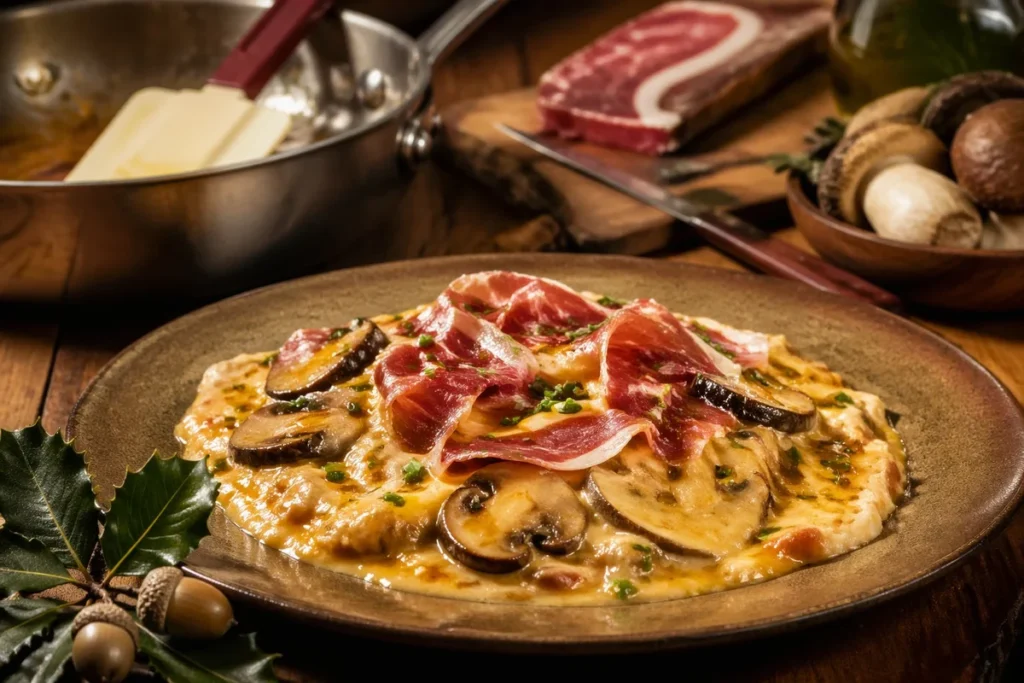
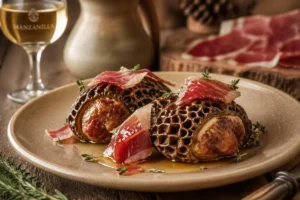
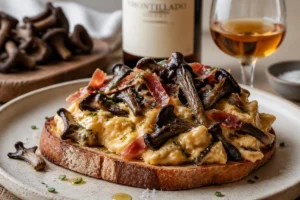
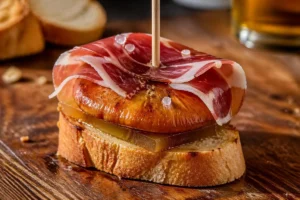
A decadent Spanish scramble featuring wild Boletus edulis and "broken" organic eggs, topped with translucent shavings of 100% Ibérico de Bellota ham and finished with a drop of truffle-infused olive oil.
Castilian “Revuelto de Boletus”
The Golden Scramble: Acorn-Fed Luxury and Forest Gold
The Historical Prelude: The Dehesa and the Monastery Kitchen
In the vast **Dehesas** (oak grasslands) of Castile and Extremadura, a unique ecosystem exists where the **Ibérico pig** and the Boletus edulis share the same soil. Historically, the Revuelto was a humble monastery dish, designed to make the most of the daily egg collection and the seasonal mushroom forage. However, when the pigs began their Montanera (the acorn-fattening season), the foragers realized that the nutty, oleic acid-rich fat of the **Jamón Ibérico** was the molecular twin of the Porcini's aroma.
The modern Castilian *Revuelto* is far from a standard breakfast scramble. It is a dish of high technicality where the eggs are treated as a silken custard rather than a solid mass. By adding the **Jamón Ibérico de Bellota** (100% acorn-fed) at the very last second, the ham doesn't cook; instead, its fat melts into the warm eggs and mushrooms, creating a "living" sauce. This dish represents the soul of Central Spain—a landscape where the drought-resistant oaks provide both the acorns for the world's finest ham and the roots for its finest fungi.
⏱ Time: 20 Minutes
📊 Difficulty: Intermediate / Texture Control
🔥 Calories: 340 kcal / Serving
🍄 Type: Fresh Spanish "Boleto"
Culinary Philosophy: The “Baveuse” Texture
Spanish philosophy for the Revuelto is centered on Creaminess without Cream. We do not use dairy. The creaminess comes from the suspension of liquid egg yolk and the rendered fat of the ham and mushrooms. The goal is a *baveuse* state (slightly runny or "drooling"), where the mushrooms are suspended in a golden, semi-liquid cloud.
Sensory & Foraging Profile: The Holm Oak & Granite Terroir
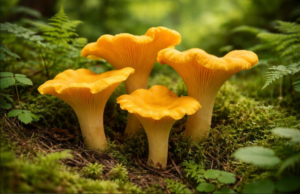
Latin Nomenclature:Boletus edulis (The Castilian "Boleto"). Terroir Analysis: Porcini from the Sierra de Guadarrama grow in high-altitude, granite-sandy soils under Holm Oak (Quercus ilex). This results in a mushroom with a lower water content and a higher concentration of **pyrazines**, giving them a "roasted" or "toasted" scent that perfectly matches the nutty flavor of the acorn-fed ham.
Selection Protocol: We use "Intermediate Buttons." We slice them into very thin vertical sections (2mm). Thin slicing is crucial here because the eggs cook in less than 2 minutes; the mushrooms must be able to achieve a perfect sautéed texture in that same window.
Essential Equipment
🔸 Non-Stick Pan or Polished Carbon Steel: To prevent the egg proteins from sticking and tearing.
🔸 Silicone Spatula: For the constant, gentle folding movement required for a custard-like texture.
🔸 Ham Knife: For slicing the Jamón Ibérico into translucent, "breath-thin" ribbons.
The Master Recipe: The Castilian Scramble
Stage 1: The Mushroom Sauté
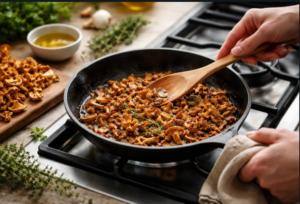
In a medium pan with extra virgin olive oil, sauté 300g of thinly sliced Porcini over medium-high heat. Add 1 whole garlic clove (to be removed later). Cook until the mushrooms are golden and have absorbed the oil. Season with sea salt.
Stage 2: The Egg Preparation
Whisk 4 organic eggs in a bowl just until the yolks and whites are combined (do not over-beat, as air bubbles will ruin the silken texture). Season the eggs lightly, keeping in mind that the Jamón will add significant saltiness later.
Stage 3: The “Low-and-Slow” Scramble
Lower the heat to minimum. Remove the garlic. Pour the eggs over the mushrooms. Using the spatula, move the eggs constantly in a figure-eight motion. As soon as small curds begin to form and the eggs look like a thick sauce (approx. 90 seconds), remove from heat immediately.
Stage 4: The Ibérico Infusion
Place the Revuelto on warm plates. Drape 40g of Jamón Ibérico de Bellota ribbons over the top. The residual heat of the eggs will turn the ham's fat translucent and release its acorn aroma. Finish with a few drops of truffle oil or a sprinkle of chives.
Chef’s Secret: The “Off-Heat” Finish
The secret to a world-class Revuelto is to stop cooking when the eggs look 70% done. The residual heat of the sautéed mushrooms and the pan will carry the eggs to the perfect 100% "baveuse" state during the 30 seconds it takes to move them to the plate. If they look "done" in the pan, they will be overcooked and dry on the plate.
The Umami Secret: Oleic Acid & Glutamate Synergies
Jamón Ibérico de Bellota is unique because its fat is primarily **Oleic Acid** (the same as olive oil) due to the pig's diet of acorns. When this "liquid gold" fat melts and coats the **Glutamates** of the Porcini, it creates a lipid-bridge that allows the flavor to linger on the palate for a long time. The lecithin in the egg yolk acts as an emulsifier, binding the fat of the ham and the umami of the mushroom into a single, coherent flavor experience.
The Art of Pairing
Sommelier's Selection: A chilled **Fino** or **Manzanilla Sherry**. The saline, bone-dry character of the Sherry is the only thing that can cut through the intense richness of the eggs and Ibérico fat.
Non-Alcoholic: A sparkling mineral water with a twist of lemon and a drop of alcohol-free bitters.
Micro-FAQ
Q: Can I use regular Serrano ham? A: You can, but Serrano is much saltier and lacks the buttery, acorn-fed fat of Ibérico. If using Serrano, use less salt in the eggs and don't expect the same "melting" texture.
Q: Why remove the garlic? A: In a Revuelto, we want the *perfume* of garlic in the oil, but not the physical "crunch" of garlic bits, which would distract from the silken texture of the eggs.
The Porcini Directory: Global Names for Boletus edulis
The King Bolete, or simply Porcini, is arguably the most recognized wild mushroom in the culinary world. Its linguistic variety reflects its presence in forests from the Alps to the Himalayas:
Language
Regional & Folk Names
Expert Insights
Italian
Porcino, Brisa, Fungo di faggio
"Porcini" (little pigs) is the global trade name.
French
Cèpe de Bordeaux, Gros pied, Polonais
"Cèpe" comes from the Gascon word for trunk/stump.
German
Steinpilz, Herrenpilz, Edelpilz
"Steinpilz" (Stone mushroom) refers to its firm flesh.
To provide the best experiences, we use technologies like cookies to store and/or access device information. Consenting to these technologies will allow us to process data such as browsing behavior or unique IDs on this site. Not consenting or withdrawing consent, may adversely affect certain features and functions.
Functional
Always active
The technical storage or access is strictly necessary for the legitimate purpose of enabling the use of a specific service explicitly requested by the subscriber or user, or for the sole purpose of carrying out the transmission of a communication over an electronic communications network.
Preferences
The technical storage or access is necessary for the legitimate purpose of storing preferences that are not requested by the subscriber or user.
Statistics
The technical storage or access that is used exclusively for statistical purposes.The technical storage or access that is used exclusively for anonymous statistical purposes. Without a subpoena, voluntary compliance on the part of your Internet Service Provider, or additional records from a third party, information stored or retrieved for this purpose alone cannot usually be used to identify you.
Marketing
The technical storage or access is required to create user profiles to send advertising, or to track the user on a website or across several websites for similar marketing purposes.