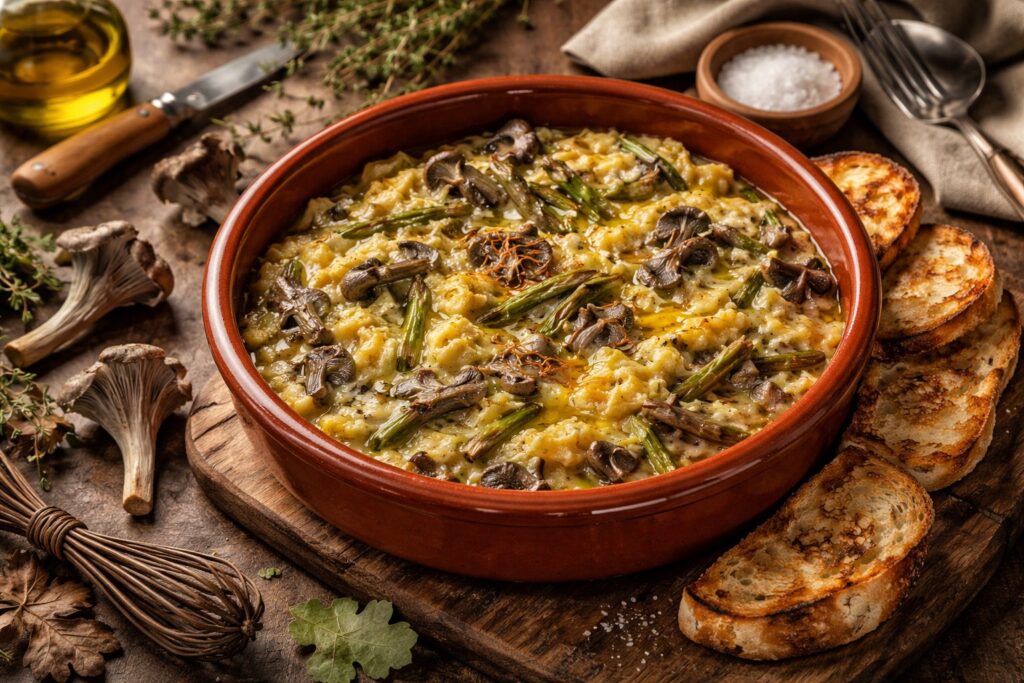
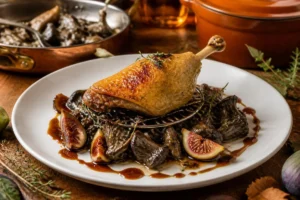
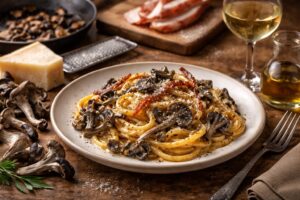
A rustic Pyrenean masterclass in egg emulsion featuring the peppery Cantharellus cinereus and the bitter snap of forest asparagus.
Spanish Revuelto de Setas
The Pyrenean Scramble and the Mineral Echo of the High Sierras
The Historical Prelude: The Shepherd’s “Broken” Breakfast
The Revuelto is the crown jewel of the Spanish mezze or tapas tradition, representing a technical departure from the firm, structured French omelet. Originating in the high-altitude pastures of the Pyrenees and the Sierra de Guadarrama, the dish was the primary sustenance of transhumance shepherds. Historically, these mountain men carried only the basics: eggs from their village, a flask of Arbequina olive oil, and a knife for gathering whatever the forest provided.
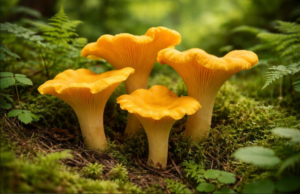
In the late autumn, when the Cantharellus cinereus (Gray Chanterelle) appeared in the damp leaf litter of the oak and beech stands, it became the centerpiece of the "Revuelto de Temporada." The shepherds noted that the Gray Chanterelle—which they called Trompeta Pequeña—possessed a natural resilience; it did not "weep" liquid into the eggs, allowing the scramble to remain creamy and custard-like.
By the early 20th century, the dish ascended into the royal hunting lodges of Aragon and Navarre, where it was refined by the addition of Espárragos Trigueros (Wild Asparagus). The bitter, metallic snap of the asparagus combined with the peppery, ashen notes of the Gray Chanterelle created a flavor profile that defined the Iberian forest palate. Today, a professional Revuelto is a test of patience; it is not a "fry," but a gentle, thermal suspension of protein and mushroom essence, requiring a heat control so precise it borders on the meditative.
Narrative Intro: In a true Spanish Revuelto, the eggs should never see "fire"—only warmth. Our philosophy for the Gray Chanterelle preparation is "Custardization." We use a low-and-slow technique to ensure the eggs form a silken, continuous ribbon that envelopes the mushrooms. The Gray Chanterelle is the perfect partner here because its firm, chitinous texture provides a "snap" that contrasts with the luxurious softness of the egg curd.
Sensory & Foraging Profile: The Arid-Mist and Schist Terroir
The Cantharellus cinereus of the Pyrenean foothills is shaped by the metamorphic schist soils and the drastic temperature shifts between day and night. This "thermal stress" produces a mushroom with a concentrated peppery finish and a high density of aromatic phenols. Their scent is a sophisticated mixture of burnt thyme, wet stone, and dried black currants.
Ethical Harvesting & The "Blade-and-Brush" Ritual: In Spain, we follow the "Navaja" protocol—using a folding knife to clean the base of the mushroom before it ever touches the basket. Because Gray Chanterelles grow in dense, ashy clusters, we practice "Thinning the Colony," harvesting only the outer specimens to allow the central "mother" mycelium to retain its moisture during the arid Spanish autumn. We use hog-hair brushes to sweep the gills, ensuring the mineral-rich spores remain in the forest to seed the following year's crop.
Essential Equipment: The Iberian Station
Earthenware Cazuela: A traditional clay pot that retains "soft heat" better than any metal pan.
Silicon Spatula: To ensure a continuous, gentle fold without breaking the delicate mushroom caps.
Whisk of Natural Twigs: Traditionally used to aerate eggs without over-beating (A professional secret for texture).
Fine Mandoline: To slice the wild asparagus into paper-thin disks for rapid cooking.
Master Recipe: Gray Chanterelle Revuelto
Stage 1: The Infusion of the Liquid Gold
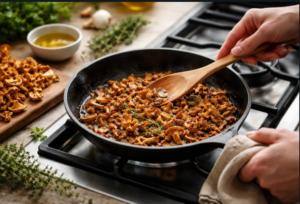
In a Cazuela or heavy skillet, heat 40ml of Extra Virgin Arbequina Olive Oil. Add 200g of fresh, whole Gray Chanterelles and 100g of wild asparagus tips. Sauté over medium heat until the mushrooms are glossy and the asparagus has brightened to a vibrant green. Season with a pinch of Flor de Sal.
Stage 2: The Egg Tempering
Crack 4 large organic eggs into a bowl. Break the yolks with a fork but **do not whisk**. You want visible streaks of white and gold. Add a tablespoon of heavy cream to stabilize the proteins and prevent them from seizing under the heat.
Stage 3: The Thermal Descent (The Scramble)
Reduce the heat to its absolute lowest setting. Pour the egg mixture over the mushrooms. Wait 30 seconds for the edges to set slightly. Using the spatula, begin a slow, circular motion, "pulling" the cooked egg from the edges toward the center. The mushrooms should be "suspended" in the liquid egg like fossils in amber.
Stage 4: The Residual Finish
When the eggs are 80% cooked—looking like a thick, glossy custard—remove the pan from the heat entirely. The residual heat of the Cazuela will finish the cooking. The final texture should be "babosa" (slightly runny/wet), which is the hallmark of a professional Spanish Revuelto.
Stage 5: The Presentation
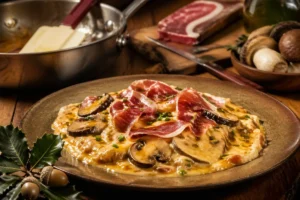
Serve immediately on slices of charred Pan de Cristal. Garnish with a final drizzle of raw olive oil and a few threads of Saffron to enhance the golden hue of the eggs and the ashen contrast of the chanterelles.
Substitutions & Variations: The Luxury Palette
The Oil: Use Smoked Olive Oil (Aceite Ahumado) to amplify the natural "ashen" notes of the Gray Chanterelle.
The Meat: Add finely diced **Jamón Ibérico de Bellota** at Stage 1 for a nutty, acorn-infused fat profile.
The Acid: Squeeze a few drops of **Amontillado Sherry** over the mushrooms just before adding the eggs for an oxidative, walnut finish.
Pro Technique: The “Off-Heat Mantecatura”
To achieve the legendary silkiness of a Michelin-starred Revuelto, perform the final 2 minutes of cooking by moving the pan **on and off** the burner every 10 seconds. This prevents the proteins from reaching the "coagulation point" where they release water, ensuring the umami-rich fats from the Gray Chanterelle remain trapped within the egg emulsion.
The Umami Secret: Asparagine and Glutamate Coupling
Wild asparagus is incredibly high in Asparagine, an amino acid that acts as a natural flavor enhancer. When this meets the Free Glutamates in the Gray Chanterelle and the **Lipids** in the egg yolks, it creates a "Savory Multiplier." The bitterness of the asparagus resets the palate after every bite, preventing "umami fatigue" and allowing the peppery notes of the mushroom to feel fresh and vibrant throughout the meal.
The Art of Pairing: The Sommelier’s Selection
Sommelier's Choice: A Manzanilla Sherry. Its bone-dry, saline character and slight floral notes are the only match for the combination of egg richness and forest bitterness.
Non-Alcoholic Alternative: A Warm Infusion of Toasted Barley and Thyme. The grain's roasted profile mirrors the bread and the mushroom, while the thyme echoes the Pyrenean scrubland.
Storage & Reheating: Professional Restoration
A Revuelto is a "live" dish and cannot be stored. Reheating will destroy the delicate protein structure, turning the silken custard into a dry, rubbery mass. If you must use leftovers, fold them into a Croquette mixture with bechamel and fry them—the only way to restore the lost texture.
Ancestral Nutrition: The Iberian Vitalizer
The Gray Chanterelle is an exceptional source of Vitamin B12 and Iron. Asparagus contributes Folate and Vitamin K. Historically, this dish was given to mountain villagers during the "hunger gap" of late autumn to provide a concentrated burst of fat-soluble vitamins and minerals to prepare for the winter freeze.
Micro-FAQ
Q: Why did my eggs turn gray? A: You likely overcooked the mushrooms or used an aluminum pan. Gray Chanterelles contain high levels of iron; use stainless steel, clay, or seasoned cast iron to prevent discoloration.
Q: Can I use garden asparagus? A: Yes, but you will lose the specific "wild bitterness" that defines the Pyrenean profile. If using garden asparagus, add a pinch of mustard powder to compensate.
Q: Why no milk? A: Milk adds water, which causes the eggs to steam rather than emulsify. A professional Spanish Revuelto relies on the fat of the oil and the richness of the yolk alone.
The Ashen Lexicon: Global Names for Cantharellus cinereus
The Ashen Chanterelle is a sophisticated relative of the golden chanterelle, prized for its deep, fruity aroma. Its regional names often describe its elegant grey-to-black coloration and trumpet-like hollow stem:
To provide the best experiences, we use technologies like cookies to store and/or access device information. Consenting to these technologies will allow us to process data such as browsing behavior or unique IDs on this site. Not consenting or withdrawing consent, may adversely affect certain features and functions.
Functional
Always active
The technical storage or access is strictly necessary for the legitimate purpose of enabling the use of a specific service explicitly requested by the subscriber or user, or for the sole purpose of carrying out the transmission of a communication over an electronic communications network.
Preferences
The technical storage or access is necessary for the legitimate purpose of storing preferences that are not requested by the subscriber or user.
Statistics
The technical storage or access that is used exclusively for statistical purposes.The technical storage or access that is used exclusively for anonymous statistical purposes. Without a subpoena, voluntary compliance on the part of your Internet Service Provider, or additional records from a third party, information stored or retrieved for this purpose alone cannot usually be used to identify you.
Marketing
The technical storage or access is required to create user profiles to send advertising, or to track the user on a website or across several websites for similar marketing purposes.