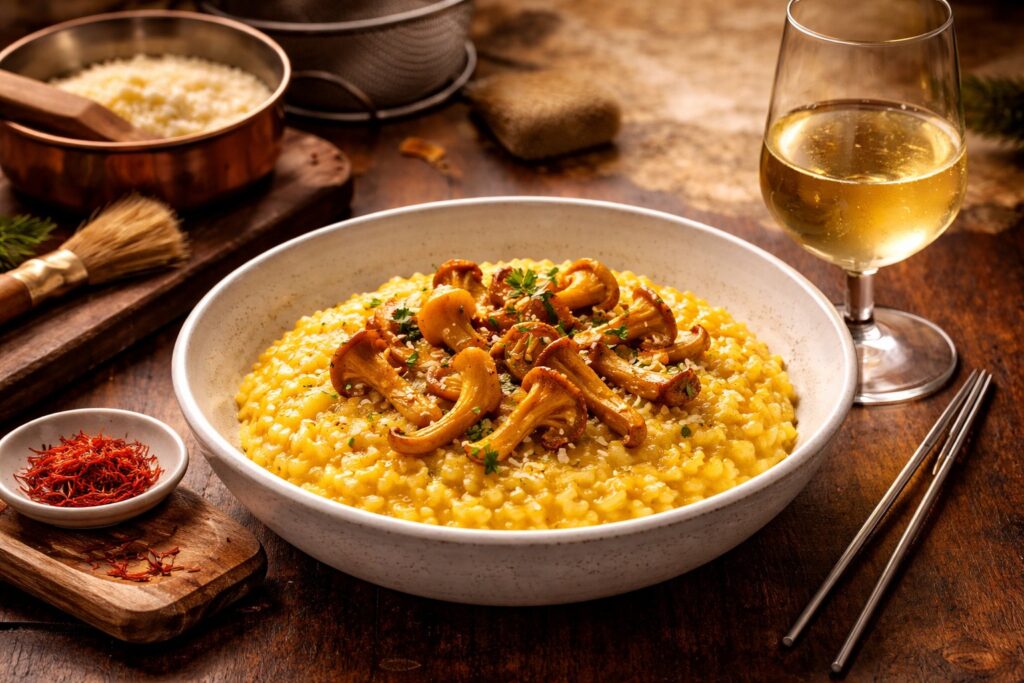
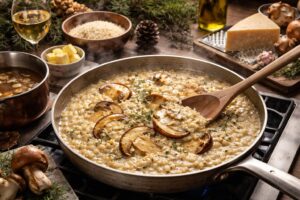
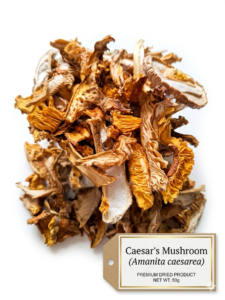
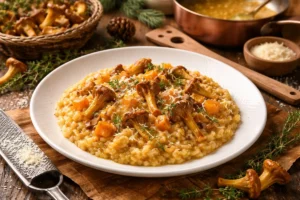
A Venetian saffron risotto with Yellow Foot chanterelles. An exploration of the Silk Road's historical ties, mineral fungi, and the creamy architecture of Acquerello rice.
The Historical Prelude: The Gold of the Serenissima
During the zenith of the Venetian Republic, the city served as the ultimate crucible where the exotic spices of the East met the raw bounty of the European hinterland. Risotto dell'Oro (Golden Risotto) was never merely a meal; it was a political statement of wealth, combining precious Iranian saffron with the "forest gold" of the northern Italian highlands—the Yellow Foot Chanterelle (Craterellus lutescens).
Legend suggests that the Venetian Doges specifically requested this dish during winter banquets, as the mushroom's vibrant amber hue perfectly mimicked the glint of Venetian ducats. The culinary evolution of this risotto is intrinsically linked to the Veneto region's mastery of rice, specifically the all'onda technique ("on the wave")—a term coined by Venetian masters to describe a texture that remains fluid and rhythmic, mirroring the movements of the lagoon itself.
By the late 19th century, the Artusi school of Italian cooking refined the technique further, recognizing that the apricot-like esters in the Yellow Foot were natural chemical partners to the floral, medicinal notes of saffron. Today, this dish stands as a bridge between Venice's maritime history and the mystical pine forests of the Dolomites, representing the highest form of Cucina Povera transformed into pure, technical luxury.
Narrative Intro: Our philosophy for Risotto dell'Oro is "Chromatic Synergy." The Yellow Foot is not a mere garnish; its natural pigments are extracted during the toasting phase to reinforce the saffron's glow. The goal is to achieve a perfect emulsion between the rice starch and the mushroom's aromatic oils, creating a silky "wave" that coats the palate without overwhelming it.
Sensory & Foraging Profile: The Limestone and Needle Terroir
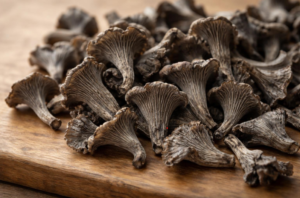
Craterellus lutescens in Northern Italy flourishes on calcareous soils beneath larch and pine. This specific terroir provides the mushroom with a mineral, almost flinty finish that balances its high concentration of apricot-like compounds. They are far more delicate than the standard Girolle, with a hollow stem that makes them extremely fragile and exceptionally fast to cook.
Ethical Harvesting & The "Golden Thread" Protocol: Professional Italian foragers use camel-hair brushes to clean the mushrooms in situ. The Yellow Foot is snipped at the base without disturbing the moss, preserving the moisture of the mycelial network. We never harvest specimens with a cap diameter under 2cm, ensuring the spores have reached full maturity before the mushroom is removed from the forest floor.
Essential Equipment: The Venetian Station
Rame (Copper Pan): For absolute thermal control, crucial for the steady release of rice starch.
Spatola di Legno (Wooden Spatula): Specifically one with a central hole to increase aeration during the mantecatura.
Fine Mesh Sieve: To strain the broth to a point of absolute clarity.
Precision Tweezers: For the delicate placement of the trumpeted mushrooms atop the finished "wave."
Master Recipe: Risotto dell’Oro
Stage 1: The “Golden Broth” Infusion
Prepare a light vegetable stock. In a small portion of the warm broth, steep 0.5g of Saffron threads. Let rest for at least 20 minutes. Add 50g of dried Yellow Foot chanterelles to the main stock to provide a deep, foundational forest note.
Stage 2: Tostatura (The Toasting)
Heat your copper pan without oil. Add 320g of Acquerello rice (aged). The heat must "open" the grain; it should be hot to the touch but not change color. This step is vital to seal the starch and ensure the rice remains al dente.
Stage 3: Aromatic Extraction
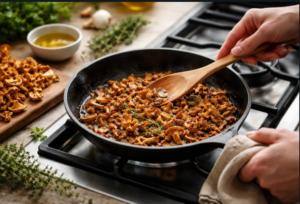
Deglaze with 100ml of dry white wine (Pinot Grigio). Once the alcohol evaporates, add 300g of fresh Yellow Foot chanterelles. The mushrooms will begin to release their aromatic oils directly into the grain.
Stage 4: Cooking “All’Onda”
Begin adding the hot broth ladle by ladle, stirring constantly. Halfway through the process, add the saffron infusion. The rice should cook for approximately 16-18 minutes until it achieves a perfect bite.
Stage 5: La Mantecatura
Remove from heat. Add 50g of cold, cubed butter and 60g of finely grated Grana Padano Riserva. Vigorously shake the pan and stir (the all'onda movement) until a creamy, golden emulsion forms.
Substitutions & Variations: The Luxury Palette
The Rice: If Acquerello is unavailable, use Vialone Nano—it absorbs more liquid and is the traditional choice for the Venetian style.
The Cheese: For a sharper finish, substitute a portion of the Grana with Piave Vecchio DOP.
The Fat: Use bone marrow instead of butter for the initial phase to reach an authentic Northern Italian depth.
Pro Technique: The Cold Mantecatura
The secret of Italy's top risotterias is the use of ice-cold butter. The thermal shock between the piping hot rice and the frozen fat helps create a stable, micro-emulsion faster, giving the risotto its characteristic gloss without making it feel heavy or greasy on the tongue.
The Umami Secret: Crocetin and Glycosidic Bonding
Saffron contains Crocetin, a fat-soluble carotenoid. The Yellow Foot contains specific Glycosides that release fruity aromas upon heating. When combined in the presence of rice starch and butter, these molecules bond to create "Flavor Amplification"—making the saffron taste deeper and the mushroom taste sweeter. It is a biological lock-and-key mechanism for the palate.
The Art of Pairing: The Sommelier’s Selection
Sommelier's Choice: A Soave Classico DOCG (2021). Its volcanic mineral notes and hints of white flowers are a mirror image of the Yellow Foot's terroir.
Non-Alcoholic Alternative: A Chilled Chamomile and Dried Apricot infusion. The floral and stone-fruit notes repeat the dish's profile without the alcohol burn.
Micro-FAQ
Q: Why did my risotto turn into mush? A: You likely used the wrong rice or cooked at too low a temperature. Risotto needs constant agitation and high heat to force the starch out into the broth.
Q: Can I wash the Yellow Foot chanterelles? A: Never! Their hollow stems will act as straws, soaking up water and diluting their delicate apricot scent into a bland liquid.
Q: When is the best time to add the saffron? A: Always at the midpoint of cooking. Too early, and the volatile aromas vanish; too late, and the grains won't be dyed uniformly gold.
To provide the best experiences, we use technologies like cookies to store and/or access device information. Consenting to these technologies will allow us to process data such as browsing behavior or unique IDs on this site. Not consenting or withdrawing consent, may adversely affect certain features and functions.
Functional
Always active
The technical storage or access is strictly necessary for the legitimate purpose of enabling the use of a specific service explicitly requested by the subscriber or user, or for the sole purpose of carrying out the transmission of a communication over an electronic communications network.
Preferences
The technical storage or access is necessary for the legitimate purpose of storing preferences that are not requested by the subscriber or user.
Statistics
The technical storage or access that is used exclusively for statistical purposes.The technical storage or access that is used exclusively for anonymous statistical purposes. Without a subpoena, voluntary compliance on the part of your Internet Service Provider, or additional records from a third party, information stored or retrieved for this purpose alone cannot usually be used to identify you.
Marketing
The technical storage or access is required to create user profiles to send advertising, or to track the user on a website or across several websites for similar marketing purposes.