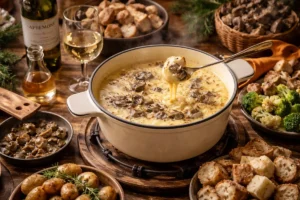
The Historical Prelude: From Peasant Fuel to Chalet Luxury
The Tartiflette is a dish of high-altitude resilience, born in the heart of the Aravis massif in the French Savoie. While its modern name was popularized in the 1980s, its ancestor, la péla, has been the fuel of Alpine shepherds for centuries. Traditionally, it was a simple skillet of potatoes, onions, and the iconic Reblochon AOP—a cheese so creamy it was born from a historical "second milking" to evade 13th-century tax collectors.
The Yellow Foot Chanterelle (Craterellus lutescens) was the aristocratic addition to this rustic frame. In the late 19th century, as the French Alps became the winter playground for the European elite, chefs in Megeve and Chamonix began replacing the traditional salt pork with the "Gold of the Pine Slopes." They discovered that the mushroom's unique apricot esters acted as a chemical bridge, cutting through the heavy, nutty fats of the Reblochon.
The dish was famously refined by the Bocuse-trained mountain chefs who understood that the Yellow Foot is the only fungus capable of surviving the intense heat of a cheese-gratin without becoming slimy. Today, the Tartiflette aux Chanterelles Jaunes is considered the pinnacle of Cuisine d'Alpage, representing a sophisticated dialogue between the mineral richness of the mountainside and the fermented complexity of high-altitude dairy.
Narrative Intro: This is not a common potato bake; it is an emulsion of forest and farm. Our philosophy for the Tartiflette de Luxe is "Lipid Absorption." We sear the Yellow Feet in butter until they are thirsty, then allow them to "drink" the melting Reblochon cream. The result is a texture where the mushroom is no longer a separate ingredient, but a savory, fruity extension of the cheese itself.
Sensory & Foraging Profile: The Alluvial and Conifer Terroir
The Craterellus lutescens of the Savoie thrives in moist, mossy alluvial fans near mountain streams. This terroir produces a mushroom with a high concentration of Vitamin D and a flavor profile that evokes wet slate, wild apricot, and cold cream. Unlike the European Girolle, its stem is hollow, making it a perfect vessel for carrying heavy sauces.
Ethical Harvesting & The "Snow-Line" Protocol: In the Alps, we follow the "Snow-Line" rule—harvesting only until the first frost touches the forest floor. We use soft-bristle brushes to remove pine needles, as the hollow funnel of the Yellow Foot can trap debris. We strictly leave the "Elder Clusters" (specimens over 7cm) untouched to ensure the genetic longevity of the patch.
Essential Equipment: The Alpine Kitchen
Mandoline: For slicing Belle de Fontenay potatoes to a precise 3mm thickness for even cooking.
Cast-Iron Cocotte: For superior heat retention and a perfect "cheese crust" (la croûte).
Copper Sauté Pan: For the high-heat "shock" required to sear the mushrooms.
Cheese Wire: To slice the Reblochon horizontally without crushing its aerated, buttery core.
Master Recipe: Alpine Tartiflette de Luxe
Stage 1: The Potato Par-Boil
Peel 800g of waxy potatoes. Slice into 3mm rounds. Boil in salted water for exactly 8 minutes. They must remain firm (al dente) to survive the final bake without turning into mash.
Stage 2: The Mushroom & Onion “Suhage”
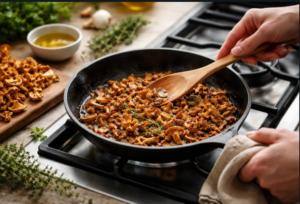
Sauté 2 sliced shallots and 1 clove of garlic in 30g of butter. Add 400g of fresh Yellow Foot chanterelles. Increase heat to high and sear until the mushrooms are slightly crisped at the edges. Deglaze with 50ml of Apremont or another dry Savoyard white wine.
Stage 3: The Cream Infusion
Add 200ml of Crème Fraîche to the mushroom pan. Season with nutmeg, white pepper, and a very small amount of salt (the cheese is salty). Simmer for 2 minutes to allow the mushroom's apricot notes to infuse the fat.
Stage 4: The Construction
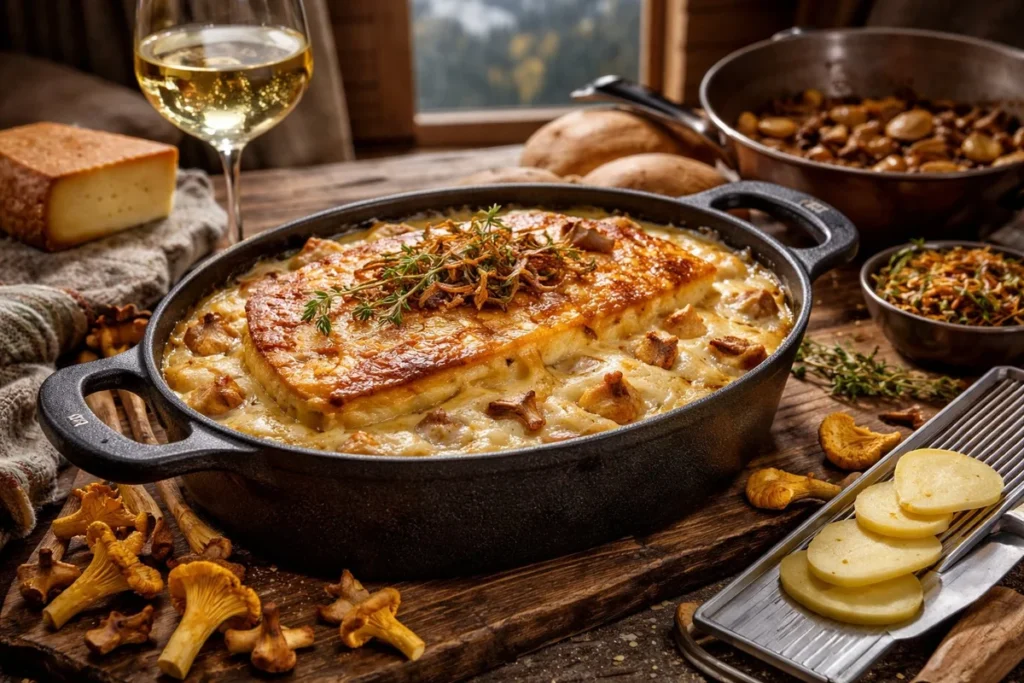
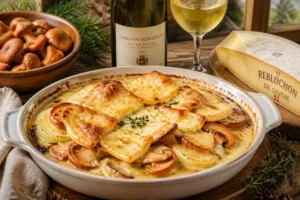
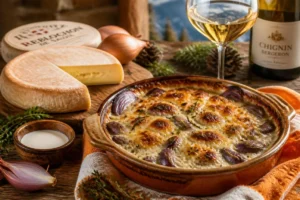
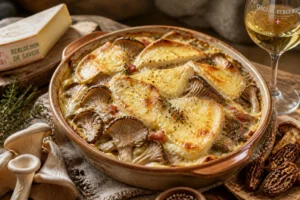
Layer the potatoes and the mushroom-cream mixture in a buttered baking dish. Slice one whole Reblochon de Savoie AOP horizontally. Place both halves, rind-side up, on top of the potatoes. This is the technical "Savoie Secret"—the rind protects the cheese as it melts, creating a golden, toasted crust.
Stage 5: The Gratination
Bake at 200°C for 20 minutes until the cheese is bubbling and the rind is a deep, crackling amber. Let rest for 5 minutes before serving to allow the emulsion to set.
Substitutions & Variations: The Luxury Palette
The Cheese: If Reblochon is unavailable, use Vacherin Mont d'Or for an even more liquid, resinous finish.
The Acid: Use a dash of Apple Cider Vinegar in the mushrooms to emphasize their natural fruitiness.
The Garnish: Top with crispy fried leeks to add a structural contrast to the velvety cheese and soft mushrooms.
Pro Technique: The “Rind-Steam” Method
By placing the Reblochon rind-side up, you create a natural "oven" for the cheese. The steam from the potatoes and mushrooms is trapped beneath the rind, forcing the cheese to melt downwards and fully encapsulate every potato slice in a cheesy-mushroom lacquer. This prevents the top from drying out and ensures every bite is perfectly moist.
The Umami Secret: Casein and Octenol Synergy
The **Reblochon** rind is rich in Brevibacterium linens, which produce complex, pungent sulfur compounds. The **Yellow Foot** contains high levels of 1-octen-3-ol (the primary "mushroom" scent). When these interact under high heat, they create a savory "super-compound" that mimics the taste of aged meats. This is why a vegetarian Yellow Foot Tartiflette feels just as robust and "meaty" as the original pork version.
The Art of Pairing: The Sommelier’s Selection
Sommelier's Choice: A Chignin-Bergeron (Savoie). Made from the Roussanne grape, it has apricot and honey notes that perfectly mirror the Yellow Foot Chanterelle.
Non-Alcoholic Alternative: A Sparkling Apple and Thyme Juice. The crisp acidity and herbal notes cut through the cheese beautifully.
Micro-FAQ
Q: Why do I put the cheese rind-side up? A: It acts as a shield, letting the cheese melt into the dish while the rind itself becomes a crispy, flavorful delicacy.
Q: Can I use Golden Chanterelles? A: They are less "fruit-forward" and can get lost in the heavy cheese. The Yellow Foot's intense aroma makes it technically superior for this dish.
Q: Is the rind of the Reblochon edible? A: Absolutely. It is the most flavorful part of the cheese and provides the essential "funk" to the dish.
To provide the best experiences, we use technologies like cookies to store and/or access device information. Consenting to these technologies will allow us to process data such as browsing behavior or unique IDs on this site. Not consenting or withdrawing consent, may adversely affect certain features and functions.
Functional
Always active
The technical storage or access is strictly necessary for the legitimate purpose of enabling the use of a specific service explicitly requested by the subscriber or user, or for the sole purpose of carrying out the transmission of a communication over an electronic communications network.
Preferences
The technical storage or access is necessary for the legitimate purpose of storing preferences that are not requested by the subscriber or user.
Statistics
The technical storage or access that is used exclusively for statistical purposes.The technical storage or access that is used exclusively for anonymous statistical purposes. Without a subpoena, voluntary compliance on the part of your Internet Service Provider, or additional records from a third party, information stored or retrieved for this purpose alone cannot usually be used to identify you.
Marketing
The technical storage or access is required to create user profiles to send advertising, or to track the user on a website or across several websites for similar marketing purposes.