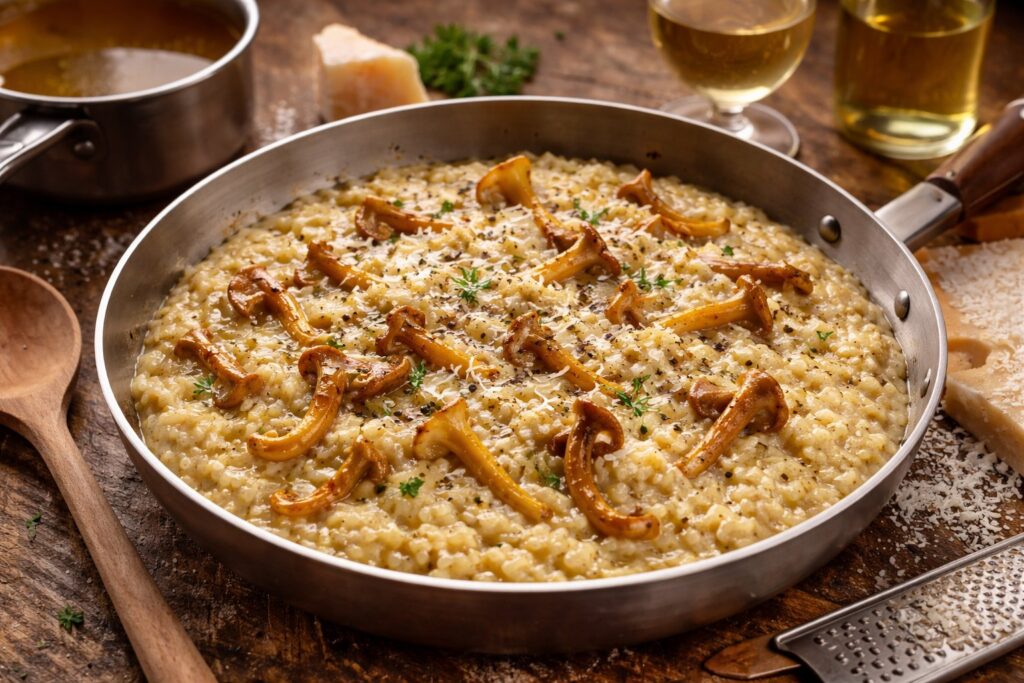
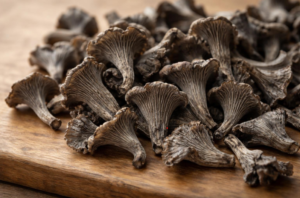
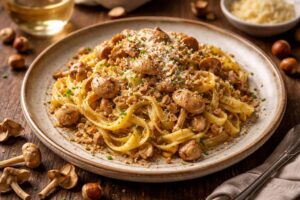
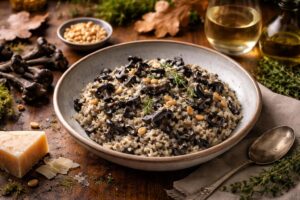
In the high altitudes of the Balkan Massif and the Alpine ranges, the Craterellus lutescens (Yellow Foot) is the foragers' late-season reward. This risotto is an homage to the patience required by the European wilderness. Unlike the instant gratification of a sauté, a true risotto is a rhythmic exchange—adding stock, stirring, and waiting for the rice to surrender its starch to the earthy, apricot-scented essence of the wild-harvested mushroom.
This culinary masterpiece focuses on the structural integrity of the Yellow Foot. Because its stem is hollow and resilient, it maintains a sophisticated "snap" even after being enveloped in the creamy, pure umami emulsion of aged Parmigiano. It is a dish of high regional spirit, designed to ground the diner in the damp, mineral-rich terroir of the ancient pine forests.
Sensory & Foraging Profiles: The Highland Terroir
The Craterellus lutescens is a mycorrhizal fungus that thrives in acidic, needle-laden soils. Its flavor profile is a complex matrix of benzaldehyde (almond-like) and octen-3-ol (mushroomy).
Microbiology & Texture: The rice variety—ideally Carnaroli—provides the amylopectin necessary to create a silk-like coating, which acts as a flavor carrier for the mushroom's fat-soluble compounds.
Ethical Harvesting: When foraging at high elevations, always leave the "over-mature" caps. These serve as the biological bank for the forest, ensuring the symbiosis between the Yellow Foot and the conifer roots remains intact.
Essential Equipment
Wide, shallow heavy-bottomed pan (for even evaporation)
Wooden spoon (to avoid breaking the rice grains)
Small pot for warm stock
Fine grater for Parmigiano
The Master Recipe: Highland Yellow Foot Risotto
Ingredients
350g Fresh Wild-Harvested Craterellus lutescens
300g Carnaroli or Arborio rice
1.2L Light chicken or mushroom stock (kept at a simmer)
100ml Dry white wine (Pinot Grigio)
1 medium Shallot (finely diced)
60g Cold butter (cubed)
80g Aged Parmigiano Reggiano (freshly grated)
Fleur de Sel & Freshly cracked white pepper
Culinary Steps
The Tostatura: Heat a dry pan over medium heat. Add the rice and toast for 2 minutes until the grains are hot to the touch and smell slightly nutty.
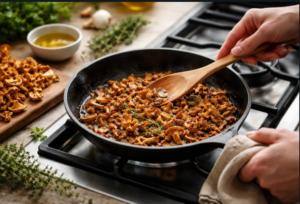
The Aromatics: Add a small knob of butter and the shallots. Sauté for 1 minute, then add the Yellow Foot. Cook until the mushrooms soften and release their floral aroma.
The Deglaze: Pour in the wine. Stir constantly until the liquid has been almost entirely absorbed by the rice.
The Gradual Infusion: Add one ladle of warm stock at a time. Stir gently but frequently. Add the next ladle only when the previous one has been absorbed and the rice looks glossy.
The Mantecatura: After 18-20 minutes, when the rice is *al dente*, remove from heat. Add the cold butter cubes and Parmigiano.
The Rest: Cover the pan for 2 minutes. Then, beat vigorously with the wooden spoon until the risotto is creamy and moves like a wave ("all'onda").
Substitutions & Variations
For a vegetarian version, use a roasted onion dashi instead of chicken stock. If Yellow Foot is out of season, dried and rehydrated Yellow Foot provides an even deeper, more concentrated umami flavor.
Pro Technique: The Mushroom-Stock Synergy
To elevate the Highland spirit, take 10% of your fresh Yellow Foot and finely mince them into a paste. Add this paste to your stock as it simmers. This creates a double-layered infusion where the liquid itself is saturated with the Craterellus essence before it even touches the rice.
The Umami Secret: Amylopectin & Glutamate Binding
The natural glutamates in Yellow Foot mushrooms are highly soluble. As the rice releases amylopectin (starch) during stirring, it creates a thick physical matrix that traps these glutamate molecules. This "starch-binding" prevents the savory notes from being washed away, ensuring that every grain of rice becomes a vehicle for umami-rich intensity.
The Art of the Pairing
A dish this creamy and earthy requires a white wine with body—a Northern Italian Soave or an Altesse from the Savoie. For red lovers, a light Nebbiolo provides the tannic structure to cut through the Parmigiano. Non-alcoholic: A sparkling apple cider mirrors the fruity esters of the mushroom.
Storage & Reheating
Risotto is best fresh. To reheat: Add a splash of stock and a knob of butter to a pan over low heat, stirring gently to restore the creaminess. Pro Tip: Use leftovers to make Arancini.
Ancestral Nutrition
Yellow Foot is an excellent source of Vitamin D2 and Dietary Fiber. Combined with the high-quality proteins and calcium in Parmigiano, this dish provides sustained metabolic energy, traditionally valued by mountain communities for its "thermal" properties in cold climates.
Micro-FAQ
Q: Why wash the rice? A: Never wash risotto rice. You need the surface starch to create the signature creamy texture.
Q: Can I use butter instead of oil for the toast? A: Toasting is best done dry or with a tiny amount of oil; butter can burn during the high-heat toast phase.
Q: My mushrooms disappeared! A: Yellow Foot shrinks significantly; always use more than you think you need for a visible presence.
To provide the best experiences, we use technologies like cookies to store and/or access device information. Consenting to these technologies will allow us to process data such as browsing behavior or unique IDs on this site. Not consenting or withdrawing consent, may adversely affect certain features and functions.
Functional
Always active
The technical storage or access is strictly necessary for the legitimate purpose of enabling the use of a specific service explicitly requested by the subscriber or user, or for the sole purpose of carrying out the transmission of a communication over an electronic communications network.
Preferences
The technical storage or access is necessary for the legitimate purpose of storing preferences that are not requested by the subscriber or user.
Statistics
The technical storage or access that is used exclusively for statistical purposes.The technical storage or access that is used exclusively for anonymous statistical purposes. Without a subpoena, voluntary compliance on the part of your Internet Service Provider, or additional records from a third party, information stored or retrieved for this purpose alone cannot usually be used to identify you.
Marketing
The technical storage or access is required to create user profiles to send advertising, or to track the user on a website or across several websites for similar marketing purposes.