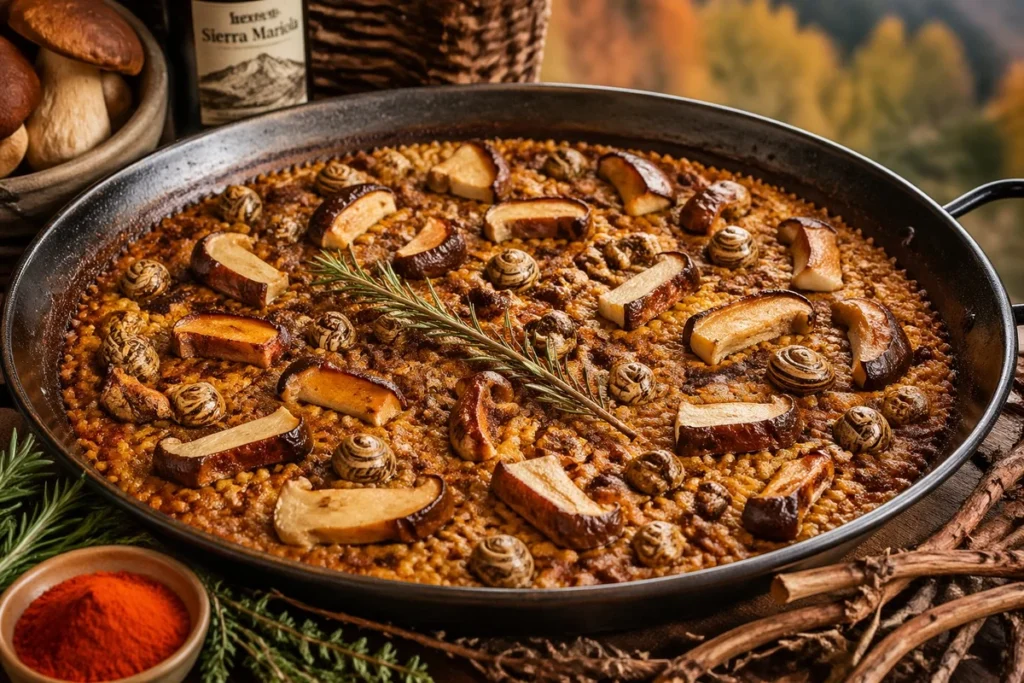
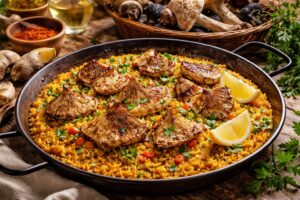
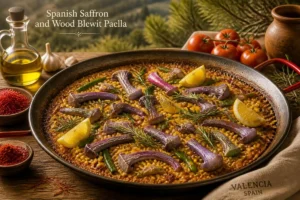
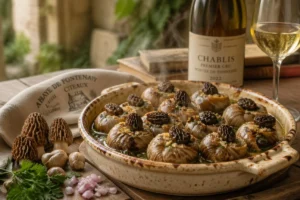
A robust, "dry-style" mountain rice cooked over vine branches, featuring wild Boletus edulis, land snails (vaquetes), and a deeply concentrated forest-game stock.
Arroz de Montaña (Mountain Rice)
The Scent of the Levant: Rosemary, Vine Smoke, and Wild Fungi
The Historical Prelude: The Rice of the Interior
While the world looks to the coast for Paella, the true "Soul of the Rice" in Spain is found in the Arroz de Montaña. In the high-altitude forests of the Sierra de Mariola, rice was historically a luxury brought from the coast, but the ingredients added to it were purely of the land. Historically, shepherds and foragers combined the Boletus edulis with land snails (vaquetes)—which fed on wild rosemary and thyme—to create a dish of extreme aromatic density.
Unlike the seafood versions, this rice is defined by "The Burn"—the smoky flavor imparted by cooking over dried vine branches (sarmientos). It is a dish of the autumn harvest, representing the moment when the mountain air cools and the first porcini appear under the holm oaks. To eat Arroz de Montaña is to experience the "Terroir of the Scrubland," where the rice acts as a neutral sponge, capturing the essential oils of the herbs, the iron-rich snails, and the heavy glutamates of the mushroom.
⏱ Time: 45 Minutes
📊 Difficulty: Intermediate / Heat Control
🔥 Calories: 440 kcal / Serving
🍄 Type: Meaty Spanish "Boleto"
Culinary Philosophy: The “Socarrat” and the Thin Layer
The Spanish philosophy of rice is Horizontal Concentration. We do not want a deep pot of rice; we want a thin, single layer of grains in a wide paella pan. This allows for the formation of the **Socarrat**—the caramelized, crispy crust at the bottom. The Porcini are added in the final stages of the boil so they don't overcook, ensuring their juices are absorbed directly into the grains as the liquid vanishes.
Sensory & Foraging Profile: The Holm Oak & Rosemary Terroir
Latin Nomenclature:Boletus edulis (The Levant phenotype). Terroir Analysis: Porcini from the Alicante mountains grow in limestone-heavy, dry soils under Holm Oaks (Quercus ilex). This environment results in a mushroom that is smaller but much more concentrated in flavor, with a distinct "roast-nut" profile. The nearby wild rosemary (romero) infuses the air and soil, which the mushroom absorbs into its cuticle.
Selection Protocol: We use "Medium Buttons." We slice the caps into quarters and the stems into "coins." The snails provide the chewiness, while the Porcini provide the "flesh," making for a textural masterpiece.
Essential Equipment
🔸 Traditional Paella Pan (34-40cm): To ensure the rice layer is no more than 1.5cm thick.
🔸 Bomba or Calasparra Rice: Short-grain Spanish varieties that can absorb 3x their weight in liquid without breaking.
🔸 Dried Vine Branches (Sarmientos): For the authentic smoky finish (can be substituted with smoked pimentón).
The Master Recipe: The Mountain Boil
Stage 1: The “Sofrito” Base
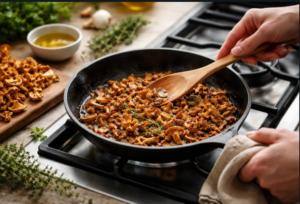
In the center of the pan, sauté 400g of sliced Porcini and 20 cleaned land snails in extra virgin olive oil. Once browned, push to the edges. In the center, add 1 grated tomato and 2 cloves of garlic. Cook until the tomato becomes a dark, thick paste (the sofrito).
Stage 2: The Rice Pearl
Add 320g of Bomba Rice. Stir for 2 minutes (nacarar) until the grains are coated in oil and appear translucent. This step ensures the grains remain separate and firm.
Stage 3: The Forest Extraction
Pour in 1 liter of boiling mushroom-game stock (infused with a sprig of rosemary). Do not stir the rice from this point forward. Cook over high heat for 10 minutes, then lower to medium for 8 minutes.
Stage 4: The Socarrat Ritual
In the last 2 minutes, increase the heat to high. Listen for a "crackling" sound—this is the rice beginning to fry in the remaining oil. Remove from heat immediately, cover with a cloth, and rest for 5 minutes. This rest is essential for the moisture to redistribute.
Chef’s Secret: The “Rosemary Smoke”
If you don't have a wood fire, place a fresh branch of rosemary directly on top of the rice during the resting phase and cover it tightly. The residual steam will extract the essential oils from the rosemary and infuse the rice with the scent of the Spanish scrubland, perfectly bridging the gap between the snails and the Porcini.
The Umami Secret: The Mycelial-Snail Synergy
Land snails are exceptionally high in Iron and **Minerals**, while Porcini provide the **Glutamate** backbone. When cooked in a thin layer of rice, the high surface temperature creates a massive concentration of these molecules. The rice acts as a "flavor capacitor," holding these compounds until they are released simultaneously on the palate.
The Art of Pairing
Sommelier's Selection: A structured red from **Jumilla** or **Yecla** (Monastrell grape). These wines have the "dusty" tannins and dark fruit that can handle the smokiness and earthiness of the mountain rice.
Non-Alcoholic: A chilled, fermented grape juice with a pinch of smoked salt.
Micro-FAQ
Q: Do I have to use snails? A: For the authentic "Arroz de Montaña," yes. However, if you are squeamish, you can substitute with small pieces of wild rabbit, which share a similar iron-rich profile.
Q: My rice is mushy! A: You stirred it. Never stir Spanish rice once the liquid is added, as it releases starch and turns the dish into a risotto-like texture instead of the desired dry, separate grains.
The Porcini Directory: Global Names for Boletus edulis
The King Bolete, or simply Porcini, is arguably the most recognized wild mushroom in the culinary world. Its linguistic variety reflects its presence in forests from the Alps to the Himalayas:
Language
Regional & Folk Names
Expert Insights
Italian
Porcino, Brisa, Fungo di faggio
"Porcini" (little pigs) is the global trade name.
French
Cèpe de Bordeaux, Gros pied, Polonais
"Cèpe" comes from the Gascon word for trunk/stump.
German
Steinpilz, Herrenpilz, Edelpilz
"Steinpilz" (Stone mushroom) refers to its firm flesh.
To provide the best experiences, we use technologies like cookies to store and/or access device information. Consenting to these technologies will allow us to process data such as browsing behavior or unique IDs on this site. Not consenting or withdrawing consent, may adversely affect certain features and functions.
Functional
Always active
The technical storage or access is strictly necessary for the legitimate purpose of enabling the use of a specific service explicitly requested by the subscriber or user, or for the sole purpose of carrying out the transmission of a communication over an electronic communications network.
Preferences
The technical storage or access is necessary for the legitimate purpose of storing preferences that are not requested by the subscriber or user.
Statistics
The technical storage or access that is used exclusively for statistical purposes.The technical storage or access that is used exclusively for anonymous statistical purposes. Without a subpoena, voluntary compliance on the part of your Internet Service Provider, or additional records from a third party, information stored or retrieved for this purpose alone cannot usually be used to identify you.
Marketing
The technical storage or access is required to create user profiles to send advertising, or to track the user on a website or across several websites for similar marketing purposes.