The Historical Prelude: The Tides and the Timberland
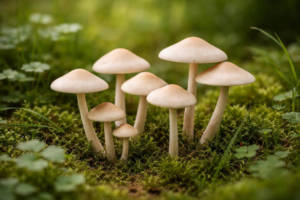
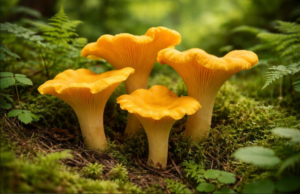
In the coastal regions of Brittany (Bretagne), the culinary identity is forged by the collision of the Atlantic Ocean and the ancient Huelgoat Forest. Historically, the winter months brought a simultaneous bounty: the peak season for King Scallops (Saint-Jacques) and the final, frost-resistant flush of the Yellow Foot Chanterelle (Craterellus lutescens).
Breton fishermen and foragers realized that the natural sweetness of a perfectly seared scallop shared a molecular frequency with the apricot-and-almond profile of the Yellow Foot. To unite these two disparate worlds, chefs utilized Cauliflower—a winter staple of the region—transforming it into a silken purée that acts as a neutral, creamy stage for the "land and sea" performance.
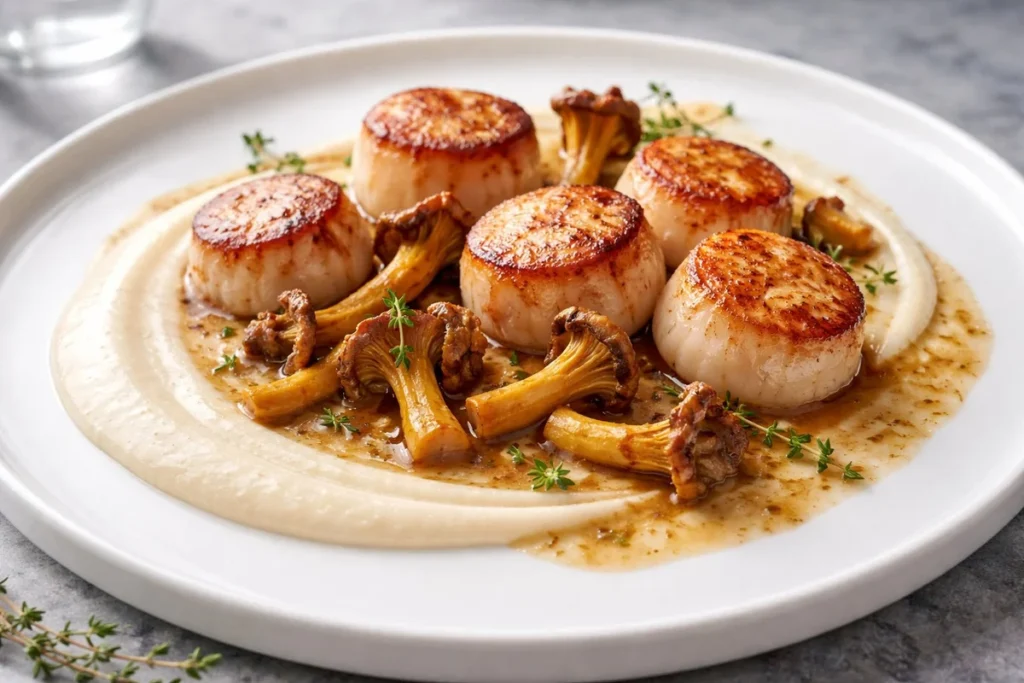
This dish represents a study in Ivory Gastronomy. The visual palette is restrained—whites, creams, and golden oranges—mirroring the misty, pale winter sun over the Celtic Sea. It is a technical masterpiece of Maillard management: the caramelization of the scallop's sugars must be balanced against the delicate, waxy texture of the wild fungi.
Narrative Intro: This dish is a "Mist-Covered Reef." Our philosophy for the Scallops and Yellow Foot is to use the cauliflower silk as a "flavor-fixer." The cruciferous fats capture the scallop's brine and the mushroom's fruitiness, preventing them from evaporating and ensuring a long, mineral-heavy finish.
Sensory & Foraging Profile: The Saline Pine and Moss Terroir
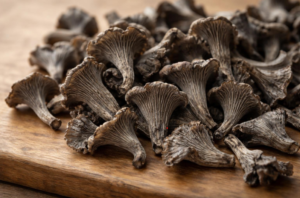
The Craterellus lutescens found in coastal forests grows in acidic soils influenced by salt-heavy air. This maritime terroir imparts a sharper, almost iodine-like mineral edge to the mushroom's stone-fruit profile. Their hollow stems are resilient and flexible, capable of being quickly sautéed at high heat to achieve a "snap" that contrasts with the buttery softness of the scallop.
Ethical Harvesting & Professional Protocols: In the coastal pine barrens, we follow the "Salt-Spray" protocol—harvesting only from the interior forest edges where the salt concentration is lower, preserving the delicate apricot esters. We utilize natural hair brushes and strictly avoid washing the mushrooms, as the Yellow Foot's hollow stem can act as a straw, diluting its concentrated flavor with water.
Essential Equipment: The Sear & Purée Station
Stainless Steel or Cast Iron Skillet: Essential for the high-intensity heat required to achieve a caramelized "crust" on the scallops without overcooking the center.
High-Speed Blender (Vitamix): To achieve the "Silk" texture of the cauliflower purée, breaking down the fibers into a micro-emulsion.
Offset Spatula: For the professional "swoosh" of purée on the plate.
Paper Towels: Crucial for ensuring the scallops are "bone-dry" before they hit the pan.
Master Recipe: Atlantic Scallops & Yellow Foot
Stage 1: The Cauliflower Silk
Simmer cauliflower florets in half-milk, half-cream with a pinch of salt until falling apart. Drain (reserve some liquid) and blend with a knob of cold butter until perfectly smooth. The texture should be like heavy satin.
Stage 2: The Scallop Preparation
Ensure 6 Large King Scallops are dry. Season with sea salt only at the last second. Excess moisture is the enemy of the sear; it will cause the scallop to steam rather than caramelize.
Stage 3: The Forest Sauté
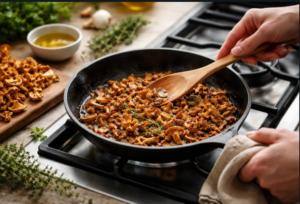
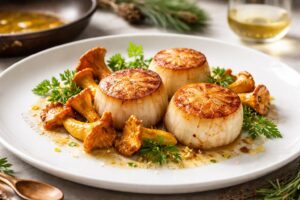
In a hot pan with beurre noisette (brown butter), sauté 200g of Yellow Foot chanterelles. Once they release their apricot perfume, deglaze with a tiny squeeze of Lemon juice. Set aside and keep warm.
Stage 4: The 60-Second Sear
In a smoking-hot skillet with a high-smoke-point oil, place the scallops. Do not move them for 60-90 seconds. Once a dark golden crust forms, flip and sear for 30 seconds. The center must remain translucent (rare).
Stage 5: The Final Composition
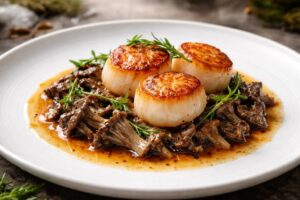
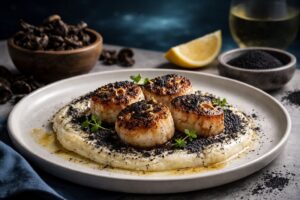
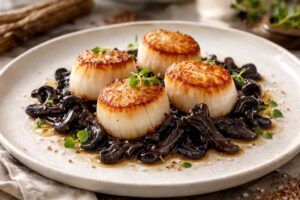
Swoosh the cauliflower silk across a warm plate. Place the scallops atop the purée. Cluster the sautéed Yellow Foot mushrooms around the scallops, drizzling any remaining brown butter from the mushroom pan over the fish.
Substitutions & Variations: The Luxury Palette
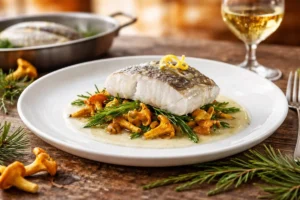
The Fish: Replace scallops with Monkfish medallions for a firmer, more "meat-like" seafood texture.
The Purée: Use Parsnip instead of cauliflower for a sweeter, more earthy foundation.
The Mushroom: For an extra hit of "Ocean and Earth," add a small amount of Dried Dulse (Seaweed) to the sautéing mushrooms.
Pro Technique: The “Cold-Butter Glaze”
After searing the scallops, add a small knob of cold butter and a sprig of thyme to the pan. Baste the scallops with the foaming butter for the final 20 seconds. This creates a secondary layer of nutty flavor that bonds the scallop's caramel crust to the mushroom's forest aromatics.
The Umami Secret: Trimethylamine and Linalool
The **Scallops** contain Trimethylamine oxide (marine savoriness) and high levels of Glycine (sweetness). The **Yellow Foot** contains Linalool (apricot) and 1-Octen-3-ol. When these interact over a base of Glucosinolates (from the cauliflower), they create a "Flavor Bridge" that tricks the brain into perceiving a third, hidden ingredient—something akin to **Fresh Truffle and Hazelnut**.
The Art of Pairing: The Sommelier’s Selection
Sommelier's Choice: A Muscadet Sèvre et Maine sur lie. Its high salinity and bone-dry finish are the traditional partner for scallops, acting as a palate cleanser for the creamy purée.
Non-Alcoholic Alternative:Cucumber and Mint Infused Water. The "green" freshness provides a sharp contrast to the rich, buttery textures of the dish.
Storage & Reheating
Scallops are ruined by reheating. **Pro Tip:** If you have leftover cauliflower silk, it makes a magnificent base for a Creme Dubarry soup the next day. The mushrooms can be kept for 24 hours and used in a morning omelet.
Ancestral Nutrition
Scallops are incredibly high in Vitamin B12 and Magnesium. Yellow Foot chanterelles provide Vitamin D2 and Potassium. In Breton coastal lore, this combination was known as "The Sea-Captain's Focus," believed to provide the clarity and energy needed for navigating the winter gales.
Micro-FAQ
Q: Why do my scallops stick to the pan? A: Either the pan isn't hot enough, or you didn't dry the scallops sufficiently. Moisture creates steam, which acts like glue between the protein and the metal.
Q: Can I use frozen scallops? A: Yes, but "dry-packed" frozen scallops are essential. "Wet-packed" scallops are treated with phosphates that prevent a proper sear and leave a soapy aftertaste.
Q: Is the cauliflower purée healthy? A: Despite the cream and butter, cauliflower is a nutritional powerhouse of fiber and antioxidants, making it a far lighter alternative to mashed potatoes.
To provide the best experiences, we use technologies like cookies to store and/or access device information. Consenting to these technologies will allow us to process data such as browsing behavior or unique IDs on this site. Not consenting or withdrawing consent, may adversely affect certain features and functions.
Functional
Always active
The technical storage or access is strictly necessary for the legitimate purpose of enabling the use of a specific service explicitly requested by the subscriber or user, or for the sole purpose of carrying out the transmission of a communication over an electronic communications network.
Preferences
The technical storage or access is necessary for the legitimate purpose of storing preferences that are not requested by the subscriber or user.
Statistics
The technical storage or access that is used exclusively for statistical purposes.The technical storage or access that is used exclusively for anonymous statistical purposes. Without a subpoena, voluntary compliance on the part of your Internet Service Provider, or additional records from a third party, information stored or retrieved for this purpose alone cannot usually be used to identify you.
Marketing
The technical storage or access is required to create user profiles to send advertising, or to track the user on a website or across several websites for similar marketing purposes.