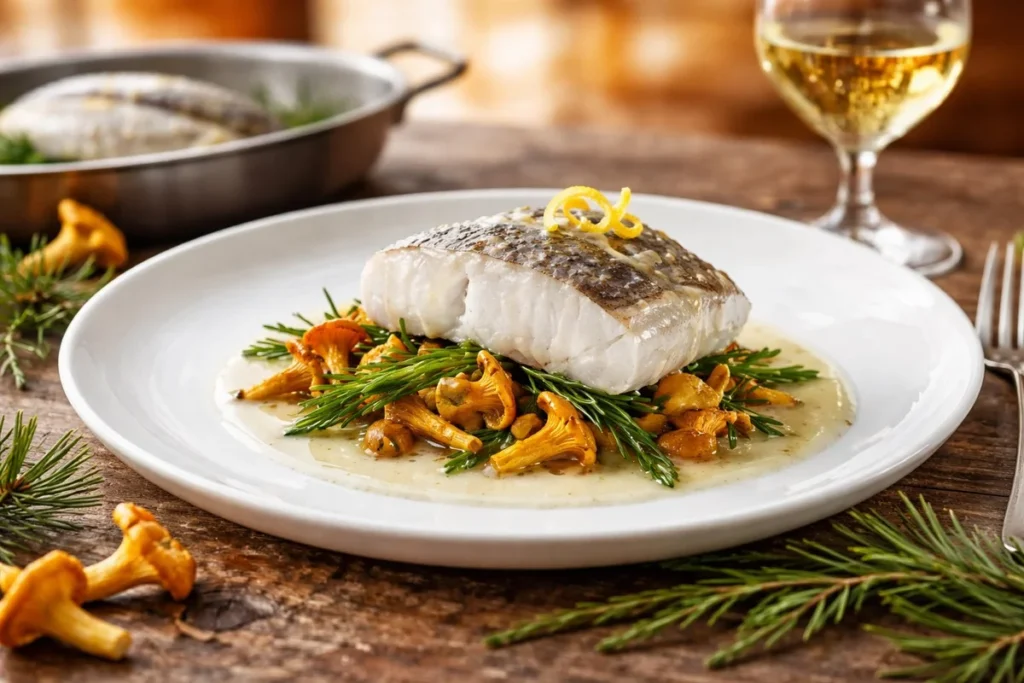
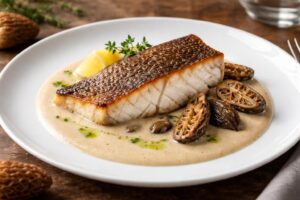
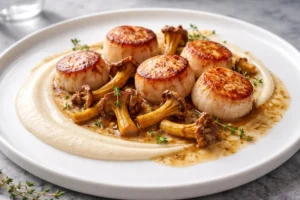
A masterpiece of the Atlantic Fringe, combining the "King of Fish" with the stone-fruit aromatics of the Yellow Foot chanterelle and the saline crunch of samphire.
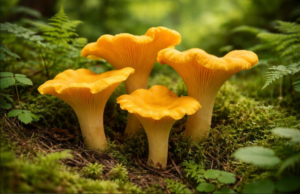
Along the wild, jagged coastlines of Brittany (Bretagne), the culinary identity is forged by the collision of the deep Atlantic and the dense ancient forests of the interior. The Turbot has long been hailed as the "King of the Sea," a flatfish prized by 18th-century French royalty for its firm, white, and gelatinous flesh. Historically, the most sought-after turbot was served with the seasonal "Gold of the Moorlands"—the Yellow Foot Chanterelle (Craterellus lutescens).
Foragers in the Finistère region discovered that the Yellow Foot mushrooms growing in the pine forests near the coast possessed a unique saline-apricot aroma, a direct result of the salt-spray mists that penetrate the tree line. When paired with the natural collagen of the turbot, these mushrooms created a sauce of incredible viscosity and depth.
The addition of Samphire (Salicorne) was the technical innovation of the Nouvelle Cuisine era in the 1970s. Chefs realized that the intense, briny "pop" of the sea-asparagus acted as a biological replacement for traditional salt, highlighting the mineral notes in the Yellow Foot. This dish represents the ultimate "Atlantic Umami"—a refined dialogue between the forest floor and the tidal basin.
Narrative Intro: This dish is a study in "Saline Fruitiness." Our philosophy for the Atlantic Turbot is to treat the Yellow Foot as an aromatic seasoning. By poaching the fish on a bed of mushrooms, we allow the turbot's collagen to act as a magnet for the fungi's stone-fruit esters, resulting in a flavor profile that is both oceanic and terrestrial.
Sensory & Foraging Profile: The Oceanic Pine and Sandy Terroir
The Craterellus lutescens found along the Atlantic fringe grows in sandy, acidic soils blanketed by maritime pine needles. This terroir produces a mushroom with a sharp metallic finish and a high concentration of linalool, which provides the signature apricot scent. The proximity to the ocean ensures the mushrooms are perpetually bathed in iodine-rich mists, adding a layer of mineral complexity absent in inland varieties.
Ethical Harvesting & The "Sea-Mist" Protocol: In Brittany, we harvest only when the tide is outgoing, as the shifting air pressure is said to "open" the mushroom's aromatic pores. We use porous hemp bags to allow the sea air to circulate around the harvest. We strictly avoid harvesting within 10 meters of the high-tide line to ensure the mycelium isn't damaged by excessive salt-water inundation.
Essential Equipment: The Atlantic Station
Turbotière: A traditional diamond-shaped poaching pan specifically designed for cooking whole flatfish.
Thermocouple Probe: To monitor the turbot's internal temperature with 0.1°C precision.
Fine Mesh Chinois: For straining the "Forest-Sea" poaching liquor.
Silicon Tweezers: For the professional placement of delicate samphire sprigs.
Master Recipe: Atlantic Turbot & Yellow Foot
Stage 1: The Turbot “Skin-on” Prep
Prepare 4 Turbot fillets (180g each), leaving the skin on. The skin contains the essential gelatin that will thicken our sauce. Season lightly with Sel de Guérande.
Stage 2: The Mushroom & Sea Base
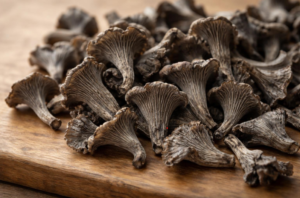
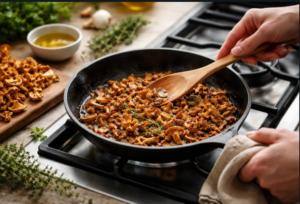
In a wide pan, melt 30g of Demi-Sel Butter. Add 300g of fresh Yellow Foot chanterelles and 1 thinly sliced shallot. Sauté gently until the mushrooms are tender. Add 50g of fresh Samphire at the last second just to warm it through.
Stage 3: The Forest-Sea Poach
Place the turbot fillets directly on top of the mushroom bed. Pour in 100ml of dry Muscadet Sèvre-et-Maine and 50ml of light fish fumet. Cover with a parchment paper "cartouche" and poach over low heat until the fish reaches 48°C internally.
Stage 4: The Emulsion (The “Glaze”)
Remove the fish and mushrooms. Increase the heat of the poaching liquid. Whisk in 40g of cold butter to emulsify the gelatin-rich stock. The sauce should be ivory-white and naturally thick.
Stage 5: The Plating
Place the Yellow Foot and samphire mound in the center. Rest the turbot on top. Nap the fish with the forest-sea emulsion. Garnish with lemon zest to bridge the fruit and brine.
Substitutions & Variations: The Luxury Palette
The Fish: If Turbot is unavailable, use Brill or Sole (reduce poaching time by 40%).
The Brine: Replace samphire with sea-fennel for a more anise-forward profile.
The Mushroom: Use dried Yellow Feet rehydrated in clam juice for an explosive oceanic umami boost.
Pro Technique: The “Skin-Gelatin” Reduction
Turbot is unique because of its high Collagen content. During the poaching phase, this collagen melts into the mushroom-wine broth. When you whisk in cold butter for the final emulsion, the collagen acts as a natural stabilizer, creating a "Buerre Blanc" that is far more durable and glossy than one made with cream.
The Umami Secret: Iodine and Guanylate Synergy
The **Samphire** is rich in Iodine and Sodium. The **Yellow Foot** contains Guanylate (a nucleotide). When iodine-rich minerals interact with fungal nucleotides, they lower the "tasting threshold" for umami. This means the turbot tastes more savory and "meaty" without the need for high salt or fat. This is the secret to the legendary lightness of Breton high-cuisine.
The Art of Pairing: The Sommelier’s Selection
Sommelier's Choice: A Muscadet Sèvre-et-Maine Sur Lie. Its "sur lie" aging provides a bready, yeasty base that supports the mushroom's fruit and the fish's richness.
Non-Alcoholic Alternative:Cucumber and Sea-Salt Water with a dash of White Grape Juice. This mimics the saline acidity of the Atlantic coast.
Micro-FAQ
Q: Why is my turbot mushy? A: You likely cooked it at too high a temperature. Turbot must be poached gently (sub-simmer) to allow the collagen to soften without the muscle fibers tightening and releasing their water.
Q: Can I use land asparagus instead of samphire? A: You can, but you will lose the specific "saline pop." If using green asparagus, add a touch more sea salt and lemon to compensate.
Q: Is the skin edible? A: Absolutely. On a turbot, the skin is a delicacy rich in flavor. However, it will not be crispy when poached; it will be soft and velvety.
To provide the best experiences, we use technologies like cookies to store and/or access device information. Consenting to these technologies will allow us to process data such as browsing behavior or unique IDs on this site. Not consenting or withdrawing consent, may adversely affect certain features and functions.
Functional
Always active
The technical storage or access is strictly necessary for the legitimate purpose of enabling the use of a specific service explicitly requested by the subscriber or user, or for the sole purpose of carrying out the transmission of a communication over an electronic communications network.
Preferences
The technical storage or access is necessary for the legitimate purpose of storing preferences that are not requested by the subscriber or user.
Statistics
The technical storage or access that is used exclusively for statistical purposes.The technical storage or access that is used exclusively for anonymous statistical purposes. Without a subpoena, voluntary compliance on the part of your Internet Service Provider, or additional records from a third party, information stored or retrieved for this purpose alone cannot usually be used to identify you.
Marketing
The technical storage or access is required to create user profiles to send advertising, or to track the user on a website or across several websites for similar marketing purposes.