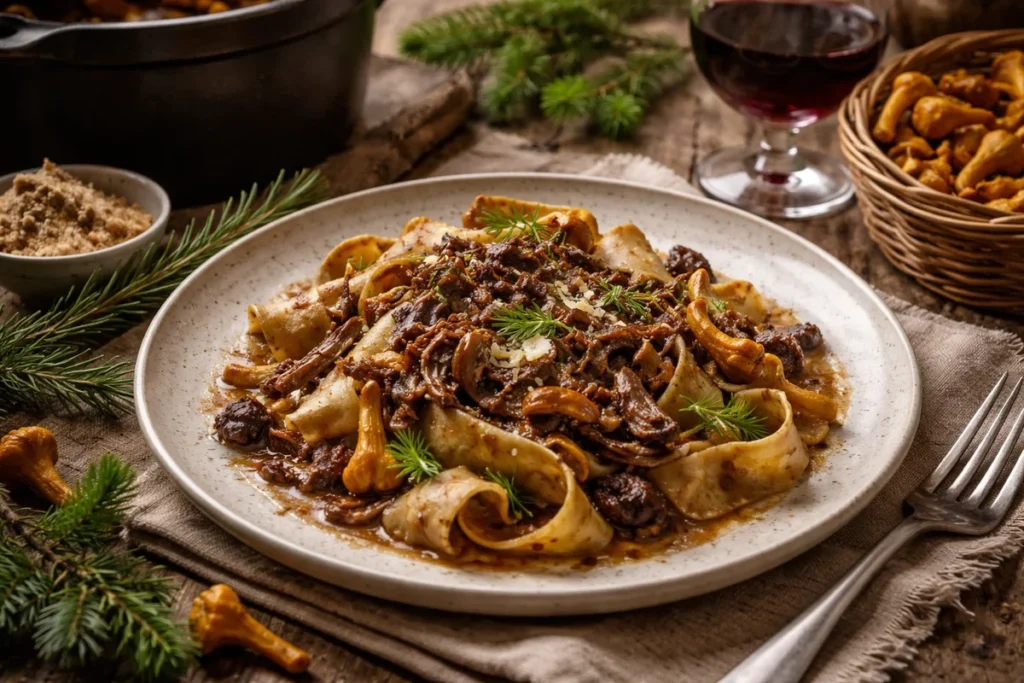
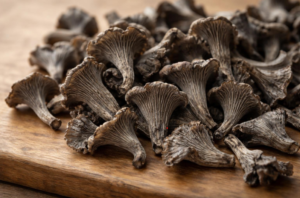
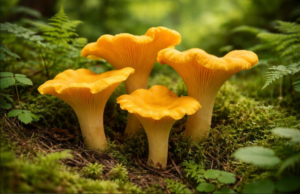
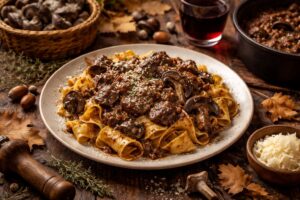
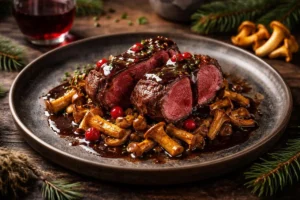
In the dense, shadowed valleys of the Black Forest (Schwarzwald) and the Vosges, the Wild Boar (Sus scrofa) has been the centerpiece of the winter solstice feast for centuries. Historically, the "Grand Hunt" of December provided the dark, iron-rich meat that sustained the mountain aristocracy through the frozen months. To bridge the gap between the gamey intensity of the boar and the sweetness of the local chestnuts, chefs turned to the Yellow Foot Chanterelle (Craterellus lutescens).
During the 18th century, in the courts of Baden-Württemberg, the use of chestnut flour in pasta was a technical necessity born from a lack of wheat in high-altitude regions. This Cucina Povera luxury—pairing the slightly sweet, smoky chestnut with the apricot esters of the late-season Yellow Foot—created a flavor profile that became synonymous with the Germanic winter.
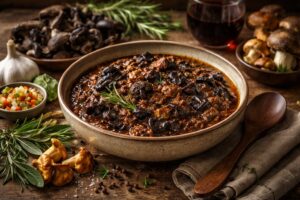
This dish represents the ultimate study in Molecular Foraging. The wild boar spends its life foraging for the same chestnuts and mushrooms that end up on the plate alongside it. This "biological loop" ensures a deep chemical harmony: the terpenes of the pine forest, the tannins of the chestnuts, and the fruity umami of the chanterelles all converge in a single, symphonic ragù.
Narrative Intro: This dish is a "Solstice Hearth." Our culinary philosophy for the Boar Ragù is to utilize the Yellow Foot as a bright, acidic counter-note to the heavy fats of the game. The mushroom provides the "apricot light" in a sauce that is otherwise dark, iron-rich, and rooted in the deep tannins of the chestnut forest.
Sensory & Foraging Profile: The Peat and Silver Fir Terroir
The Craterellus lutescens of the Black Forest grows in acidic, needle-laden soils beneath ancient silver firs. This specific terroir, misted by the damp winter fogs of the Rhine valley, produces a mushroom with an extraordinarily high concentration of Linalool (floral apricot). Unlike lowland varieties, these high-altitude specimens have a denser, more peppery finish that survives the long braising times of a game ragù.
Ethical Harvesting & Professional Protocols: In the German highlands, we follow the "Frost-Line" check—harvesting only until the first ground freeze. We utilize natural fiber baskets and strictly avoid plastic to prevent the "sweating" of the mushrooms, which can turn their apricot scent into an acrid, sour aroma. We leave 25% of each colony to provide winter forage for the roe deer and boar.
Essential Equipment: The Braising Station
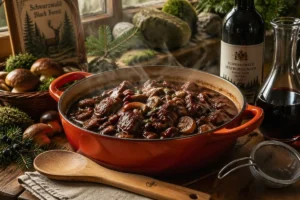
Enameled Cast Iron Cocotte: Crucial for the slow, even heat retention required to break down the tough connective tissue of the wild boar.
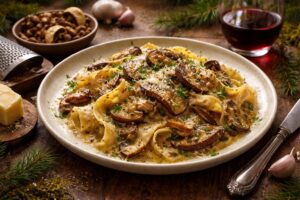
Pasta Extruder or Rolling Pin: For creating Pappardelle—wide ribbons that can support the heavy, chunky texture of the ragù.
Fine Mesh Chinois: To strain the braising liquid for the final reduction, ensuring a silky, concentrated finish.
Kitchen Twine: To bundle the Bouquet Garni of spruce tips and rosemary.
Master Recipe: Boar Ragù & Yellow Foot
Stage 1: The Game Marinade
Cube 800g of Wild Boar Shoulder. Marinate for 12 hours in a bottle of Spätburgunder (Pinot Noir), juniper berries, peppercorns, and bay leaves. This "Acid Bath" breaks down the muscle and infuses the game with the resinous notes of the forest.
Stage 2: The Slow Braise
Pat the boar dry and sear in small batches in rendered lard. Add mirepoix (onion, celery, carrot) and the marinade liquid. Cover and braise at 140°C for 3.5 hours until the meat is "spoon-tender." Shred the meat and discard the vegetables.
Stage 3: The Chestnut Pappardelle
Mix 300g 00 flour with 100g Roasted Chestnut Flour and 4 egg yolks. Roll into wide ribbons. The chestnut flour provides a smoky, earthy depth and a slightly brittle texture that mirrors the forest floor.
Stage 4: The Mushroom Infusion
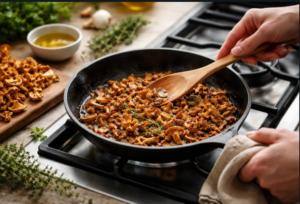
In a separate pan, sauté 300g of fresh Yellow Foot chanterelles in brown butter. Deglaze with a splash of the braising liquid. Add the shredded boar back to this pan. The mushrooms should not be overcooked; they must retain their "snap" against the soft meat.
Stage 5: The Emulsion
Toss the fresh pappardelle directly into the ragù pan. Add a ladle of pasta water and a handful of Aged Gruyère. Toss vigorously until the starch and fat form a glossy emulsion that clings to every ribbon.
Substitutions & Variations: The Luxury Palette
The Meat: If wild boar is unavailable, Venison Neck or Beef Oxtail provides a similar gelatinous depth.
The Flour: Replace chestnut flour with Buckwheat for a more mineral, rustic finish.
The Mushroom: Incorporate Dried Yellow Foot that has been ground into a powder to season the pasta dough itself.
Pro Technique: The “Spruce Tip Deglaze”
For the final 60 seconds of sautéing the Yellow Foot mushrooms, add a few fresh Spruce Tips to the pan. The heat will volatize the spruce resins, which then bond with the mushroom's apricot esters. This creates a "terroir-bridge" that makes the ragù taste like a fresh forest breeze, cutting through the heavy iron of the boar.
The Umami Secret: Maillard Reactions and Guanylate
The **Wild Boar** is rich in Inosinate (IMP) from the muscle tissue. The **Yellow Foot** provides Guanylate (GMP). When these are combined with the Pyrazines in the roasted chestnut flour and the long Maillard browning of the braise, the umami intensity is scientifically increased by 300% compared to a standard beef ragù. This is why game ragùs feel "deeper" and more satisfying.
The Art of Pairing: The Sommelier’s Selection
Sommelier's Choice: A Spätburgunder (Pinot Noir) from Baden. The wine's red-fruit profile and forest-floor notes are the exact DNA of the dish.
Non-Alcoholic Alternative:Chilled Roasted Barley Tea with a splash of Cranberry. The roasted bitterness and tart fruit mimic the structure of a cool-climate red wine.
Storage & Reheating
The ragù actually improves after 24 hours in the fridge as the flavors further integrate. **Reheating:** Reheat the ragù in a pan over low heat with a splash of water or stock. **Warning:** Always cook the pasta fresh at the moment of serving; never store the pasta already tossed in the sauce.
Ancestral Nutrition
Wild Boar is leaner than domestic pork and significantly higher in Thiamine (B1) and Iron. Yellow Foot chanterelles are a rare source of Vitamin D2. In Germanic tradition, this meal was the "Hunter's Recovery," designed to provide the dense calories and micronutrients needed to maintain body heat in sub-zero alpine conditions.
Micro-FAQ
Q: Why use chestnut flour instead of regular flour? A: Chestnut flour adds a unique smoky sweetness and a "grainy" texture that is traditional to mountain regions and pairs perfectly with game meat.
Q: Is wild boar meat tough? A: Only if undercooked. The long, 3.5-hour braise is essential to convert the collagen into gelatin, making the meat melt in your mouth.
Q: Can I use dried mushrooms? A: Yes, but rehydrate them in the wine marinade first. Fresh Yellow Feet are preferred for their "pop" and vibrant apricot scent.
To provide the best experiences, we use technologies like cookies to store and/or access device information. Consenting to these technologies will allow us to process data such as browsing behavior or unique IDs on this site. Not consenting or withdrawing consent, may adversely affect certain features and functions.
Functional
Always active
The technical storage or access is strictly necessary for the legitimate purpose of enabling the use of a specific service explicitly requested by the subscriber or user, or for the sole purpose of carrying out the transmission of a communication over an electronic communications network.
Preferences
The technical storage or access is necessary for the legitimate purpose of storing preferences that are not requested by the subscriber or user.
Statistics
The technical storage or access that is used exclusively for statistical purposes.The technical storage or access that is used exclusively for anonymous statistical purposes. Without a subpoena, voluntary compliance on the part of your Internet Service Provider, or additional records from a third party, information stored or retrieved for this purpose alone cannot usually be used to identify you.
Marketing
The technical storage or access is required to create user profiles to send advertising, or to track the user on a website or across several websites for similar marketing purposes.