The Historical Prelude: The Sun King’s Winter Gold
In the royal courts of Versailles, the Guinea Fowl (Pintade) was prized for its gamey elegance—a bird that possessed the tenderness of chicken but the lean, aromatic depth of a pheasant. Historically, as the French winter approached, the court chefs looked to Saffron (the world's most expensive spice) to mimic the warmth of the sun on the plate.
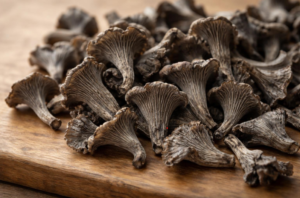
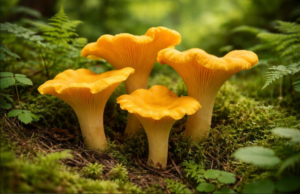
The Yellow Foot Chanterelle (Craterellus lutescens) was the final piece of this golden trinity. Emerging in the damp pine forests of Provence and the Rhône Valley, its orange-yellow stems and apricot-scented caps were found to be the perfect aromatic mirror to saffron's floral profile.
This dish represents the pinnacle of Classical French Reduction. By utilizing a Velouté—a sauce thickened with a white roux and poultry stock—the chef creates a medium that can carry the heavy, fat-soluble esters of both the saffron and the mushroom. It is a dish that celebrates the color gold, from the crisp skin of the fowl to the vibrant stems of the chanterelles.
Narrative Intro: This dish is a "Sunlight in the Fog." Our philosophy for the Guinea Fowl is to use the saffron velouté as a "flavor stage." The saffron provides the high-frequency floral notes, while the Yellow Foot provides the earthy, fruity mid-tones, creating a full-spectrum aromatic experience.
Sensory & Foraging Profile: The Clay and Maritime Pine Terroir
The Craterellus lutescens of Southern France thrives in the sandy-clay soils beneath maritime pines. This terroir, influenced by the saline Mediterranean breeze, imparts a subtle oceanic mineral finish to the mushroom's profile. The mushrooms here tend to have more resilient caps, making them perfect for "swimming" in a silken velouté without losing their structural integrity.
Ethical Harvesting & Professional Protocols: In the pine groves of the Var, we follow the "Golden Hour" protocol—harvesting only when the morning dew has evaporated but the sun hasn't yet reached its zenith. We utilize natural hair brushes to clean the hollow stems and strictly harvest only 40% of a patch, ensuring the local avian population can continue to spread the spores across the forest floor.
Essential Equipment: The Saucing Station
Copper Saucier: Essential for the delicate temperature control required to prevent the saffron velouté from breaking.
Fine Mesh Chinois: For straining the velouté to a perfectly smooth, velvet-like consistency.
Oven-Safe Cast Iron Skillet: To achieve a "parchment-crisp" skin on the guinea fowl before finishing in the oven.
Digital Scale: To precisely measure the saffron threads (0.1g) to prevent the sauce from becoming medicinal.
Master Recipe: Guinea Fowl & Yellow Foot
Stage 1: The Saffron Infusion
Steep 0.2g of High-Quality Saffron Threads in 100ml of hot poultry stock for 20 minutes. The liquid should turn a deep, neon orange. This infusion is the aromatic soul of the dish.
Stage 2: The Searing of the Bird
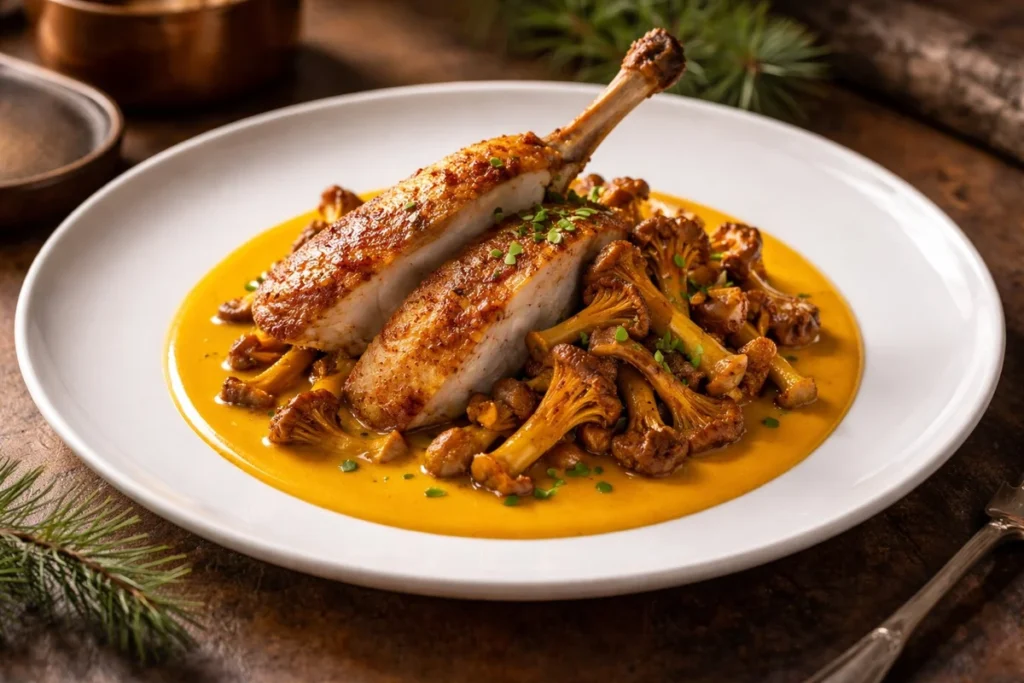
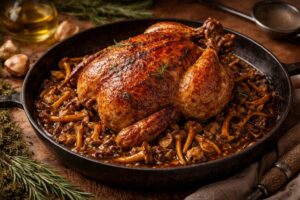
Season 2 Guinea Fowl Supremes (breast with wing bone) with salt. Sear skin-side down in a hot skillet with clarified butter until golden and crisp. Flip and roast in the oven at 180°C for 8-10 minutes. Let the meat rest for 5 minutes before slicing.
Stage 3: The Yellow Foot Sauté
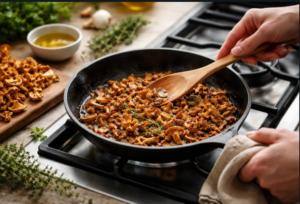
In the same skillet used for the bird, sauté 250g of fresh Yellow Foot chanterelles. The mushrooms will pick up the rendered fat and juices of the fowl. Deglaze with a splash of Noilly Prat or dry vermouth.
Stage 4: The Saffron Velouté
Make a light roux with 20g butter and 20g flour. Gradually whisk in the saffron-infused stock and 100ml of heavy cream. Simmer until the sauce coats the back of a spoon. Strain through a chinois for a professional finish.
Stage 5: The Final Assembly
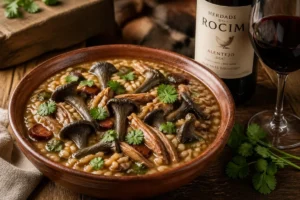
Pool the saffron velouté at the bottom of a warm plate. Place the sliced guinea fowl in the center, and spoon the sautéed Yellow Foot mushrooms over and around the meat. Finish with a few micro-chives for a touch of green.
Substitutions & Variations: The Luxury Palette
The Protein: Replace Guinea Fowl with Corn-Fed Chicken or Quail for a milder flavor profile.
The Spice: Use Turmeric and Ginger for a more "earthy-modern" twist on the golden sauce.
The Mushroom: Incorporate Dried Yellow Foot ground into a salt-rub for the bird's skin to double the mushroom intensity.
Pro Technique: The “Saffron-Mushroom Bridge”
To maximize the flavor interaction, sauté the Yellow Foot mushrooms with a pinch of orange zest. The citrus oils in the zest act as a chemical bridge between the saffron's floral notes and the mushroom's apricot esters, resulting in a three-dimensional flavor that "blooms" in the mouth.
The Umami Secret: Crocin and Linalool
The **Saffron** contains Crocin (color) and Safranal (aroma). The **Yellow Foot** contains Linalool (apricot) and Beta-Ionone. When combined in a creamy medium (the velouté), the Lipids in the cream stabilize these volatile molecules, preventing them from evaporating during the roasting process. This ensures that the final dish retains a powerful "forest-floral" punch.
The Art of Pairing: The Sommelier’s Selection
Sommelier's Choice: A Viognier from the Northern Rhône (Condrieu). Viognier is famous for its apricot and honey notes, making it the molecular twin of the Yellow Foot chanterelle.
Non-Alcoholic Alternative:Apricot and White Tea Infusion. The tea's tannins provide the structure, while the apricot mirrors the mushroom's scent.
Storage & Reheating
Guinea fowl is best eaten fresh. **Reheating:** The velouté can be stored for 48 hours. To reheat, add a splash of stock and whisk over low heat to restore the emulsion. **Note:** Reheating the bird may cause it to dry out; it is better served as a cold "Salade de Pintade" if left over.
Ancestral Nutrition
Guinea fowl is a powerhouse of Lean Protein and Vitamin B6. Yellow Foot chanterelles provide Potassium and Beta-glucans. In Provençal tradition, saffron was used as an "internal heater" to ward off the chill of the Mistral wind, while the mushrooms provided the fiber needed for winter health.
Micro-FAQ
Q: Why use Noilly Prat instead of white wine? A: Noilly Prat is a fortified vermouth with botanical notes (coriander, chamomile) that align much better with the saffron-mushroom aromatics than a standard dry white wine.
Q: My saffron sauce is bitter. Why? A: You likely used too much. Saffron is potent; 0.1g to 0.2g is all that is needed for two people. High quality saffron should be floral, not medicinal.
Q: Can I use frozen Guinea Fowl? A: Yes, but ensure it is fully thawed and patted dry to achieve the necessary skin-crispness.
To provide the best experiences, we use technologies like cookies to store and/or access device information. Consenting to these technologies will allow us to process data such as browsing behavior or unique IDs on this site. Not consenting or withdrawing consent, may adversely affect certain features and functions.
Functional
Always active
The technical storage or access is strictly necessary for the legitimate purpose of enabling the use of a specific service explicitly requested by the subscriber or user, or for the sole purpose of carrying out the transmission of a communication over an electronic communications network.
Preferences
The technical storage or access is necessary for the legitimate purpose of storing preferences that are not requested by the subscriber or user.
Statistics
The technical storage or access that is used exclusively for statistical purposes.The technical storage or access that is used exclusively for anonymous statistical purposes. Without a subpoena, voluntary compliance on the part of your Internet Service Provider, or additional records from a third party, information stored or retrieved for this purpose alone cannot usually be used to identify you.
Marketing
The technical storage or access is required to create user profiles to send advertising, or to track the user on a website or across several websites for similar marketing purposes.