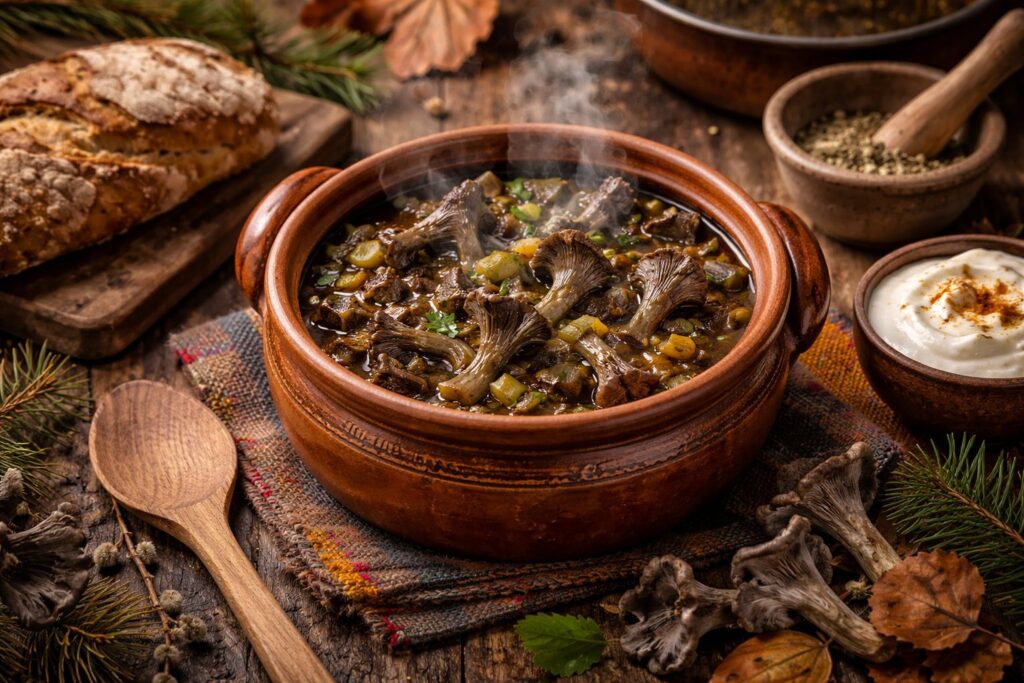
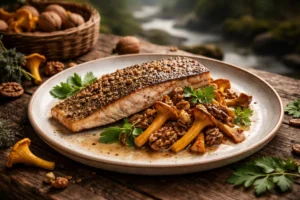
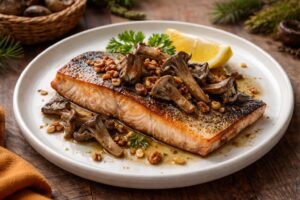
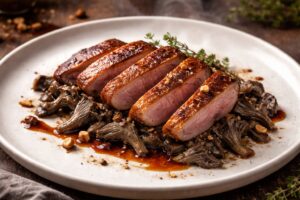
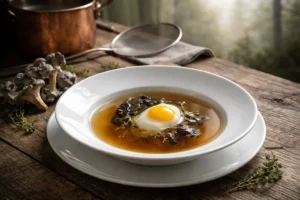
A sophisticated, woodland-inspired variation of the traditional Balkan slow-cook, featuring the smoky Cantharellus cinereus and the sweetness of winter leeks.
Gray Chanterelle & Leek Kavarma
The Thracian Autumn: Smoked Ash and the Silk of the Rhodope Valleys
The Historical Prelude: The Shepherd’s Clay Pot
The Kavarma is one of Bulgaria's most enduring culinary exports, traditionally a slow-simmered "dry stew" cooked in individual earthenware pots called gyuvetché. While meat is often the protagonist, the version found in the Rhodope and Rila mountains celebrates the "peppery ghost" of the forest—the Siv Pachi Krak (Gray Chanterelle).
Historically, the Gray Chanterelle was prized by Bulgarian mountain foragers specifically for its compatibility with leeks (praz), which are sweeter and more robust than onions in the Balkan winter. Because the Gray Chanterelle possesses a natural "ashy" smokiness and a firm, hollow structure, it does not collapse into the sauce like other fungi. Instead, it maintains its integrity, acting as a savory sponge for the aromatic oils of the leeks and the sharp, high-altitude paprika.
By the era of the Bulgarian National Revival, this "Lenten Kavarma" (Gubena Kavarma) became a staple for the wealthy merchants of Plovdiv and Koprivshtitsa. It was often served with a side of kachamak (maize porridge), bridging the gap between humble mountain foraging and the sophisticated, spice-heavy influences of the Silk Road. Today, this dish is the benchmark for the Bulgarian "Gourmet-Forest" movement, emphasizing the deep umami of wild-harvested species over mass-produced ingredients.
Narrative Intro: Bulgarian Kavarma is not a soup; it is a "reduction of spirit." Our philosophy for the Gray Chanterelle preparation is "Layered Osmosis." We allow the leeks to sweat their sugars until they become a transparent jam, then introduce the mushrooms to absorb that sweetness. The result is a savory-sweet-smoky complex that represents the true soul of the Bulgarian forest floor.
Sensory & Foraging Profile: The Humus and Beech-Root Terroir
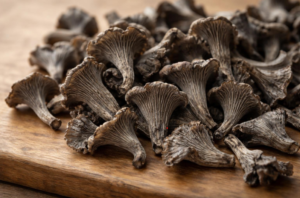
The Cantharellus cinereus of the Bulgarian ranges thrives in the heavy humus beneath ancient beech and oak trees. This specific environment results in a mushroom with a flinty, metallic finish and a scent profile that evokes wet slate, wild thyme, and toasted walnuts. Their dark, ashen color is a natural pigment that intensifies when cooked in clay.
Ethical Harvesting & The "Sredna Gora" Protocol: In the Bulgarian tradition, foragers use soft willow branches to gently sweep away the leaves covering the mushroom patches. We harvest only "The Gray Crown"—the outermost mushrooms of a colony—leaving the central mycelial network protected by a layer of pine needles or beech leaves. We strictly avoid harvesting during the midday sun to prevent the delicate "trumpets" from losing their essential oils, which are most concentrated at dawn.
Essential Equipment: The Balkan Station
Troyan Pottery Gyuvetché: Traditional clay pots with glazed interiors for the perfect slow-convection heat.
Wooden Spatula: To ensure the leeks are "sweated" rather than fried.
Copper Pan: For the initial high-heat "activation" of the Gray Chanterelles.
Mortar and Pestle: For hand-crushing the Chubritza (Summer Savory) to release its oils.
Master Recipe: Gray Chanterelle & Leek Kavarma
Stage 1: The Leek Foundation
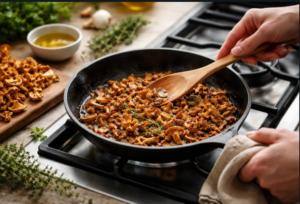
Slice 3 large winter leeks (white and light green parts only) into 1cm rings. In a heavy pan, melt 40g of butter with a splash of sunflower oil. Sauté the leeks on low heat for 15 minutes until they are soft and translucent. Do not let them brown.
Stage 2: The Mushroom Activation
Increase the heat to medium. Add 400g of fresh Gray Chanterelles (Siv Pachi Krak). The mushrooms will initially release their "forest water." Continue cooking until this liquid has almost entirely evaporated, concentrating the mineral flavors. This "dry-sear" is critical for the mushroom's texture.
Stage 3: The Bulgarian Spice Profile
Add 1 tablespoon of sweet Bulgarian Paprika, a pinch of hot chili flakes, and a generous amount of Chubritza (Summer Savory). Deglaze with 100ml of Mavrud or a dry white wine. The wine should be absorbed by the mushrooms, turning them glossy and dark.
Stage 4: The Clay Pot Finish (The “Bake”)
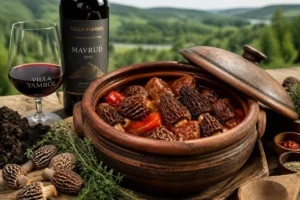
Divide the mixture into individual gyuvetché pots. Add a single whole tomato (peeled and diced) and a splash of vegetable stock. Cover the pots and place them in a 180°C oven for 25 minutes. This allows the clay to "marry" the flavors under gentle pressure.
Stage 5: The Presentation
Open the pots at the table to release the aromatic steam. Serve with a side of thick, strained Bulgarian yogurt and a crusty loaf of warm bread. The contrast between the hot, peppery mushrooms and the cold, acidic yogurt is a classic Bulgarian sensory experience.
Substitutions & Variations: The Luxury Palette
The Fat: For a more traditional mountain flavor, use rendered duck fat or smoked lard for the initial sauté.
The Spice: Add a pinch of Fenugreek (Sminduh) to enhance the earthy, nutty notes of the Gray Chanterelle.
The Mushroom: If fresh Gray Chanterelles are out of season, use rehydrated dried ones, using the soaking liquid as the braising stock.
Pro Technique: The “Paprika Tempering”
To avoid the common mistake of bitter paprika, always move the pan off the heat for 10 seconds before adding the spice. The oil should be hot enough to "bloom" the paprika's color and scent, but not hot enough to burn its sugars. This creates the signature vibrant red-orange "eye" of fat on top of the Kavarma.
The Umami Secret: Sulfur-Phenol Bridging
Leeks are rich in Organosulfur compounds. Gray Chanterelles contain a high density of Smoky Phenols. When these two molecules interact during a slow clay-pot bake, they form a "Flavor Bridge" that the human brain perceives as meat-like umami. This is why a well-made mushroom Kavarma can satisfy even the most committed carnivore—it is a chemical simulation of a high-protein feast.
The Art of Pairing: The Sommelier’s Selection
Sommelier's Choice: A Broad-Leaved Melnik. This indigenous Bulgarian wine has the tannic structure to handle the mushroom's minerals and the spicy finish to match the paprika.
Non-Alcoholic Alternative: A Salted Ayran with a touch of mint. The salt enhances the mushroom's savory notes while the mint echoes the forest's herbal character.
Micro-FAQ
Q: My Gray Chanterelles are slightly bitter. Why? A: You likely didn't cook off the "forest water" in Stage 2. That liquid contains the mushroom's raw tannins; it must be evaporated or discarded for a clean finish.
Q: Can I use Golden Chanterelles? A: Yes, but the dish will be much sweeter and less "smoky." The Gray Chanterelle is what gives this Kavarma its sophisticated, dark character.
Q: Why use clay pots instead of a regular pan? A: Clay is a porous material that absorbs and releases moisture, creating a unique "micro-steam" environment that keeps the leeks succulent and the mushrooms tender.
The Ashen Lexicon: Global Names for Cantharellus cinereus
The Ashen Chanterelle is a sophisticated relative of the golden chanterelle, prized for its deep, fruity aroma. Its regional names often describe its elegant grey-to-black coloration and trumpet-like hollow stem:
To provide the best experiences, we use technologies like cookies to store and/or access device information. Consenting to these technologies will allow us to process data such as browsing behavior or unique IDs on this site. Not consenting or withdrawing consent, may adversely affect certain features and functions.
Functional
Always active
The technical storage or access is strictly necessary for the legitimate purpose of enabling the use of a specific service explicitly requested by the subscriber or user, or for the sole purpose of carrying out the transmission of a communication over an electronic communications network.
Preferences
The technical storage or access is necessary for the legitimate purpose of storing preferences that are not requested by the subscriber or user.
Statistics
The technical storage or access that is used exclusively for statistical purposes.The technical storage or access that is used exclusively for anonymous statistical purposes. Without a subpoena, voluntary compliance on the part of your Internet Service Provider, or additional records from a third party, information stored or retrieved for this purpose alone cannot usually be used to identify you.
Marketing
The technical storage or access is required to create user profiles to send advertising, or to track the user on a website or across several websites for similar marketing purposes.