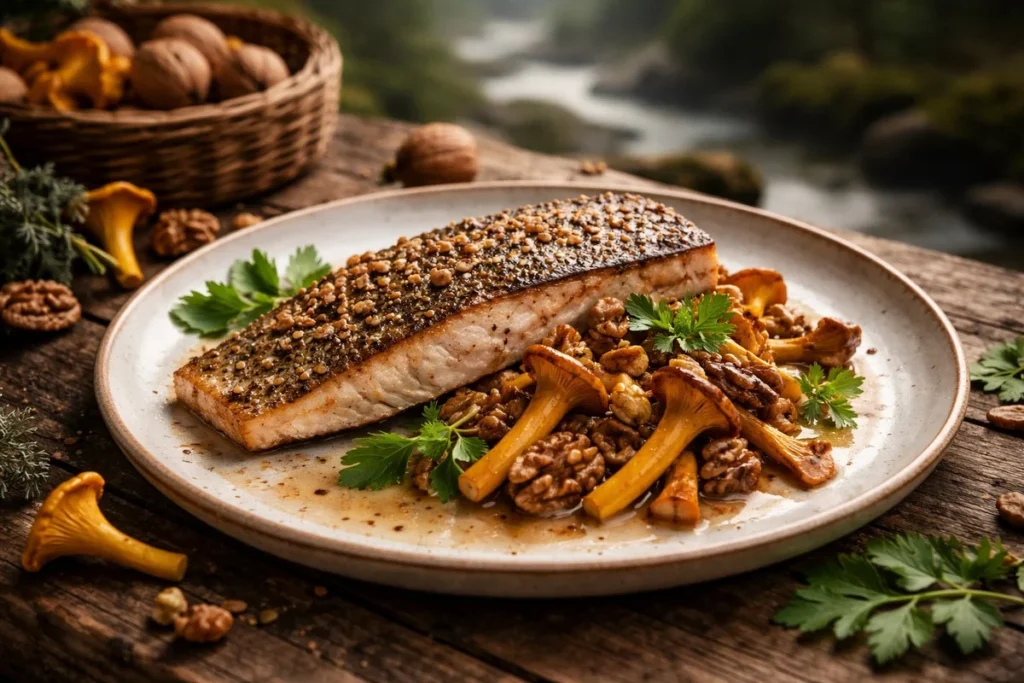
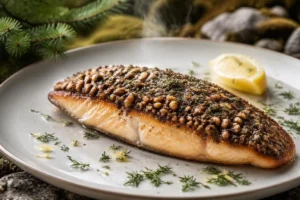
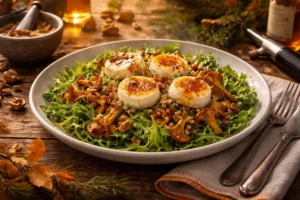
A technical study in the "Hidden Valleys" of the Rhodopes, featuring cold-water trout, crushed walnuts, and the apricot-scented Yellow Foot chanterelle.
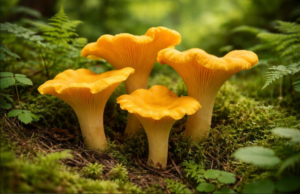
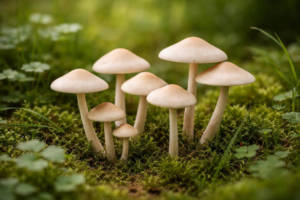
In the mystical, fog-draped peaks of the Rhodope Mountains, the relationship between the river and the forest is sacred. Historically, the local populations—and the monks of the ancient Bachkovo Monastery—celebrated the late autumn "Convergence." This was the moment when the mountain trout grew fat for the winter and the Yellow Foot Chanterelle (Craterellus lutescens), known locally as Siv pachi krak, began its golden bloom in the damp spruce hollows.
The Bulgarian approach to this pairing is defined by Minimalist Rusticism. Unlike the heavy creams of the North, the Rhodope kitchen utilizes Walnuts (Orehi)—the region's primary source of fat. The bitter tannins of the walnut skins were found to be the perfect counter-weight to the sweet, apricot-like esters of the Yellow Foot, creating a "Forest-Nut" crust that protected the delicate trout flesh during frying.
By the modern era, this dish has been refined by chefs in Plovdiv and Smolyan into a study of textures. It represents the "Vertical Terroir" of the Balkans: the cold mineral salt of the river, the fatty crunch of the orchard, and the peppery stone-fruit of the pine needle floor. It is a dish that tastes of the damp earth and the rushing water that defines the Southern Bulgarian landscape.
Narrative Intro: This dish is a study in "Mineral Friction." Our philosophy for Rhodope Trout is to use the walnut as a bridge between the river and the tree. The walnut's astringency acts as a palate cleanser, allowing the subtle, metallic minerals of the trout to coexist with the aromatic "flower-scent" of the Yellow Foot.
Sensory & Foraging Profile: The Humid Granite and Spruce Terroir
The Craterellus lutescens of the Rhodopes thrives in the acidic granite soils under ancient spruce and fir canopies. This terroir imparts a stronger peppery-smoke scent and an exceptionally bright, yellow-orange stem. The high altitude and rapid temperature shifts create a mushroom with a denser fiber, allowing it to maintain its shape even when sautéed with heavy nuts.
Ethical Harvesting & The "Balkan" Protocol: In the Rhodopes, we harvest only in the "Shadow Hour" (late afternoon), when the humidity is highest. We use hand-woven wicker baskets to allow the spores to return to the granite-rich earth. We strictly leave the "Elder Clusters"—the largest mushrooms in a patch—as they provide the strongest genetic link for the following year's mountain flushes.
Essential Equipment: The Rhodope Station
Steel Skillet: To achieve the "Paper-Thin" crispy skin required for mountain trout.
Stone Mortar (Havan): For roughly crushing walnuts to maintain their textural integrity.
Fine Tweezers: For the professional cleaning of the hollow stems.
Small Sieve: To dust a light, protective layer of flour over the fish skin.
Master Recipe: Rhodope Trout & Yellow Foot
Stage 1: The Trout Preparation
Clean 2 River Trout (300g each), filleted but skin-on. Pat the skin with salt and let it sit for 5 minutes to draw out moisture. Wipe dry and dust the skin side only with a very fine layer of cornflour for extra crunch.
Stage 2: The Walnut Toasting
In a dry pan, toast 60g of walnut halves until fragrant. Roughly crush them in a mortar. Do not turn them into a powder; you want "Golden Pebbles" of nut.
Stage 3: The Yellow Foot Sauté
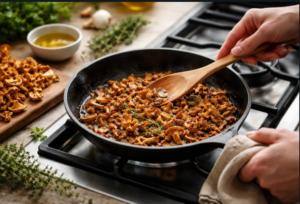
Heat 30g of butter in a pan. Add 300g of fresh Yellow Foot chanterelles. Sauté for 3 minutes until they release their apricot aroma. Add the crushed walnuts and a squeeze of lemon to create a "Nutty-Mushroom Crumble." Set aside and keep warm.
Stage 4: The Flash-Sear
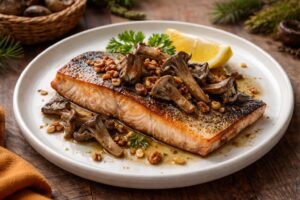
In a very hot skillet with a splash of oil, place the trout skin-side down. Press firmly for 30 seconds. Cook for 3 minutes until the skin is rigid and golden. Flip for only 30 seconds to finish the flesh. The center must remain moist.
Stage 5: The Assembly
Place the trout on the plate, skin-side up to maintain the crunch. Pile the Yellow Foot and walnut mixture generously over one half of the fish. Garnish with fresh lovage (devesil) or parsley.
Substitutions & Variations: The Luxury Palette
The Fat: Use Ghee (clarified butter) for the sauté to achieve a higher smoke point and a deeper toasted flavor.
The Herb: Use Fresh Lovage; its celery-anise profile is the traditional Bulgarian partner for trout.
The Mushroom: If fresh Yellow Feet are unavailable, use Bulgarian Porcini (Manatarka), but add a drop of apricot nectar to the pan to mimic the Yellow Foot's scent.
Pro Technique: The “Walnut-Skin” Tannin Control
The secret of the Rhodope kitchen is to leave the skins on the walnuts. When the skins hit the hot butter alongside the Yellow Foot, they release polyphenols that act as a natural bittering agent. This prevents the "sweet" mushroom and the "sweet" trout fat from becoming cloying, providing a sophisticated, adult finish to the dish.
The Umami Secret: Juglone and Linalool Synergy
The **Walnuts** contain Juglone (a natural naphthoquinone). The **Yellow Foot** contains Linalool (floral esters). When these interact with the **Omega-3 Fatty Acids** of the trout, they form a "Flavor Shield" that preserves the delicate taste of the river fish while amplifying the earthy notes of the mushroom. It is a biological lock-and-key for mountain cuisine.
The Art of Pairing: The Sommelier’s Selection
Sommelier's Choice: A Bulgarian Mavrud (Rose) or a crisp Misket from Karlovo. The high acidity and floral notes bridge the gap between the walnuts and the mushrooms.
Non-Alcoholic Alternative:Chilled Elderflower and Walnut Leaf Tea. The floral sweetness and herbal bitterness mimic the dish's internal logic.
Micro-FAQ
Q: Why is my trout skin sticking? A: Your pan wasn't hot enough, or the fish skin was still wet. High heat and absolute dryness are the only way to achieve a "Glass-Skin" finish.
Q: Can I use regular Pachi Krak (Golden Chanterelle)? A: Yes, but the Siv Pachi Krak (Yellow Foot) is more delicate and peppery. If using regular ones, chop them smaller to match the walnut texture.
Q: What is Lovage? A: Known as Devesil in Bulgaria, it is an herb that tastes like a cross between celery, parsley, and anise. It is the essential herb for Bulgarian fish dishes.
To provide the best experiences, we use technologies like cookies to store and/or access device information. Consenting to these technologies will allow us to process data such as browsing behavior or unique IDs on this site. Not consenting or withdrawing consent, may adversely affect certain features and functions.
Functional
Always active
The technical storage or access is strictly necessary for the legitimate purpose of enabling the use of a specific service explicitly requested by the subscriber or user, or for the sole purpose of carrying out the transmission of a communication over an electronic communications network.
Preferences
The technical storage or access is necessary for the legitimate purpose of storing preferences that are not requested by the subscriber or user.
Statistics
The technical storage or access that is used exclusively for statistical purposes.The technical storage or access that is used exclusively for anonymous statistical purposes. Without a subpoena, voluntary compliance on the part of your Internet Service Provider, or additional records from a third party, information stored or retrieved for this purpose alone cannot usually be used to identify you.
Marketing
The technical storage or access is required to create user profiles to send advertising, or to track the user on a website or across several websites for similar marketing purposes.