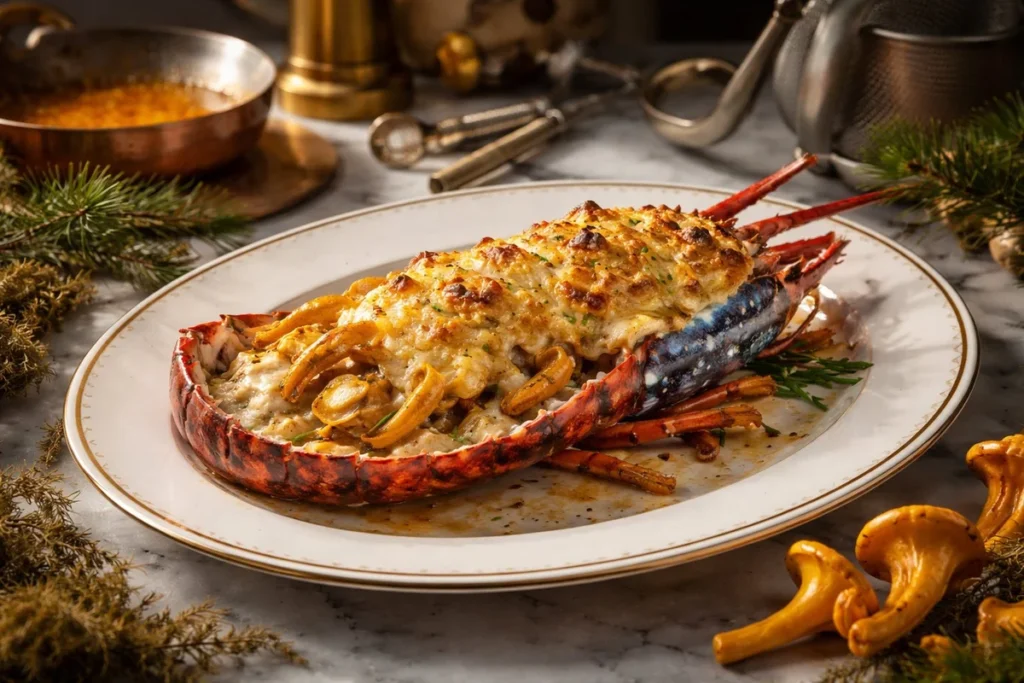
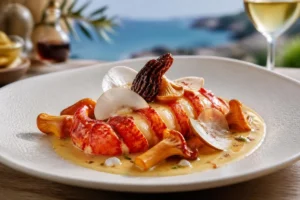
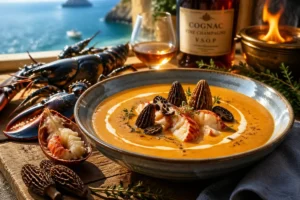
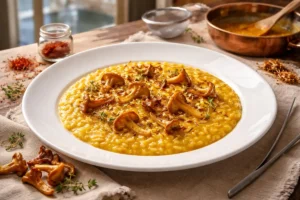
The origin of Homard Thermidor is a masterpiece of culinary theater. Named after the eleventh month of the French Republican Calendar, the dish was premiered on January 24, 1894, at the Maison Maire in Paris, specifically created by the legendary chef Auguste Escoffier to celebrate the opening of Victorien Sardou's play, Thermidor. While the original Parisian recipe focused on mustard and cream, the coastal masters of Brittany (Bretagne) introduced a seasonal variant that utilized the forests bordering the Atlantic.
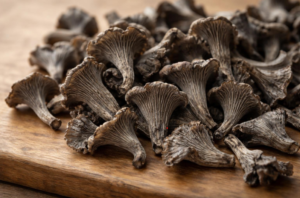
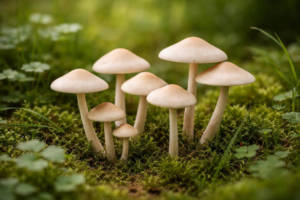
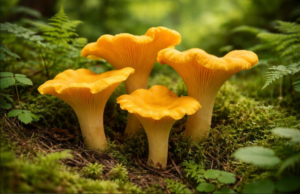
In the late 19th century, the Yellow Foot Chanterelle (Craterellus lutescens) was a prized find in the humid, mossy woodlands of the Finistère. Coastal chefs realized that the blue lobster of the Atlantic, known for its sweet, firm flesh, possessed a chemical profile that mirrored the stone-fruit esters of the Yellow Foot. By incorporating these "Autumnal Trumpets" into the rich brandy-infused béchamel, they bridged the gap between the brine of the ocean and the damp minerals of the French forest.
This evolution of Thermidor represents the peak of Belle Époque luxury. It was a dish favored by the maritime aristocracy, often served during the final hunts of the season before the winter freeze. The Yellow Foot provides a necessary peppery lift to the heavy cream, ensuring that the lobster's delicate sweetness remains the protagonist while being supported by the complex, apricot-scented background of the woods.
Narrative Intro: This dish is an "Oceanic Orchard." Our philosophy for the Breton Thermidor is to treat the Yellow Foot as a biological aromatic. We utilize the mushroom's hollow structure to trap the Calvados reduction, creating "flavor capsules" that explode with fruitiness when bitten into alongside the saline lobster meat.
Sensory & Foraging Profile: The Saline-Peat Terroir
The Craterellus lutescens of the Atlantic Fringe grows in the acidic, peaty soils beneath maritime pines and beech trees. This specific terroir, perpetually misted by the salt-spray of the Atlantic, produces a mushroom with a high iodine-to-linalool ratio. The scent is reminiscent of dried apricots dusted with sea salt.
Ethical Harvesting & Professional Protocols: In the Brittany woods, we utilize the "Vertical Extraction" method—using a brush to clear pine needles before a clean cut with a ceramic blade to avoid oxidation. Following the "20-80 Rule," professional foragers only harvest 20% of a colony to ensure that the underground mycelial network remains robust enough to withstand the coastal winter storms.
Essential Equipment: The Seafood Station
Copper Sauté Pan: For the precise, even reduction of the cognac-based cream sauce.
Lobster Crackers & Picks: To extract the claw meat without damaging the delicate muscle fibers.
Kitchen Torch or Salamander: To achieve the traditional "Thermidor Crust" without overcooking the meat.
Fine Mesh Chinois: To ensure the béchamel base is perfectly smooth before adding the mushrooms.
Master Recipe: Lobster Thermidor & Yellow Foot
Stage 1: The Poaching & Extraction
Prepare a Court-Bouillon with white wine, peppercorns, and bay leaf. Blanch two 800g Brittany Blue Lobsters for 4 minutes. Shock in ice water. Split the shells lengthwise, remove the meat, and cut into 2cm medallions. Retain the shells for serving.
Stage 2: The Forest Sauté
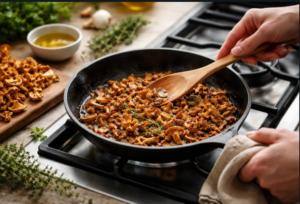
In a hot pan with Isigny AOP butter, sauté 300g of fresh Yellow Foot chanterelles. Once they release their liquid, add one finely minced shallot and a splash of Cognac. Flambé to remove the alcohol, leaving only the oak and grape essence.
Stage 3: The Thermidor Emulsion
Whisk together 200ml of Crème Fraîche, 1 tsp of Dijon mustard, and a pinch of cayenne pepper. Fold this into the mushroom pan. Add the lobster meat and simmer for 60 seconds to coat the protein in the yellow-gold cream.
Stage 4: The Final Garnish & Glaze
Spoon the mixture back into the lobster shells. Top with a light dusting of Gruyère AOP and fresh breadcrumbs. Place under a salamander or hot grill for 2 minutes until bubbling and golden.
Substitutions & Variations: The Luxury Palette
The Shellfish: If Blue Lobster is unavailable, Langoustines provide an even sweeter, more delicate profile.
The Cheese: Replace Gruyère with Comté (24-month) for a more pronounced nutty/floral finish.
The Spirit: Use Calvados instead of Cognac to emphasize the mushroom's apple-apricot esters.
Pro Technique: The “Coral Infusion”
Take the lobster coral (roe) and whisk it into the butter before sautéing the mushrooms. The coral will turn bright red and infuse the fat with a profound marine umami that acts as a base note for the high-frequency fruit scents of the Yellow Foot.
The Umami Secret: Glutamate-Nucleotide Synergies
The **Lobster** is a powerhouse of Inosinate (IMP), while the **Yellow Foot** contains high levels of Guanylate (GMP). When these two nucleotides meet in the presence of Glutamic Acid (found in the cream and cheese), the perceived umami intensity is multiplied by eight times. This is why Thermidor feels so "filling" despite its delicate ingredients.
The Art of Pairing: The Sommelier’s Selection
Sommelier's Choice: A Meursault (Burgundy). The wine's hazelnut and buttery notes mirror the Thermidor sauce, while its acidity handles the lobster fat.
Non-Alcoholic Alternative:Verjuice and Sparkling Water. The high acidity and unripe grape notes mimic the structure of a premium Chardonnay.
Storage & Reheating
Lobster Thermidor should be consumed immediately. However, if stored, keep in a sealed container for max 24 hours. **Reheating:** Do not microwave. Place in a 120°C oven covered with foil for 8 minutes to restore the cream's emulsion without toughening the lobster meat.
Ancestral Nutrition
Yellow Foot chanterelles are a rare non-animal source of Vitamin D2 and are exceptionally high in Selenium. Historically, Breton coastal communities used mushroom infusions as a tonic for "Ocean-Mist Lung" (bronchitis), believing the forest minerals cleared the sea-salt from the respiratory system.
Micro-FAQ
Q: Why is it called Thermidor? A: It honors the month of Thermidor (July/August) in the French Revolutionary calendar, though the dish itself is a classic for the late autumn/winter season.
Q: Can I use frozen lobster? A: It is possible, but the texture will be significantly softer. Freshness is key to the structural integrity of the medallions.
Q: Are Yellow Feet poisonous if undercooked? A: No, but they contain chitin that is hard to digest. Sautéing them for at least 3 minutes is recommended for gastrointestinal comfort.
To provide the best experiences, we use technologies like cookies to store and/or access device information. Consenting to these technologies will allow us to process data such as browsing behavior or unique IDs on this site. Not consenting or withdrawing consent, may adversely affect certain features and functions.
Functional
Always active
The technical storage or access is strictly necessary for the legitimate purpose of enabling the use of a specific service explicitly requested by the subscriber or user, or for the sole purpose of carrying out the transmission of a communication over an electronic communications network.
Preferences
The technical storage or access is necessary for the legitimate purpose of storing preferences that are not requested by the subscriber or user.
Statistics
The technical storage or access that is used exclusively for statistical purposes.The technical storage or access that is used exclusively for anonymous statistical purposes. Without a subpoena, voluntary compliance on the part of your Internet Service Provider, or additional records from a third party, information stored or retrieved for this purpose alone cannot usually be used to identify you.
Marketing
The technical storage or access is required to create user profiles to send advertising, or to track the user on a website or across several websites for similar marketing purposes.