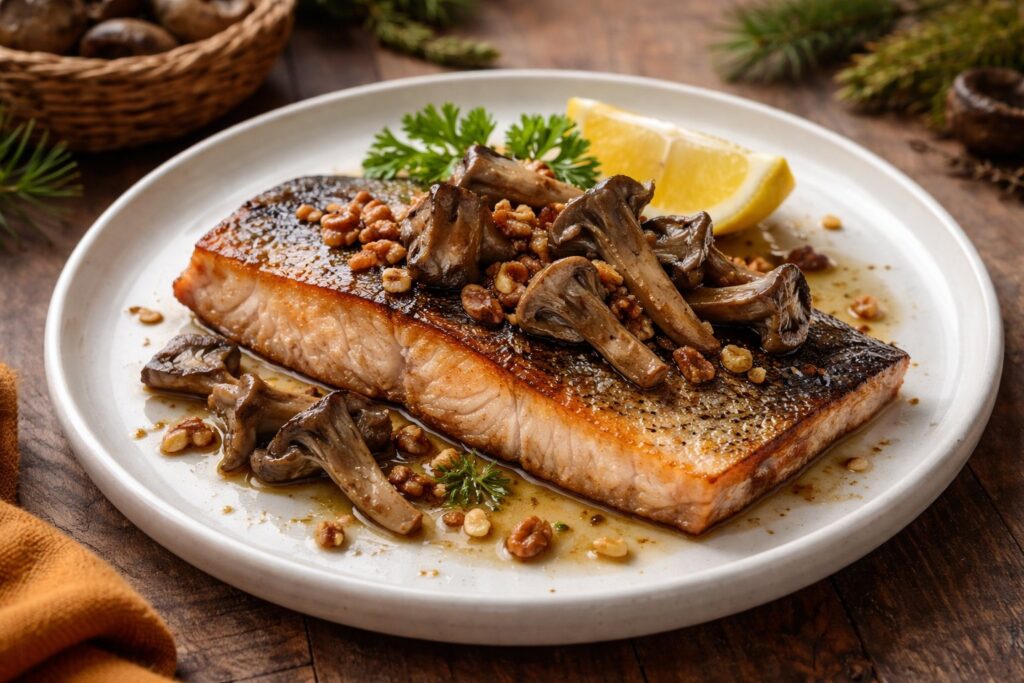
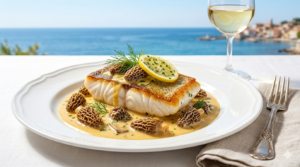
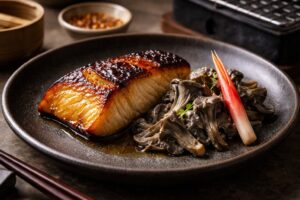
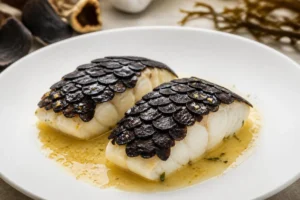
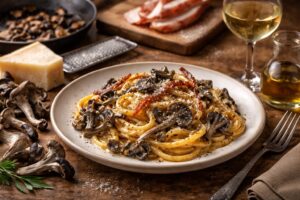
A technical study in the textures of the Rhodope Mountains, pairing the peppery Cantharellus cinereus with fresh-caught trout and the buttery crunch of local walnuts
Rhodope Trout & Gray Chanterelle
The River's Edge: Silver Scales and the Smoke of the Pine Forest
The Historical Prelude: The High-Altitude Harvest
In the crystalline streams of the Rhodope Mountains, the wild river trout (Pastrava) has long been the primary source of protein for the "Mountain People." However, a specific culinary tradition exists in the villages of Shiroka Laka and Dospat where the fish is never served without the "Grey Ghost" of the forest—the Siv Pachi Krak (Gray Chanterelle).
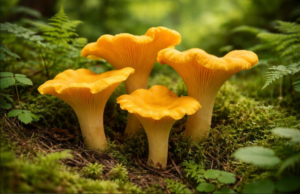
Historically, this pairing was a seasonal necessity. As the trout became more active in the cooling autumn waters, the Gray Chanterelle would flourish in the damp moss under the nearby conifers. Bulgarian mountain foragers realized that the high mineral content of the trout's flesh required a mushroom with a peppery, metallic finish to balance its natural sweetness. The addition of crushed walnuts—a staple of Bulgarian orchards—provided the necessary tannins and fats to bind these two wild elements together.
By the mid-20th century, this preparation was adopted by the "Forest Lodges" of the Bulgarian elite. It is a dish that eschews the heavy cream sauces of the West in favor of nut-oil emulsions and the raw, unadulterated flavor of the wild-harvested fungi. Today, it stands as the ultimate expression of the "River-Forest" continuum, where the minerals of the mountain peaks flow through the water and the soil to meet on a single plate.
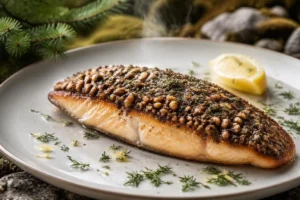
Narrative Intro: The trout is a creature of "Snap and Silk." Our philosophy for the Gray Chanterelle pairing is "Thermal Synchronization." We sear the fish skin to a glass-like crackle while simultaneously "frying" the mushrooms in walnut butter to a slightly chewy, jerky-like state. The result is a dish where the textures are as loud as the flavors, echoing the crunch of dry pine needles underfoot.
Sensory & Foraging Profile: The Conifer-Needle and Silt Terroir
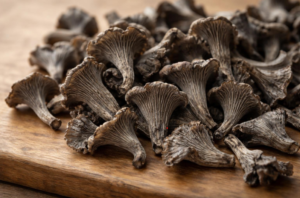
The Cantharellus cinereus of the Rhodope ranges grows almost exclusively in the acidic duff beneath spruce and pine trees. This produces a mushroom with a pronounced resinous scent and a flavor profile that evokes toasted grain, cold ash, and black pepper. Their firm, hollow structure makes them ideal for absorbing the intense, nutty oils of the walnuts.
Ethical Harvesting & The "Needle-Bed" Protocol: In Bulgaria, we follow the "Dry Hands" rule—harvesting Gray Chanterelles only when the morning dew has completely evaporated. This prevents the delicate, trumpet-shaped gills from absorbing excess water, which would ruin their "sear" potential. We use hand-woven hazelnut baskets to transport the mushrooms, ensuring they remain aerated and that their spores continue to seed the forest floor as we walk back toward the river.
Essential Equipment: The River Station
Blue Steel Pan: Critical for achieving a parchment-thin, crispy trout skin without overcooking the delicate flesh.
Stone Mortar: For "bruising" the walnuts to release their natural oils without turning them into a paste.
Fish Spatula: To ensure the trout is flipped only once, maintaining the integrity of the Maillard crust.
Cedar Plank (Optional): For a final "smoke-finish" if serving in a rustic outdoor setting.
Master Recipe: Rhodope Trout & Gray Chanterelles
Stage 1: The Trout Preparation
Butterfly two fresh river trout (approx. 300g each). Dry the skin thoroughly with a cloth. Rub the skin side with a very small amount of salt and a drop of sunflower oil. This "draws" out the moisture, ensuring a crisp result.
Stage 2: The Walnut Infusion
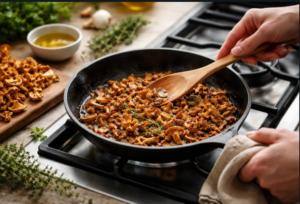
In a small pan, gently toast 50g of Bulgarian walnuts until they release their aroma. Add 30g of butter and a sprig of fresh thyme. As the butter foams, the walnut oils will emulsify into it. Set this "nut-butter" aside.
Stage 3: The Mushroom Flash-Fry
Heat a skillet to high. Add 250g of whole Gray Chanterelles. Cook dry for 2 minutes until they shrink and brown slightly. Pour in half of the walnut butter. The mushrooms will "hiss" and absorb the fat, becoming glossy and intense. Season with black pepper.
Stage 4: The Skin-Side Sear
In your steel pan, place the trout skin-side down. Press firmly with a spatula for 10 seconds to prevent the fish from curling. Cook for 3 minutes on the skin side only. Flip and cook for only 30 seconds on the flesh side. This ensures the trout remains succulent and "translucent" in the center.
Stage 5: The “Mountain Marriage”
Plate the trout skin-side up. Spoon the Gray Chanterelles and the remaining walnut butter directly over the fish. Garnish with a squeeze of lemon to brighten the forest minerals and a sprinkle of fresh parsley.
Substitutions & Variations: The Luxury Palette
The Fat: Replace the butter with cold-pressed walnut oil for a more intense, modern Bulgarian flavor profile.
The Nut: Use Hazelnuts if you wish to emphasize the mushroom's natural toasted-grain notes.
The Acid: Use Pomegranate molasses instead of lemon for a darker, sweet-sour Middle-Eastern influence common in the Southern Rhodopes.
Pro Technique: The “Press-Release” Sear
To achieve the "shatter-crisp" skin found in high-end Sofia restaurants, do not move the fish after the initial press. The skin needs to stay in direct contact with the hot steel to render the subcutaneous fat. If the skin sticks, it is not ready. Once the fat has fully rendered, the trout will "release" itself from the pan naturally.
The Umami Secret: Polyunsaturated Fat and Chitin Interaction
Walnuts are rich in Omega-3 fatty acids, which have a high affinity for the Chitin molecules in the Gray Chanterelle. When the mushrooms are seared in walnut butter, the fats penetrate the mushroom's cell walls, creating a "sustained umami" effect. The peppery notes of the mushroom are rounded out by the bitterness of the walnut skin, creating a flavor loop that mimics the taste of aged, high-quality mountain cheese.
The Art of Pairing: The Sommelier’s Selection
Sommelier's Choice: A Tamianka (Bulgarian Muscat). This wine's floral, spicy notes act as a bright "light" against the dark, smoky minerals of the Gray Chanterelle and the oily trout.
Non-Alcoholic Alternative: A Chilled Elderflower and Wild Thyme Soda. The floral and herbal profile echoes the Rhodope riverbank in spring.
Micro-FAQ
Q: Why did my trout skin stick to the pan? A: Either the pan wasn't hot enough, or you used a non-stick pan (which doesn't conduct heat as aggressively as steel). Use a steel or cast-iron pan for the best results.
Q: Can I use Golden Chanterelles? A: You can, but they are more delicate and will not hold up to the walnut oils as well as the robust, peppery Gray Chanterelle.
Q: Is it necessary to toast the walnuts? A: Yes. Raw walnuts have a "green" flavor that can overpower the mushrooms. Toasting them unlocks the "roasted" notes that bridge the gap to the smoky Gray Chanterelle.
The Ashen Lexicon: Global Names for Cantharellus cinereus
The Ashen Chanterelle is a sophisticated relative of the golden chanterelle, prized for its deep, fruity aroma. Its regional names often describe its elegant grey-to-black coloration and trumpet-like hollow stem:
To provide the best experiences, we use technologies like cookies to store and/or access device information. Consenting to these technologies will allow us to process data such as browsing behavior or unique IDs on this site. Not consenting or withdrawing consent, may adversely affect certain features and functions.
Functional
Always active
The technical storage or access is strictly necessary for the legitimate purpose of enabling the use of a specific service explicitly requested by the subscriber or user, or for the sole purpose of carrying out the transmission of a communication over an electronic communications network.
Preferences
The technical storage or access is necessary for the legitimate purpose of storing preferences that are not requested by the subscriber or user.
Statistics
The technical storage or access that is used exclusively for statistical purposes.The technical storage or access that is used exclusively for anonymous statistical purposes. Without a subpoena, voluntary compliance on the part of your Internet Service Provider, or additional records from a third party, information stored or retrieved for this purpose alone cannot usually be used to identify you.
Marketing
The technical storage or access is required to create user profiles to send advertising, or to track the user on a website or across several websites for similar marketing purposes.