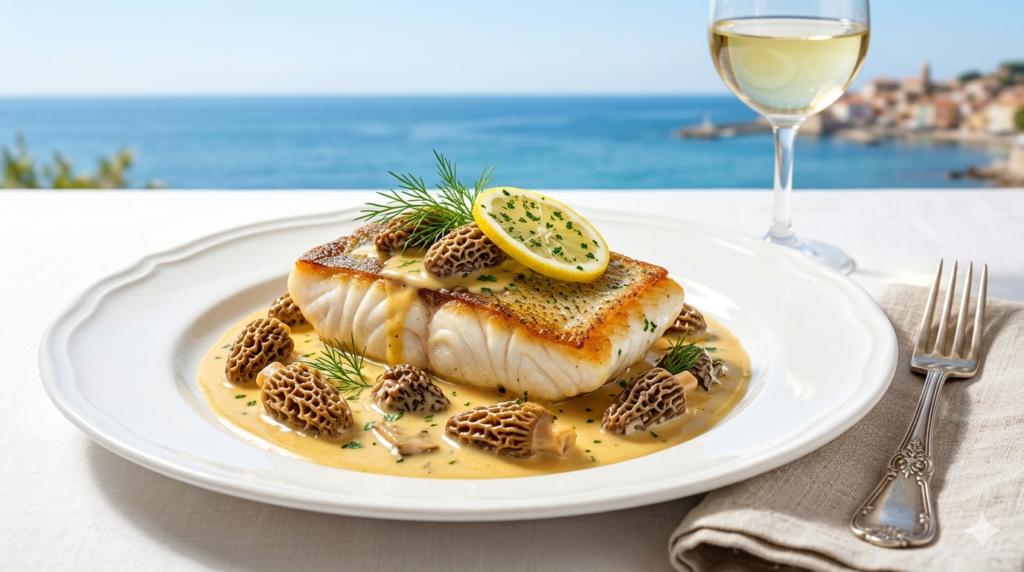
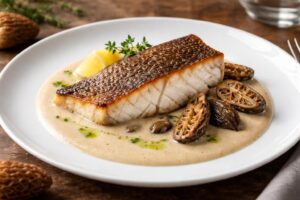
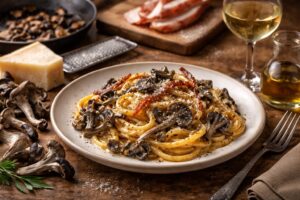
An exquisite marine symphony pairing the delicate flake of wild-caught white fish with the prestigious, smoky depth of the Morchella.
The Shore & Shadow Harmony
Wild Turbot or Sea Bass with a Silken Morel and Chablis Reduction
The Historical Prelude
The marriage of noble white fish and Morchella (Morel) mushrooms represents the culinary intersection of the Atlantic Fringes and the deep forests of the French Savoie. In the 19th century, this pairing became a hallmark of the Grand Cuisine served at the Élysée Palace. While the commoners of the coastline paired fish with lemon and herbs, the royal chefs realized that the morel's earthy, nut-like volatiles were the perfect structural bridge to the delicate, iodine-rich fats of cold-water fish.
It was Auguste Escoffier who famously noted that the "Black Morel" possessed a meat-like character that could provide the "bass notes" to a dish, while the fish provided the "soprano." This dish, often prepared for state banquets during the brief spring morel season, symbolized the monarch's reach from the sea to the highest mountain clearings. Today, it remains the ultimate expression of Western European seasonal luxury—a "surf and turf" for the refined palate.
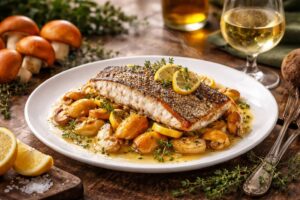
This dish is an exploration of the Maillard-Iodine Bond. The objective is to achieve a glass-like crispness on the fish skin while maintaining a translucent, succulent interior. The morel sauce is not a condiment; it is a Lipid Carrier. Because morels are hollow, they trap the wine and butter emulsion, releasing it only when bitten, providing a rhythmic contrast to the soft texture of the fish.
Sensory & Foraging Profile
Nomenclature:Morchella esculenta (Yellow Morel) and Psetta maxima (Turbot) or Dicentrarchus labrax (Sea Bass).
Terroir: The morels for this preparation are best sourced from the Atlantic Fringes, where the proximity to the sea air adds a faint mineral salinity to the mushroom's profile. The fish must be line-caught from the cold waters of the Bay of Biscay or the North Sea to ensure the firm cellular structure required for pan-searing.
Professional Protocol: We emphasize the "Cold-Chain Integrity." Both the fish and the morels must be kept at precisely 2°C until the moment they touch the pan. In accordance with "Leave No Trace" ethics, we only utilize morels that have been field-cleaned to ensure the forest's organic matter remains on the forest floor to nourish the host trees.
Essential Equipment
Heavy Stainless Steel Sauté Pan: For high-precision heat control and Maillard reaction.
Fish Spatula (Offset): For turning the delicate fillets without fracturing the skin.
Chinois (Fine Mesh Strainer): For refining the morel reduction into a molecularly smooth emulsion.
Master Recipe
Stage 1: The Protein Sear
400g White Fish Fillets (Skin-on). Pat bone-dry with linen.
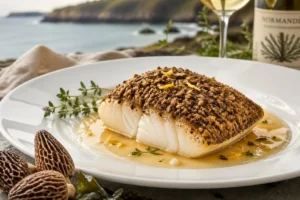
Sear skin-side down in clarified butter over medium-high heat for 4 minutes. Once the skin is "glassy," flip and cook for only 60 seconds. Remove and rest.
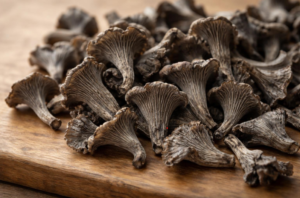
If using 30g Dried (300g Fresh equivalent), reserve the filtered rehydration liquid.
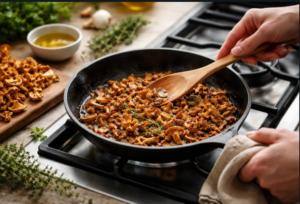
In the same fish pan, sauté the morels with 1 finely minced French shallot. The morels will "deglaze" the pan, absorbing the fish proteins.
Stage 3: The Chablis Emulsion
Pour in 80ml of Chablis (or other high-acid dry white wine). Reduce by 70%.
Add 150ml of heavy double cream and any reserved mushroom nectar. Simmer until the sauce reaches *nappe* consistency.
Finish with a whisper of fresh tarragon and a knob of cold butter (Monter au Beurre). Spoon generously around the rested fish.
The Umami Secret: The 1:10 Nucleotide Synergy
The "Pure Umami" of this dish is achieved through Ribonucleotide Bonding. White fish is rich in Inosinate, while Morels (especially when dried and restored at the 1:10 ratio) are packed with Guanylate. When these two molecules meet in the presence of the Glutamates in the cream, the savory perception is increased exponentially. This "Umami Trinity" is what gives the dish its legendary depth and "long" finish on the palate.
Pro Technique: The “Arrosé” Basting
To achieve a 3-star Michelin finish, baste the fish skin with the foaming morel-butter during the final minute of cooking. This "Arrosé" technique ensures the heat is evenly distributed while the mushroom-infused lipids penetrate the fish skin, adding an extra layer of aromatic complexity.
The Art of Pairing
Sommelier's Choice: A Puligny-Montrachet or an oaked Chardonnay from the Dolomites. the wine's lactic notes mirror the cream, while its mineral acidity cuts through the fish oils and mushroom earthiness.
Non-Alcoholic: A chilled infusion of White Tea and dried apple skin, providing a crisp, tannic counterpoint.
Ancestral Nutrition
This dish is a powerhouse of Vitamin D, Omega-3 Fatty Acids, and Selenium. Historically, in the **French Atlantic** villages, this meal was served to celebrate the first spring fishing hauls, believed to "recharge the marrow" after the long winter months.
Micro-FAQ
Q: Why is the 1:10 ratio critical for the fish sauce? A: Because 30g of dried morels provides the flavor density of 300g of fresh ones, but without the excess moisture that would make the fish skin lose its crispness.
Q: Can I use Salmon? A: You can, but the high fat content and strong flavor of Salmon can compete with the morel. A neutral, lean white fish is the "Royal" choice for this specific Pure Umami profile.
The Morel Lexicon: Regional Names for Morchella
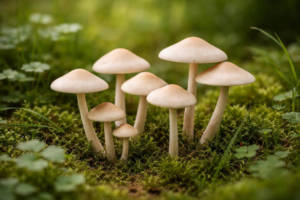
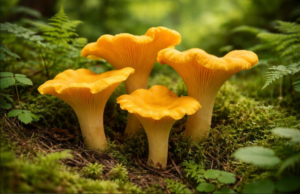
The Morel is the undisputed queen of the spring forest. Its honeycomb structure and deep earthy aroma have earned it legendary status in cuisines from the Himalayas to the Appalachian Mountains:
Language
Regional & Folk Names
Cultural Context
English
Morel, Yellow Morel, Sponge Mushroom, Dryland Fish
"Dryland fish" is a popular folk name in the American South.
French
Morille, Morille blonde, Morille ronde
A staple of classic French haute cuisine.
German
Speisemorchel, Rund-Morchel
Highly valued in Alpine culinary traditions.
Bulgarian
Смърчкула, Пумпалка, Корминка, Мрежовка
"Pumpalka" refers to its spinning-top shape.
Romanian
Zbârciog, Ciuciulete, Попеască
"Zbârciog" is the most common term in Romanian folklore.
Russian / Polish
Сморчок (Smorchok) / Smardz jadalny
Considered a sign of the real spring's arrival.
Italian / Spanish
Spugnola / Colmenilla, Morilla
"Spugnola" (Italy) and "Colmenilla" (Spain) refer to the sponge/honeycomb look.
Turkish
Kuzu Göbeği Mantarı
Literally "Lamb's Belly" mushroom, a gourmet export of Turkey.
Japanese / Chinese
Amigasa-take (アミガサタケ) / Yangdujun
In China, it is highly valued for its medicinal properties.
Nordic (SE/NO/DK)
Toppmurkla / Rund morkel
A highly anticipated spring find in Scandinavia.
Scientific identification: Genus: Morchella | Pure Umami Research 2026
To provide the best experiences, we use technologies like cookies to store and/or access device information. Consenting to these technologies will allow us to process data such as browsing behavior or unique IDs on this site. Not consenting or withdrawing consent, may adversely affect certain features and functions.
Functional
Always active
The technical storage or access is strictly necessary for the legitimate purpose of enabling the use of a specific service explicitly requested by the subscriber or user, or for the sole purpose of carrying out the transmission of a communication over an electronic communications network.
Preferences
The technical storage or access is necessary for the legitimate purpose of storing preferences that are not requested by the subscriber or user.
Statistics
The technical storage or access that is used exclusively for statistical purposes.The technical storage or access that is used exclusively for anonymous statistical purposes. Without a subpoena, voluntary compliance on the part of your Internet Service Provider, or additional records from a third party, information stored or retrieved for this purpose alone cannot usually be used to identify you.
Marketing
The technical storage or access is required to create user profiles to send advertising, or to track the user on a website or across several websites for similar marketing purposes.