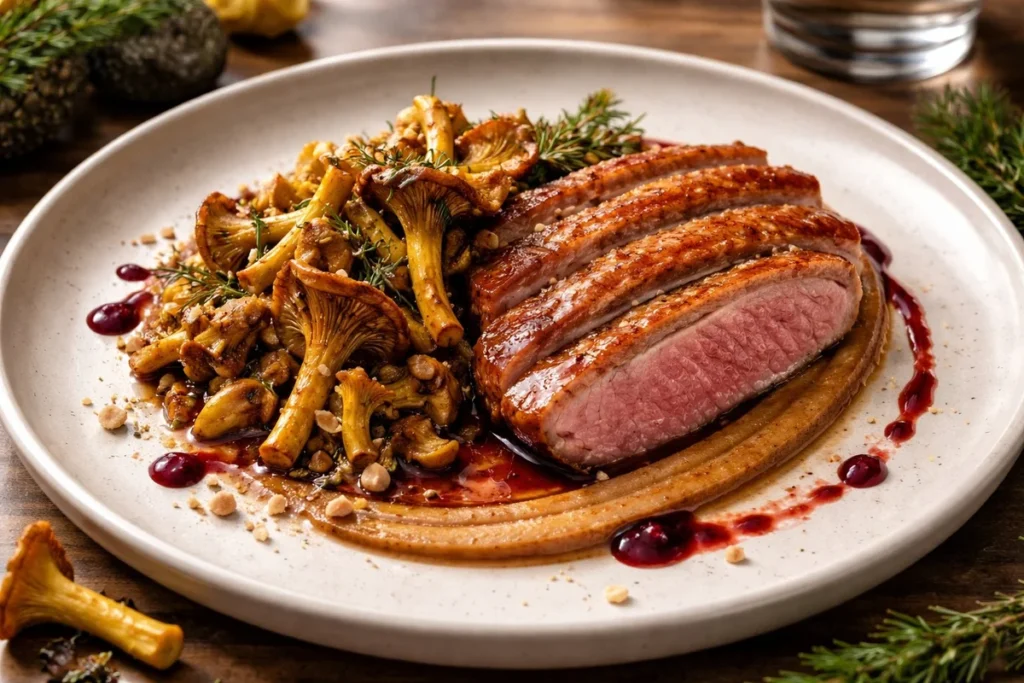
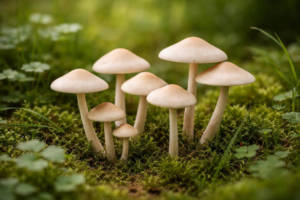
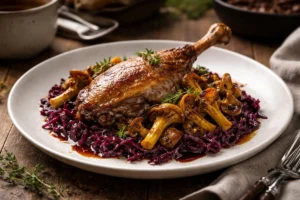
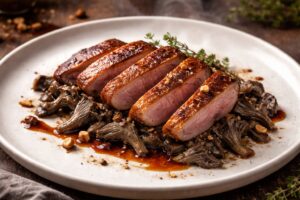
A sophisticated study in Pacific Northwest "High-Elevation" synergy, featuring pan-seared duck breast, roasted hazelnuts, and the apricot-scented Yellow Foot chanterelle.
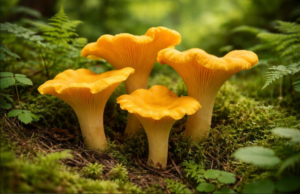
In the Pacific Northwest of the United States—specifically the mist-shrouded corridors of the Oregon Coast Range—the autumn harvest is a symphony of fat and fungi. Historically, the indigenous peoples and later pioneers of the Willamette Valley recognized a seasonal miracle: the arrival of migrating ducks coincided perfectly with the flushing of Yellow Foot Chanterelles (Craterellus lutescens) in the rain-soaked Douglas fir forests.
The Yellow Foot is often referred to locally as the "Winter Chanterelle." In the volcanic, mineral-rich soils of Oregon, these mushrooms develop a sugar-plum and peppery profile that is remarkably intense. Oregonian chefs in the 1990s, inspired by the French masters of the Willamette wine industry, began pairing this "Forest Apricot" with the state's other great crop: Hazelnuts.
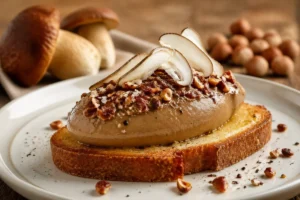
The technical evolution of this dish reached its peak with the introduction of the Savory Hazelnut Praliné. By grinding toasted hazelnuts into a smooth, savory paste and incorporating it into a duck reduction, chefs created a luxurious, fatty medium that captured the volatile aromatics of the Yellow Foot. It is a dish that defines the "Modern Cascadian" palate—heavy on minerals, high in fat, and deeply rooted in the damp, mossy silence of the woods.
Narrative Intro: This dish is a study in "Textural Fat." Our philosophy for Oregon Duck is to use the hazelnut as a chemical conductor. The hazelnut oil acts as a solvent for the mushroom's apricot esters, while the duck's rendered fat provides the weight. The result is a dish where the forest doesn't just sit on the plate—it is integrated into every fiber of the protein.
Sensory & Foraging Profile: The Douglas Fir and Basalt Terroir
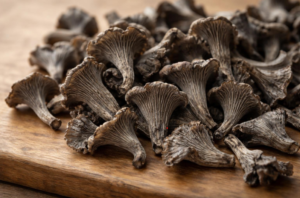
The Craterellus lutescens of Oregon is unique due to its growth in basalt-derived volcanic soils. This imparts a sulfuric-sweet edge that mimics the smell of overripe tropical fruit. They thrive in the "Drip Zone" of old-growth Douglas firs, where the constant moisture creates a mushroom with a high-snap texture and an exceptionally deep, neon-yellow stem.
Ethical Harvesting & The "Cascadian" Protocol: In Oregon, we harvest using the "Aeration Cut." By slicing the hollow stem at an angle, we prevent water from pooling in the remaining stump, which can cause the mycelium to rot in the heavy Pacific rains. We strictly harvest only in secondary-growth forests to allow the old-growth patches to act as spore-banks for the entire ecosystem.
Essential Equipment: The Oregon Station
Cold-Start Skillet: Essential for rendering duck fat slowly to achieve a "Glass-Like" crispy skin.
High-Speed Blender: For creating the ultra-smooth hazelnut praliné emulsion.
Offset Spatula: To swipe the praliné across the plate with professional precision.
Fine Mesh Chinois: To strain the duck-bone reduction to a mirror shine.
Master Recipe: Oregon Duck & Yellow Foot
Stage 1: The Cold-Start Duck
Score the skin of 2 Duck Breasts in a cross-hatch pattern. Place skin-side down in a cold pan. Turn heat to medium-low. Render for 10-12 minutes, pouring off fat periodically. Flip and cook for 2 minutes. Internal temp should be 54°C (Medium-Rare). Rest for 10 minutes.
Stage 2: The Savory Hazelnut Praliné
Toast 100g of Oregon Hazelnuts. Blend while warm with a pinch of sea salt and a teaspoon of duck fat until it reaches the consistency of a smooth butter. This is the "secret sauce" that will anchor the mushrooms.
Stage 3: The Yellow Foot Sauté
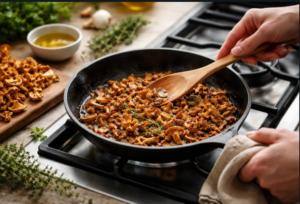
In the duck pan, sauté 300g of fresh Yellow Foot chanterelles. Add a crushed clove of garlic and a sprig of rosemary. The mushrooms will absorb the remaining duck essence and turn a deep, glistening gold.
Stage 4: The Huckleberry Gastrique
Deglaze the pan with 50ml of Pinot Noir and 1 tablespoon of Huckleberry jam (or blackberry). Reduce until it forms a thick, tart syrup. This acidity is crucial to cut through the hazelnut and duck fats.
Stage 5: The Plating
Swipe a thick line of hazelnut praliné across the plate. Place the sliced duck atop the praliné. Pile the sautéed Yellow Feet alongside. Drizzle the huckleberry gastrique around the edges and finish with crushed toasted hazelnuts.
Substitutions & Variations: The Luxury Palette
The Fat: If hazelnut praliné is too complex, use a Parsnip Purée finished with hazelnut oil.
The Fruit: Replace huckleberries with Dried Apricots rehydrated in brandy to echo the mushroom's scent.
The Mushroom: For a deeper flavor, use Yellow Foot Salt (dried, powdered mushrooms mixed with sea salt) to season the duck skin before rendering.
Pro Technique: The “Fat-Cap” Resting
While the duck rests, place a few fresh Yellow Foot chanterelles directly on top of the crispy skin. The residual heat will "wilt" the mushrooms, and the aromatic oils from the fungi will seep into the rendering fat, creating a flavored crust that is intensely "Forest-forward."
The Umami Secret: Gamma-Octalactone and Filbertone
The **Yellow Foot** contains Gamma-Octalactone (apricot/coconut notes). The **Hazelnuts** contain Filbertone (the characteristic nut aroma). When these molecules are suspended in **Animal Fat** (Duck), they undergo a "Molecular Harmonization" that creates a flavor similar to Foie Gras without the liver taste. This is the technical reason why duck, hazelnut, and chanterelles are considered the "Golden Triangle" of Pacific Northwest cuisine.
The Art of Pairing: The Sommelier’s Selection
Sommelier's Choice: An Oregon Pinot Noir (Willamette Valley). The wine's famous "forest floor" (sous-bois) and red fruit profile are a genetic match for the duck and chanterelles.
Non-Alcoholic Alternative:Chilled Roasted Dandelion Root Tea. Its earthy, nutty bitterness mimics the structure of an aged red wine.
Micro-FAQ
Q: Why start the duck in a cold pan? A: Starting in a hot pan "shocks" the fat, sealing it in and making the skin rubbery. A cold start allows the fat to melt (render) out slowly, resulting in paper-thin, cracker-crisp skin.
Q: Can I use hazelnut butter from the store? A: You can, but ensure it has no added sugar. Store-bought nut butters are often too sweet; you want the savory, toasted profile of a homemade praliné.
Q: Are Yellow Feet poisonous if eaten raw? A: Not poisonous, but they contain chitin that is hard to digest and they lack flavor when raw. Heat is required to "unlock" the apricot esters and break down the cell walls.
To provide the best experiences, we use technologies like cookies to store and/or access device information. Consenting to these technologies will allow us to process data such as browsing behavior or unique IDs on this site. Not consenting or withdrawing consent, may adversely affect certain features and functions.
Functional
Always active
The technical storage or access is strictly necessary for the legitimate purpose of enabling the use of a specific service explicitly requested by the subscriber or user, or for the sole purpose of carrying out the transmission of a communication over an electronic communications network.
Preferences
The technical storage or access is necessary for the legitimate purpose of storing preferences that are not requested by the subscriber or user.
Statistics
The technical storage or access that is used exclusively for statistical purposes.The technical storage or access that is used exclusively for anonymous statistical purposes. Without a subpoena, voluntary compliance on the part of your Internet Service Provider, or additional records from a third party, information stored or retrieved for this purpose alone cannot usually be used to identify you.
Marketing
The technical storage or access is required to create user profiles to send advertising, or to track the user on a website or across several websites for similar marketing purposes.