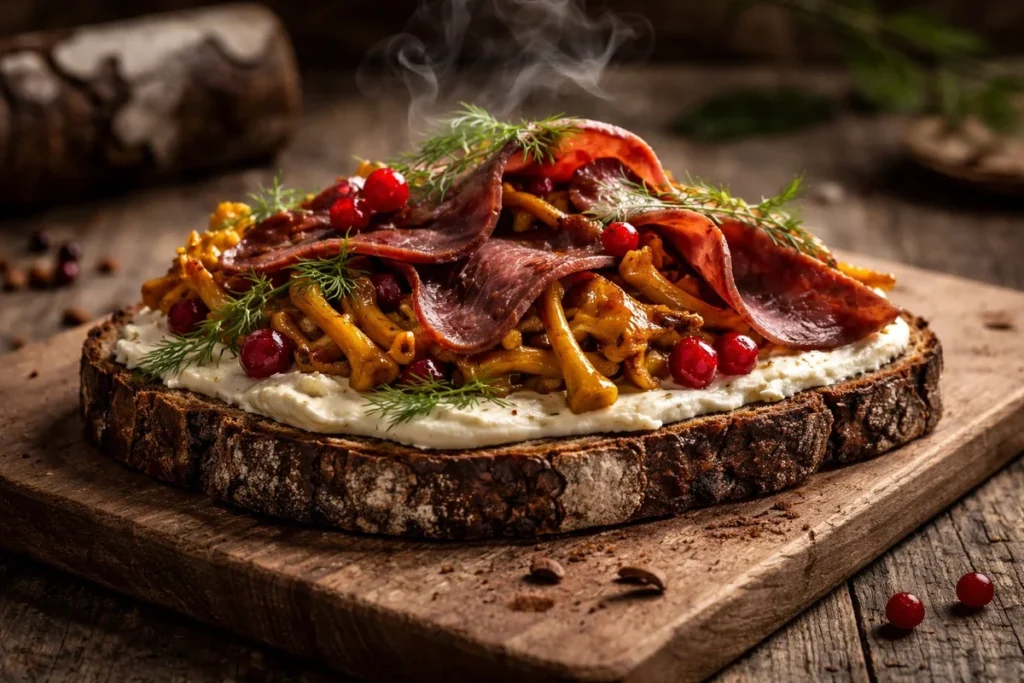
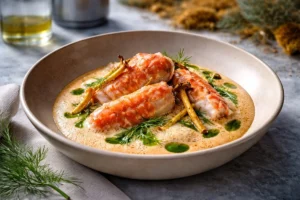
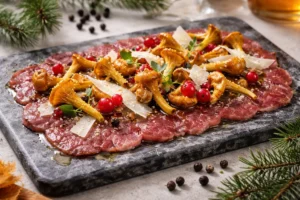
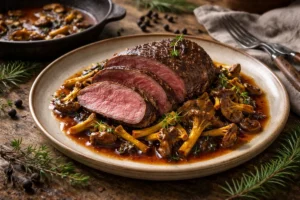
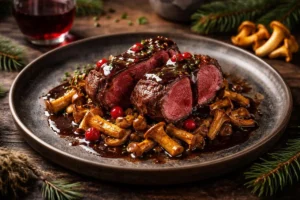
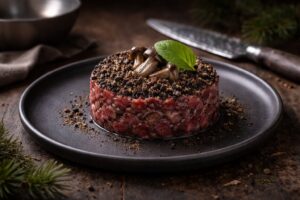
A minimalist masterclass in Scandinavian "Forest-on-Grain" synergy, featuring rye sourdough, cold-smoked venison, and the apricot-scented Yellow Foot chanterelle.
In the boreal forests of Scandinavia—from the fjords of Norway to the Swedish Lapland—the autumn transition is a frantic period of preservation. Historically, the Yellow Foot Chanterelle (Trattkantarell) was the last fresh gift of the woods before the deep freeze. Unlike the fleshy Summer Chanterelle, the Yellow Foot's ability to retain its apricot-and-pepper aroma even after a light frost made it a staple of the Nordic winter diet.
The Smørrebrød or Tartine is the vessel of choice for this fungal wealth. In the 19th-century timber camps, workers would sear these mushrooms in cultured butter and pile them onto dense, fermented Rye Bread. The addition of Smoked Venison Heart was a practical luxury; the heart is a lean, mineral-dense muscle that, when cold-smoked over birchwood, provides a primal, metallic counterpoint to the mushroom's fruitiness.
By the rise of New Nordic Cuisine in the early 2000s, chefs like René Redzepi transformed this humble worker's meal into a study in "Micro-Seasonality." The modern Nordic Tartine utilizes Crème Fraîche and Pickled Ramsons to provide acidity, ensuring that the "Forest-on-Grain" experience is a balanced landscape of smoke, acid, and earth.
Narrative Intro: This dish is a study in "Tannic Balance." Our philosophy for the Nordic Tartine is to use the charred rye bread as a structural mirror for the smoky venison. The Yellow Foot acts as the "light" in the dish—its bright, stone-fruit profile cutting through the dark, fermented flavors of the bread like an autumn sunrise through a thick pine canopy.
Sensory & Foraging Profile: The Boreal Moss and Birch Terroir
The Craterellus lutescens of the Nordic regions thrives in deep carpets of Sphagnum moss beneath spruce and birch. This terroir produces a mushroom with a bracing, clean acidity and a distinctive "cold-smoke" mineral finish. The lack of intense southern heat results in a slower growth cycle, which concentrates the apricot esters to a point where they can be detected even from several meters away in the forest.
Ethical Harvesting & The "Boreal" Protocol: In the North, we harvest using the "Thumb-and-Blade" technique, slicing the hollow stem 1cm above the moss to keep the funnel clean. We only harvest clusters found near decaying birch logs, as these offer the most complex flavor profile. We strictly leave the "Frost-Guard" specimens (those partially covered by early snow) to rot into the soil, as they provide the crucial nitrogen boost for the following year's crop.
Essential Equipment: The Nordic Station
Cast-Iron Griddle: For charring the rye bread to achieve a deep, smoky crust.
Swedish "Mora" Knife: For the paper-thin slicing of the smoked venison heart.
Small Whisk: To whip the Crème Fraîche into "Soft Peaks" for a luxurious mouthfeel.
Tweezers: For the precise arrangement of micro-herbs and pickled berries.
Master Recipe: Nordic Yellow Foot Tartines
Stage 1: The Bread Foundation
Slice 4 thick pieces of fermented Rye Sourdough. Toast them on a dry cast-iron griddle until the edges are slightly charred. While still hot, rub one side with a halved garlic clove and a generous amount of Browned Butter (Beurre Noisette).
Stage 2: The Mushroom Flash-Fry
In a hot pan, sauté 400g of fresh Yellow Foot chanterelles in 30g of salted butter. Add a sprig of fresh thyme. Cook for only 3-4 minutes; the mushrooms should remain "snappy" and bright orange. Season with a touch of smoked salt.
Stage 3: The Cream Infusion
Whisk 100ml of Crème Fraîche with a squeeze of lemon and a teaspoon of Horseradish. Spread a thick layer of this "Snow Cream" onto the toasted rye. This acts as the thermal barrier between the hot mushrooms and the cold bread.
Stage 4: The Protein Layer
Thinly shave 100g of Cold-Smoked Venison Heart (or high-quality bresaola). Drape the slices over the cream in a "ruffled" fashion to create air pockets that will trap the mushroom juices.
Stage 5: The Forest Assembly
Pile the hot Yellow Feet generously over the venison. Garnish with Pickled Lingonberries (or cranberries) and a few sprigs of Dill. The heat from the mushrooms will slightly melt the venison fat, unifying the tartine.
Substitutions & Variations: The Luxury Palette
The Protein: If smoked heart is too intense, use Smoked Duck Breast or Salt-Cured Egg Yolk shavings.
The Acid: Replace lingonberries with Pickled Mustard Seeds for a more contemporary textural pop.
The Mushroom: For a "Forest Toast" experience, add Pickled Yellow Feet alongside the sautéed ones for a dual-temperature sensation.
Pro Technique: The “Sourdough-Steam” Finish
After placing the hot mushrooms on the tartine, cover the entire assembly with a large bowl for exactly 30 seconds. This creates a "Micro-Steam" environment where the mushroom's volatile apricot oils are forced into the pores of the rye bread, ensuring the bread itself tastes like the forest floor.
The Umami Secret: Lignin and Octenol Synergy
The **Rye Bread** is rich in Lignin and Ferulic Acid from the fermentation. The **Yellow Foot** contains 1-octen-3-ol. When combined with the **Phenols** from the smoked venison, they form a "Triple-Aromatic Bond." This combination creates a perceived sweetness that balances the bitterness of the rye, making the entire tartine taste "creamier" than it actually is. It is the fundamental chemical secret behind Nordic open-faced sandwiches.
The Art of Pairing: The Sommelier’s Selection
Sommelier's Choice: A Craft Amber Ale or a Dry Apple Cider (Traditional Nordic style). The malty sweetness of the ale or the crisp fruit of the cider mirrors the bread and the mushroom perfectly.
Non-Alcoholic Alternative:Chilled Black Tea with Honey and Lemon. The tannins in the tea act as a replacement for red wine, cutting through the smoked fat.
Micro-FAQ
Q: Why use rye instead of white bread? A: White bread is too sweet and soft. The density and acidity of rye are necessary to support the weight and the intense aromatics of the wild mushrooms and smoked game.
Q: Can I use regular Chanterelles? A: You can, but they are "heavier" in flavor. The Yellow Foot's elegance and peppery finish are what make this specifically "Nordic" in style.
Q: Is the venison heart safe to eat? A: Yes, if it has been properly cold-smoked or cured. It is one of the cleanest and most flavorful muscles on the animal, often compared to high-end wagyu beef when sliced thin.
To provide the best experiences, we use technologies like cookies to store and/or access device information. Consenting to these technologies will allow us to process data such as browsing behavior or unique IDs on this site. Not consenting or withdrawing consent, may adversely affect certain features and functions.
Functional
Always active
The technical storage or access is strictly necessary for the legitimate purpose of enabling the use of a specific service explicitly requested by the subscriber or user, or for the sole purpose of carrying out the transmission of a communication over an electronic communications network.
Preferences
The technical storage or access is necessary for the legitimate purpose of storing preferences that are not requested by the subscriber or user.
Statistics
The technical storage or access that is used exclusively for statistical purposes.The technical storage or access that is used exclusively for anonymous statistical purposes. Without a subpoena, voluntary compliance on the part of your Internet Service Provider, or additional records from a third party, information stored or retrieved for this purpose alone cannot usually be used to identify you.
Marketing
The technical storage or access is required to create user profiles to send advertising, or to track the user on a website or across several websites for similar marketing purposes.