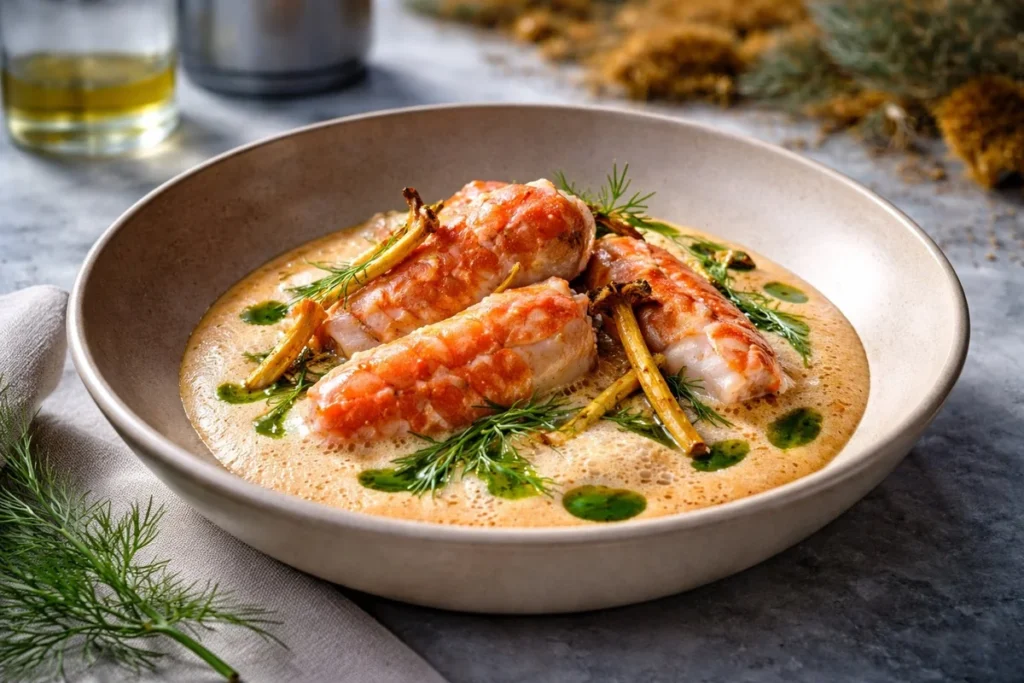
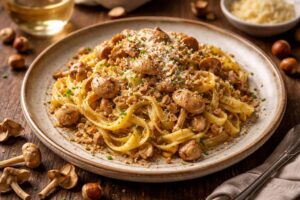
A technical masterclass in high-latitude synergy featuring Barents Sea Red Crab, hazelnut-toned brown butter, and the apricot-scented Yellow Foot chanterelle.
The Historical Prelude: The Hyperborean Convergence
The culinary meeting of the King Red Crab (Paralithodes camtschaticus) and the Yellow Foot Chanterelle (Craterellus lutescens) is a relatively modern phenomenon, born from the expansion of the crab's habitat into the Barents Sea and the Norwegian Fjords. Historically, the King Crab was a Soviet introduction to the region in the 1960s, but it soon became the "Gold of the North." As Nordic chefs began to explore the "Zero-Kilometer" philosophy, they looked to the birch and spruce forests that line the Arctic fjords for a partner to this gargantuan crustacean.
In the early 2000s, pioneering chefs in Tromsø and Oslo discovered that the extreme sweetness of the King Crab's leg meat possessed a mineral profile that resonated with the apricot-and-pepper aromatics of the Yellow Foot. By the time the mushrooms reach their peak in late October, the crabs are migrating to shallower waters, creating a seasonal intersection of immense culinary value.
This dish represents the pinnacle of Nordic Modernism. It eschews the heavy, flour-thickened sauces of the past in favor of a Mycological Emulsion—a technique where the mushroom's own cellular juices and a high-speed blender are used to create a foam-like sauce. This preserves the "lightness" of the sea while grounding the dish in the deep, nutty umami of Beurre Noisette (brown butter). It is a dish that tells the story of the Arctic: a land of crystalline ice and golden, mossy forest floors.
Narrative Intro: This dish is a "Crystalline Symphony." Our philosophy for the King Crab is to treat the Yellow Foot as a botanical condiment. We transform the mushroom into a liquid state—an emulsion that coats the crab like a second skin—ensuring that every bite of saline seafood is punctuated by the fruity, peppery spirit of the autumn woods.
Sensory & Foraging Profile: The Sub-Arctic Birch and Peat Terroir
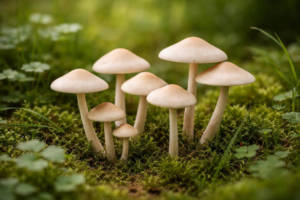
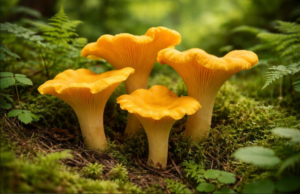
The Craterellus lutescens of the Northern Norwegian coast grows in acidic, peat-heavy soils beneath dwarf birch and spruce. This terroir, characterized by 24-hour light cycles in summer followed by rapid cooling, produces a mushroom with an extraordinarily high concentration of Linalool (apricot aroma). The stems are thinner and more vibrant than continental varieties, carrying a distinct "cold-smoke" mineral finish.
Ethical Harvesting & Professional Protocols: In the Arctic, we follow the "Shoreline Boundary" protocol—only harvesting mushrooms at least 500 meters inland to avoid excess salt deposition on the stems, which can interfere with the emulsion's stability. We utilize silicone-tipped tongs for the initial harvest to prevent bruising the delicate orange stems, which can cause premature bitterness.
Essential Equipment: The Emulsion Lab
High-Speed Blender (Vitamix Style): Essential for breaking down the chitinous cell walls of the mushroom to create a silky, stable emulsion.
Vacuum Sealer: For the "Pressure-Poaching" of the crab meat to retain 100% of its internal juices.
ISI Whipping Siphon (Optional): To aerate the Yellow Foot emulsion into a "Forest Cloud" for a lighter mouthfeel.
Digital Thermometer: To maintain a precise 55°C poaching temperature for the crab meat.
Master Recipe: King Crab & Yellow Foot Emulsion
Stage 1: The Crab Extraction & Poach
Extract the meat from 400g of King Crab Legs, keeping the sections as whole as possible. Place in a vacuum bag with 50g of Beurre Noisette (brown butter) and a sprig of dill. Cook in a water bath at 55°C for 12 minutes. This "Gentle Extraction" ensures the protein remains elastic and juicy.
Stage 2: The Mushroom Base Reduction
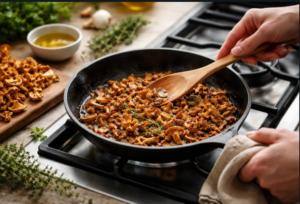
Sauté 300g of Yellow Foot chanterelles in a dry pan until they release their water. Add 50ml of dry white wine and reduce by half. Add 100ml of light shellfish stock and simmer for 5 minutes. This creates the concentrated mycological "liquor" needed for the emulsion.
Stage 3: The Yellow Foot Emulsion
Transfer the mushroom mixture to a high-speed blender. Add 60g of cold, cubed butter and a squeeze of lemon. Blend at maximum speed for 60 seconds until a frothy, pale-orange emulsion forms. Season with a pinch of sea salt and white pepper.
Stage 4: The Final Assembly
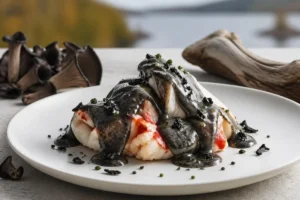
Place the poached crab leg sections in the center of warm, shallow bowls. Pour the hot Yellow Foot emulsion around the crab. The sauce should be light enough to foam but thick enough to cling to the meat.
Stage 5: The Garnish
Garnish with a few Dehydrated Yellow Foot stems (for crunch) and Fresh Dill Oil. The green oil against the orange emulsion provides the visual contrast of the Arctic autumn forest.
Substitutions & Variations: The Luxury Palette
The Seafood: Replace King Crab with Scallops (Saint-Jacques) seared for 60 seconds on one side.
The Fat: Use Smoked Butter to emphasize the "Hunter's Fire" profile of the dish.
The Mushroom: For an even more intense color, add a pinch of Saffron to the emulsion base.
Pro Technique: The “Cold-Oil Emulsification”
For the most stable emulsion, ensure the mushroom liquor is hot (80°C) but the butter is ice-cold. The rapid temperature differential allows the butter's milk solids to form a tighter bond with the mushroom's pectin and proteins, creating a sauce that won't break even under the heat of the service lamp.
The Umami Secret: Glycine and Isopentyl Acetate
The **King Crab** is uniquely high in Glycine, a sweet-tasting amino acid. The **Yellow Foot** contains high levels of Isopentyl Acetate (the chemical compound for apricot and banana). When these two interact with the Pyrazines in the Brown Butter, they create a "Sweet-Savory Bridge" that trick the palate into perceiving a much higher fat content than is actually present. This is the molecular definition of "Arctic Luxury."
The Art of Pairing: The Sommelier’s Selection
Sommelier's Choice: A Vintage Champagne (Blanc de Blancs). The high acidity and brioche notes of an aged Chardonnay-based Champagne cut through the crab fat and resonate with the brown butter.
Non-Alcoholic Alternative:Sparkling Birch Sap with a hint of Sea Buckthorn. The sap provides the woodiness, while the buckthorn mirrors the mushroom's acidity.
Storage & Reheating
Strict Warning: This dish cannot be reheated. The crab protein will become rubbery and the emulsion will collapse into a greasy liquid. **Professional Restoration:** If you have leftover emulsion, it can be stabilized with a pinch of Xanthan gum and served cold as a dip for radishes.
Ancestral Nutrition
King Crab is a vital source of Vitamin B12 and Omega-3 Fatty Acids. Yellow Foot chanterelles provide Beta-glucans, which are known to modulate the immune system. In Sámi folklore, the combination of "Deep Sea and High Forest" was considered a tonic for the "Dark Days" (Winter), helping to maintain mood and energy through high-density micronutrients.
Micro-FAQ
Q: Why use Yellow Foot instead of Winter Truffle? A: The Yellow Foot's apricot acidity is a better functional match for the sweetness of crab than the heavy, musky aroma of a truffle.
Q: Is the King Crab sustainably harvested? A: In Norway, King Crab is an invasive species, so harvesting is both a culinary luxury and an ecological necessity to protect local biodiversity.
Q: Can I use the mushroom stems? A: Yes! Unlike many mushrooms, the stems of Craterellus lutescens are tender and hold the majority of the apricot aromatics, making them essential for the emulsion.
To provide the best experiences, we use technologies like cookies to store and/or access device information. Consenting to these technologies will allow us to process data such as browsing behavior or unique IDs on this site. Not consenting or withdrawing consent, may adversely affect certain features and functions.
Functional
Always active
The technical storage or access is strictly necessary for the legitimate purpose of enabling the use of a specific service explicitly requested by the subscriber or user, or for the sole purpose of carrying out the transmission of a communication over an electronic communications network.
Preferences
The technical storage or access is necessary for the legitimate purpose of storing preferences that are not requested by the subscriber or user.
Statistics
The technical storage or access that is used exclusively for statistical purposes.The technical storage or access that is used exclusively for anonymous statistical purposes. Without a subpoena, voluntary compliance on the part of your Internet Service Provider, or additional records from a third party, information stored or retrieved for this purpose alone cannot usually be used to identify you.
Marketing
The technical storage or access is required to create user profiles to send advertising, or to track the user on a website or across several websites for similar marketing purposes.