The Historical Prelude: The Shepherd’s Autumn Feast
In the high-altitude pastures of the Jura Mountains—straddling the border of France and Switzerland—the arrival of the first frost signals the production of Vacherin Mont d'Or. Historically, this seasonal cheese was created when the cows were moved from the high summer meadows down to the valleys, and their milk became too rich and concentrated for large wheels of Gruyère. The cheese, bound in strips of spruce bark (sangle de l'épicéa), absorbs a distinct balsamic and resinous aroma during its aging process.
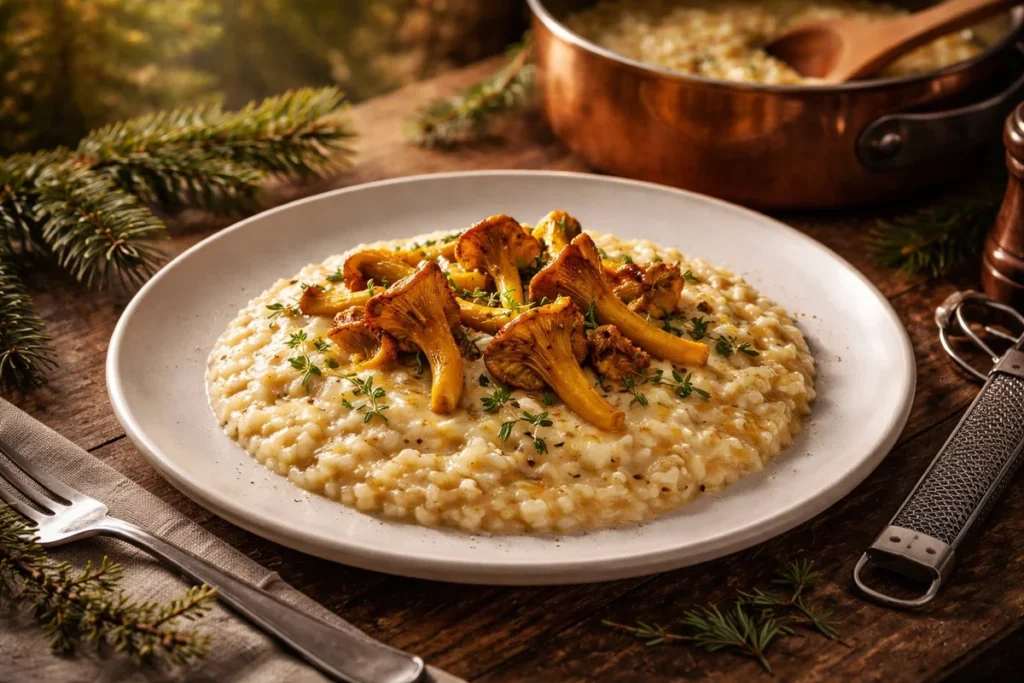
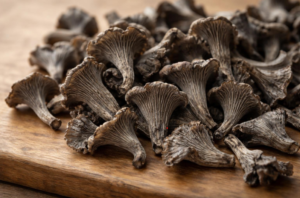
The Yellow Foot Chanterelle (Craterellus lutescens) is the botanical mirror of the Mont d'Or. Emerging in the same spruce and fir forests where the cheese's bark is harvested, the mushroom's apricot esters were discovered by Alpine shepherds to be the ultimate aromatic bridge. When folded into a risotto, the heat of the rice melts the Vacherin, releasing the scent of the forest floor into a velvety, starch-bound emulsion.
This dish represents the transition from the fluidity of summer to the caloric density of winter. By utilizing the Carnaroli grain—the "King of Rices"—the chef creates a structural foundation capable of supporting the immense fat content of the Mont d'Or. The result is a dish that does not just taste of the mountains; it captures the very atmosphere of a smoke-filled Alpine chalet at twilight, where the smell of spruce bark and wild fungi defines the hearth.
Narrative Intro: This dish is a "Resinous Embrace." Our philosophy for the Alpine Risotto is to use the Vacherin Mont d'Or not as a topping, but as a biological emulsifier. The spruce-infused fats of the cheese act as a carrier for the Yellow Foot's volatile fruit scents, creating a sensory loop that ties the mushroom back to the tree from which it grew.
Sensory & Foraging Profile: The Spruce-Needle and Limestone Terroir
The Craterellus lutescens of the Jura and Alpine regions thrives in moist, limestone-based soils covered by a thick layer of spruce needles. This terroir produces a mushroom with a denser, more elastic stem and an intense peppery-sweetness. The high mineral content of the limestone soil imparts a distinct "petrichor" (rain-on-earth) finish that perfectly complements the creamy funk of washed-rind cheeses.
Ethical Harvesting & Professional Protocols: In the Alpine spruce forests, we follow the "Mycelial Canopy" protocol—only harvesting in the 'Drip Line' of mature trees. We utilize natural bristle brushes to remove needle debris on-site, as the spruce oils on the needles can alter the mushroom's flavor if left in the basket for too long. We strictly leave the smallest specimens to reach maturity, ensuring a secondary flush before the first deep snow.
Essential Equipment: The Mantecatura Station
Copper Risottiera: For the most even heat distribution, preventing the starch from scorching during the constant stirring.
Wooden Spoon (with hole): To incorporate air into the risotto during the mantecatura (the final whipping process).
Fine Microplane: For zesting the cured egg yolk or aged cheese used as a final highlight.
Temperature-Controlled Probe: To ensure the stock remains at a constant 85°C throughout the cooking process.
Master Recipe: Alpine Risotto & Yellow Foot
Stage 1: The Tostatura (Toasting)
In a dry risottiera, toast 320g of Carnaroli Rice until the grains are hot to the touch but not colored. This hardens the outer starch. Deglaze with 100ml of a dry, acidic Alpine wine like Vin Jaune or a crisp Chasselas.
Stage 2: The Forest Infusion
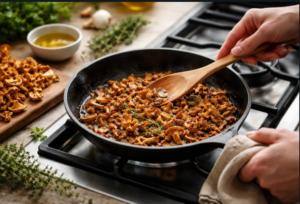
Begin adding hot Light Poultry Stock ladle by ladle. Meanwhile, in a separate pan, sauté 300g of fresh Yellow Foot chanterelles in cultured butter. Add half of the mushrooms to the rice halfway through the cooking process to integrate their flavor into the grain.
Stage 3: The Mantecatura (The Soul)
Once the rice is al dente, remove from heat. This is the critical stage. Add 100g of Vacherin Mont d'Or (ensure it is at room temperature and remove the rind). Add 30g of cold, cubed butter and a splash of stock. Beat vigorously with a wooden spoon to create a "wave" (all'onda) texture.
Stage 4: The Final Assembly
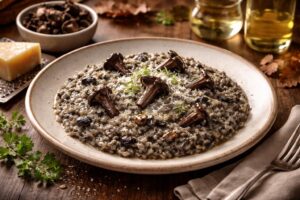
Plate the risotto on flat, warm plates. Top with the remaining sautéed Yellow Feet, which have kept their vibrant orange-yellow color. Finish with a few needles of Fresh Thyme and a crack of white pepper.
Substitutions & Variations: The Luxury Palette
The Cheese: If Vacherin Mont d'Or is out of season, use Reblochon AOP or Taleggio DOP for a similar creamy, earthy funk.
The Grain: Use Vialone Nano rice for a silkier, more fluid risotto profile.
The Mushroom: For an ultra-premium version, add White Truffle shavings alongside the Yellow Foot to emphasize the garlic-honey notes.
Pro Technique: The “Spruce Butter” Infusion
To deepen the mountain profile, take fresh spruce tips (or high-quality spruce essential oil) and infuse them into the butter used for the final mantecatura. This highlights the resinous notes of the Vacherin bark and creates a direct olfactory link to the Yellow Foot's natural environment.
The Umami Secret: Amylopectin and Terpene Trapping
The **Carnaroli Rice** releases high levels of Amylopectin starch during cooking. This starch forms a gel that acts as a physical trap for the **Yellow Foot's** volatile Linalool (apricot) and the **Vacherin's** Terpenes. By emulsifying these with the cheese's fat during the mantecatura, you prevent the aromas from evaporating, ensuring they are only released through enzymatic action in the mouth.
The Art of Pairing: The Sommelier’s Selection
Sommelier's Choice: A Savagnin from the Jura. Its oxidative, nutty profile and high acidity are designed by history to pair with the region's rich cheeses and wild fungi.
Non-Alcoholic Alternative:Toasted Buckwheat Tea (Sobacha). Its nutty, savory depth mimics the grain profile of the risotto.
Storage & Reheating
Risotto is a fleeting masterpiece and does not store well as a primary dish. **Restoration:** If you must reheat, add a splash of stock and a knob of butter in a pan over low heat, whisking constantly to restore the emulsion. **Professional Tip:** Use leftovers to make Arancini stuffed with a cube of Vacherin.
Ancestral Nutrition
Yellow Foot chanterelles are exceptionally high in Potassium and Fiber. In Alpine communities, "The Yellow Porridge" (early risotto) was considered an essential meal for building "Winter Blood"—improving circulation and providing the fat-soluble vitamins necessary to survive the mountain cold.
Micro-FAQ
Q: Why use Vacherin Mont d'Or specifically? A: It is the only cheese aged in spruce bark that has a spoonable, liquid texture at room temperature, making it a perfect natural emulsion for rice.
Q: Can I wash the mushrooms? A: Never. The hollow stems act like straws; washing them will waterlog the risotto and dilute the apricot aromatics. Use a dry brush.
Q: What does "All'Onda" mean? A: It means "like a wave." When you tilt the plate, the risotto should ripple and move slowly, not stay in a solid clump.
To provide the best experiences, we use technologies like cookies to store and/or access device information. Consenting to these technologies will allow us to process data such as browsing behavior or unique IDs on this site. Not consenting or withdrawing consent, may adversely affect certain features and functions.
Functional
Always active
The technical storage or access is strictly necessary for the legitimate purpose of enabling the use of a specific service explicitly requested by the subscriber or user, or for the sole purpose of carrying out the transmission of a communication over an electronic communications network.
Preferences
The technical storage or access is necessary for the legitimate purpose of storing preferences that are not requested by the subscriber or user.
Statistics
The technical storage or access that is used exclusively for statistical purposes.The technical storage or access that is used exclusively for anonymous statistical purposes. Without a subpoena, voluntary compliance on the part of your Internet Service Provider, or additional records from a third party, information stored or retrieved for this purpose alone cannot usually be used to identify you.
Marketing
The technical storage or access is required to create user profiles to send advertising, or to track the user on a website or across several websites for similar marketing purposes.