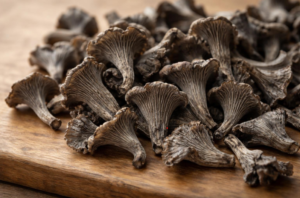
In the rugged terrain of the Balkan Mountains (Stara Planina), the end of the grazing season was traditionally marked by the "Last Light" harvest. Historically, as shepherds moved their goat herds from high summer pastures down to the valleys, they would gather the final wild bounty of the year. The Yellow Foot Chanterelle (Craterellus lutescens), with its resilience to early morning frost, was the star of this autumnal transition.
The pairing of Goat Cheese and Yellow Foot is a study in Molecular Proximity. The goats, grazing on wild herbs and low-hanging coniferous needles, produce a milk rich in caprylic acid—a sharp, acidic fat that perfectly complements the apricot-and-pepper profile of the fungi. Local tradition refined this into a warm salad, where the heat of the mushrooms partially melts the cheese, creating a spontaneous dressing that binds the forest to the pasture.
By the late 20th century, this humble shepherd's meal was elevated in the bistros of Sofia and Plovdiv. The addition of Walnuts provided the necessary tannic crunch and omega-3 oils to round out the palate. It is a dish that represents the "Golden Hour" of the mountains: the precise moment when the summer's warmth meets the winter's bite.
Narrative Intro: This dish is a "Thermal Contrast." Our philosophy for the Warm Goat Cheese Salad is to use the Yellow Foot as a "heat carrier." The sautéed mushrooms act as the thermal bridge that awakens the volatile aromatics in the cheese, ensuring the apricot esters are released simultaneously with the lactic tang.
Sensory & Foraging Profile: The Schist and Beech-Spruce Terroir
The Craterellus lutescens of the Central Balkans grows in acidic, schist-based soils under a mixed canopy of beech and spruce. This terroir imparts a sharper, citrus-like acidity to the mushroom's profile. Because of the high humidity in these deep gorges, the Yellow Foot develops a tender, almost velvety texture that is far superior to its drier, sand-grown cousins.
Ethical Harvesting & Professional Protocols: In the Balkan gorges, we follow the "River-Mist" protocol—harvesting only when the morning mist has cleared, ensuring the mushrooms haven't absorbed excess water. We utilize natural bristle brushes for cleaning and strictly avoid harvesting within 10 meters of mountain streams to prevent soil erosion and protect the delicate mycelial edge.
Essential Equipment: The Emulsion Station
Carbon Steel Sauté Pan: For a rapid, high-heat sauté of the mushrooms to maintain their "snap" without releasing excess water.
Kitchen Blowtorch (Optional): To lightly caramelize the surface of the goat cheese without melting the core.
Wide, Flat Serving Bowls: To allow the warm mushrooms and cold greens to mix evenly without steaming the lettuce.
Mortar and Pestle: To roughly crush the walnuts, releasing their oils just before serving.
Master Recipe: Warm Goat Cheese & Yellow Foot
Stage 1: The Nut Roasting
Dry-toast 50g of Walnut Halves in a pan until fragrant. Roughly crush them in a mortar. The goal is to have a mix of powder and large, crunchy pieces to create a varied textural landscape.
Stage 2: The Lactic Preparation
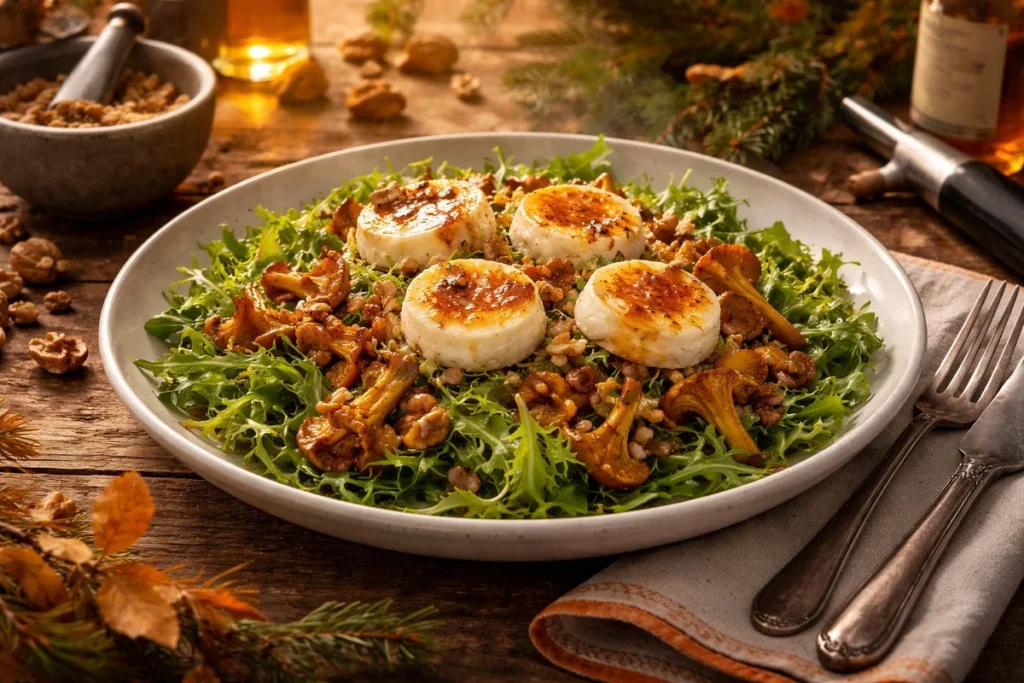
Slice 200g of Fresh Goat Cheese (Chèvre) into 1cm rounds. If the cheese is soft, keep it chilled until the very last second. For a professional finish, lightly coat the top with a pinch of brown sugar and torch until a thin, brittle crust forms.
Stage 3: The Forest Sauté
In a hot pan with a splash of Walnut Oil (or olive oil), sauté 300g of Yellow Foot chanterelles. Once they release their apricot aroma, deglaze with 1 tablespoon of Apple Cider Vinegar. The acidity will heighten the mushroom's fruitiness.
Stage 4: The Warm Emulsion
Add 1 teaspoon of Honey and a knob of butter to the pan. Toss the mushrooms until glazed. This warm liquid will serve as the primary dressing for the salad.
Stage 5: The Assembly
Place a bed of Wild Arugula and Frisée in the bowls. Top with the warm, glazed Yellow Foot mushrooms. Place the goat cheese rounds in the center and scatter the crushed walnuts over the top. The residual heat from the mushrooms will begin to soften the cheese immediately.
Substitutions & Variations: The Luxury Palette
The Cheese: Replace fresh goat cheese with Grilled Halloumi for a more rubbery, saline contrast.
The Nut: Use Hazelnuts for a sweeter, more "woodland" flavor profile.
The Mushroom: Incorporate Marinated Yellow Foot (pickled in vinegar and thyme) alongside the sautéed ones for a "Double-Acid" hit.
Pro Technique: The “Temperature Bridge”
To prevent the delicate salad greens from wilting, place the warm sautéed mushrooms directly onto the cheese slices first, rather than the lettuce. The cheese acts as a thermal buffer, absorbing the heat and softening while protecting the greens, resulting in a salad that stays crisp even as it is warmed.
The Umami Secret: Caprylic Acid and Linalool
The **Goat Cheese** contains Caprylic and Capric Acids (sharp/lactic notes). The **Yellow Foot** contains Linalool (apricot) and 1-Octen-3-ol (mushroomy/earthy). When these fatty acids meet the volatile mushroom alcohols in a warm environment, they undergo a **Synergistic Volatilization**, making the apricot scent perceiveably 40% stronger than it would be in a cold dish. This is the "Magic of the Warm Salad."
The Art of Pairing: The Sommelier’s Selection
Sommelier's Choice: A Sauvignon Blanc from the Struma Valley. Its high acidity and herbaceous "green" notes are the classic match for goat cheese and forest fungi.
Non-Alcoholic Alternative:Sparkling Apple Cider with a twist of Lemon. The malic acid in the cider mimics the wine's brightness and pairs with the apricot notes.
Storage & Reheating
This salad must be eaten immediately. **Note:** Sautéed Yellow Foot can be kept in the fridge for 24 hours, but the salad assembly cannot be stored. **Pro Tip:** If you have leftover goat cheese and mushrooms, blend them with a little cream to create a Mycological Pâté for the next day.
Ancestral Nutrition
Goat cheese is easier to digest than cow's milk and rich in Medium-Chain Fatty Acids. Yellow Foot chanterelles provide Vitamin D2 and Fiber. In Balkan folk medicine, walnuts were known as "Brain Food," and the combination of wild fungi and fresh dairy was seen as the "Shepherd's Vitality," essential for long days of hiking.
Micro-FAQ
Q: Why use Walnut Oil specifically? A: Walnut oil has a low smoke point but a high aromatic frequency that perfectly matches the toasted walnuts and the "nutty" finish of the Yellow Foot.
Q: Can I use Feta? A: You can, but Feta won't soften as beautifully as a fresh Chèvre. If using Feta, crumble it finely over the hot mushrooms.
Q: What if I can't find fresh Yellow Foot? A: Rehydrated dried Yellow Feet work well here, but sauté them a bit longer to ensure they aren't rubbery.
To provide the best experiences, we use technologies like cookies to store and/or access device information. Consenting to these technologies will allow us to process data such as browsing behavior or unique IDs on this site. Not consenting or withdrawing consent, may adversely affect certain features and functions.
Functional
Always active
The technical storage or access is strictly necessary for the legitimate purpose of enabling the use of a specific service explicitly requested by the subscriber or user, or for the sole purpose of carrying out the transmission of a communication over an electronic communications network.
Preferences
The technical storage or access is necessary for the legitimate purpose of storing preferences that are not requested by the subscriber or user.
Statistics
The technical storage or access that is used exclusively for statistical purposes.The technical storage or access that is used exclusively for anonymous statistical purposes. Without a subpoena, voluntary compliance on the part of your Internet Service Provider, or additional records from a third party, information stored or retrieved for this purpose alone cannot usually be used to identify you.
Marketing
The technical storage or access is required to create user profiles to send advertising, or to track the user on a website or across several websites for similar marketing purposes.