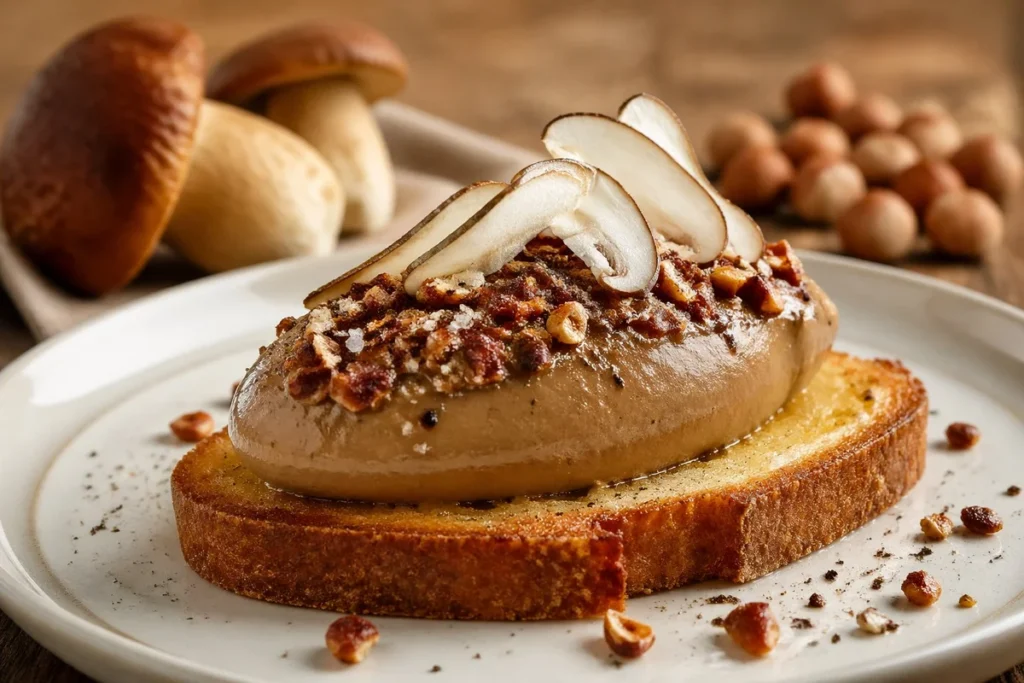
A sophisticated mycological appetizer featuring a light-as-air Boletus edulis mousse, topped with a savory hazelnut praline and served on toasted artisanal brioche.
Porcini Mousse & Hazelnut Praline
The Piedmontese Dialogue: Where the Truffle's Cousin Meets the Nocciola
The Historical Prelude: The Aristocratic Salons of Turin
In the grand 19th-century cafés of Turin, the culinary boundaries between the savory and the sweet were often blurred. Piedmont is a land of sensory contradictions: it is the home of the world's most expensive truffles, the finest Boletus edulis, and the legendary Tonda Gentile hazelnuts. Historically, this Porcini Mousse was developed as a stuzzichino (appetizer) for the Savoyard nobility, who demanded a dish that combined the rusticity of the forest with the refinement of the French-influenced pâtisserie techniques.
The inclusion of a Hazelnut Praline—traditionally a sweet confection—was a radical innovation of the early 1900s. Chefs realized that the aromatic compounds in roasted hazelnuts shared a molecular "common ancestor" with the nutty volatiles of the Porcini. By removing the sugar from the praline and replacing it with sea salt and black pepper, they created a textural masterpiece that mirrored the forest floor: soft, damp moss (the mousse) covered by crunchy, roasted leaves (the praline). This dish is the ultimate expression of Modern Piedmontese Luxury.
⏱ Time: 60 Minutes + Chilling
📊 Difficulty: Advanced Pastry Technique
🔥 Calories: 315 kcal / Serving
🍄 Type: Prime Autumn Porcini
Culinary Philosophy: The Aeration of Umami
The philosophy of this mousse is Aromatic Weightlessness. We use the techniques of a classic mousse au chocolat—specifically the folding of aerated cream and egg whites—but apply them to a concentrated mushroom reduction. The goal is to create a substance that disappears on the tongue almost instantly, leaving behind a "ghost" of Porcini flavor that is then brought back to reality by the crunch of the hazelnut.
Sensory & Foraging Profile: The Hazelnut & Oak Symbiosis
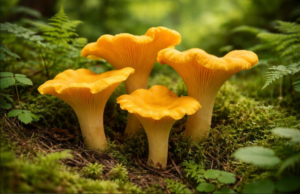
Latin Nomenclature:Boletus edulis (The Nut-King phenotype). Terroir Analysis: Piedmontese Porcini often grow in close proximity to wild hazelnut groves. The soil is a rich, calcareous marl. This proximity leads to a high concentration of **filbertone**, the principal flavor compound of hazelnuts, within the mushroom itself. This "Flavor Mimicry" is why the pairing feels so effortless.
Professional Protocols: For a mousse, we prioritize Dried Porcini for the base and Fresh Porcini for the garnish. Dried Porcini have a higher concentration of **pyrazines**, which provides the "roasted" backbone necessary to stand up to the fats in the hazelnut and brioche.
Essential Equipment
🔸 Food Processor / Thermomix: For achieving an ultra-smooth, "emulsion-grade" mushroom purée.
🔸 Siphon or Hand Whisk: To incorporate air into the heavy cream without breaking the fat molecules.
🔸 Mortar and Pestle: To crush the hazelnuts into a "rough" praline rather than a fine powder.
The Master Recipe: The Savory Aeration
Stage 1: The Porcini Essence (The Base)
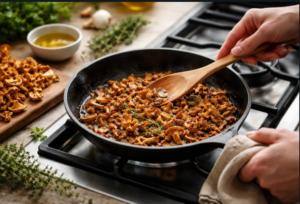
Rehydrate 50g of dried Porcini in 100ml of warm milk. Sauté with 1 shallot in butter. Blend the mixture until perfectly smooth, then pass through a fine-mesh chinois. You should have a thick, intensely brown cream.
Stage 2: The Savory Praline (The Crunch)
Toast 100g of Piedmontese hazelnuts until the skins crack. Crush roughly. In a pan, melt 20g of butter, add the hazelnuts, a teaspoon of sea salt, and a pinch of cracked black pepper. Allow to cool and harden into a savory crumble.
Stage 3: The Mousse Assembly
Whisk 200ml of heavy cream to soft peaks. Gently fold the cold mushroom essence into the cream. Add a pinch of Xanthan gum if necessary for stability. Chill for 2 hours until set but still airy.
Stage 4: The Plating
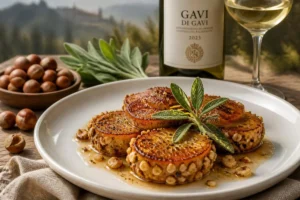
Thickly slice artisanal brioche and toast in butter. Place a large "quenelle" of the Porcini mousse on the warm brioche. Top with a generous amount of the savory hazelnut praline and a few shavings of fresh Porcini.
Pro Technique: The “Gelatin-Warm” Fold
To ensure the mousse doesn't collapse when it hits the warm brioche, dissolve a single half-sheet of gelatin into the mushroom essence while it is still warm (but not hot). This provides a "thermal skeleton" to the mousse, allowing it to maintain its shape for several minutes even as the brioche warms it from below.
The Umami Secret: Pyrazines and Filbertone
The science of this dish lies in Aromatic Congruency. Roasted hazelnuts are rich in **Pyrazines**, which are the same compounds produced when Porcini are dried and sautéed. When you eat them together, the brain doesn't perceive two separate ingredients; it perceives a "Mega-Umami" event. The fat in the brioche act as a solvent, carrying these molecules to the retro-nasal receptors for a prolonged finish.
The Art of Pairing
Sommelier's Selection: A sparkling **Alta Langa** or a **Metodo Classico** Piedmontese wine. The acidity and fine bubbles are essential to "lift" the heavy fats of the brioche and hazelnut.
Non-Alcoholic: A chilled, unsweetened pear juice with a touch of nutmeg.
Micro-FAQ
Q: Can I make this a day in advance? A: The mousse base can be made 24 hours ahead, but do not assemble until the moment of service, or the brioche will become soggy.
Q: What if I can't find Piedmontese hazelnuts? A: Use any high-quality hazelnut, but ensure they are fresh and toasted until very dark brown to mimic the intense "Tonda Gentile" profile.
The Porcini Directory: Global Names for Boletus edulis
The King Bolete, or simply Porcini, is arguably the most recognized wild mushroom in the culinary world. Its linguistic variety reflects its presence in forests from the Alps to the Himalayas:
Language
Regional & Folk Names
Expert Insights
Italian
Porcino, Brisa, Fungo di faggio
"Porcini" (little pigs) is the global trade name.
French
Cèpe de Bordeaux, Gros pied, Polonais
"Cèpe" comes from the Gascon word for trunk/stump.
German
Steinpilz, Herrenpilz, Edelpilz
"Steinpilz" (Stone mushroom) refers to its firm flesh.
To provide the best experiences, we use technologies like cookies to store and/or access device information. Consenting to these technologies will allow us to process data such as browsing behavior or unique IDs on this site. Not consenting or withdrawing consent, may adversely affect certain features and functions.
Functional
Always active
The technical storage or access is strictly necessary for the legitimate purpose of enabling the use of a specific service explicitly requested by the subscriber or user, or for the sole purpose of carrying out the transmission of a communication over an electronic communications network.
Preferences
The technical storage or access is necessary for the legitimate purpose of storing preferences that are not requested by the subscriber or user.
Statistics
The technical storage or access that is used exclusively for statistical purposes.The technical storage or access that is used exclusively for anonymous statistical purposes. Without a subpoena, voluntary compliance on the part of your Internet Service Provider, or additional records from a third party, information stored or retrieved for this purpose alone cannot usually be used to identify you.
Marketing
The technical storage or access is required to create user profiles to send advertising, or to track the user on a website or across several websites for similar marketing purposes.