Experience the molecular prestige of Massimo Bottura's Porcini & Taleggio Risotto. A professional guide to the Lombardian "All'Onda" technique featuring wild-harvested Boletus edulis for ultimate culinary mastery.
Porcini & Taleggio Risotto
The Lombardian Fog: A Symphony of Creamy Rice, Piquant Cheese, and Autumn Forest
The Historical Prelude: The Po Valley and the Val Taleggio
In the heart of Lombardy, where the fertile rice fields of the Po Valley meet the misty foothills of the Alps, risotto is more than a dish—it is a religion. Historically, Risotto ai Porcini was the autumn staple of the Milanese aristocracy. However, the addition of Taleggio DOP—a soft, washed-rind cheese from the Alpine valley of the same name—was the stroke of genius that elevated the dish to its current status.
Taleggio has been produced since Roman times, aged in the humid caves of the Valsassina. Its aroma is powerful and "funky," but its flavor is surprisingly mild and buttery. When combined with Boletus edulis foraged from the nearby pine forests of the Prealps, it creates a flavor profile that is quintessentially Lombardian: sophisticated, rich, and deeply rooted in the damp terroir of Northern Italy. This dish represents the "Mantecatura All'Onda" (the final beating) at its finest—a technique that transforms simple starch into a silken, flowing "wave."
⏱ Time: 40 Minutes
📊 Difficulty: Intermediate / Precision
🔥 Calories: 480 kcal / Serving
🍄 Type: Fresh Lombardian "Porcino"
Culinary Philosophy: The “All’Onda” Movement
Lombardian philosophy for risotto is Fluidity. A perfect risotto should never be stiff; it should move like a slow-flowing river when the plate is tilted. We achieve this by utilizing the high amylopectin content of Carnaroli rice and a vigorous mantecatura off the heat. The porcini provides the earthy bass note, while the toasted walnuts provide the "high-frequency" crunch that keeps the palate engaged.
Sensory & Foraging Profile: The Pine & Granite Terroir
Latin Nomenclature:Boletus edulis (The Lombardian phenotype). Terroir Analysis: Porcini from the Valtellina grow in granitic, slightly acidic soils under Scotch Pine and Spruce. These mushrooms are known for their resilience and a distinct "pine-nut" sweetness. This resinous quality is the perfect structural partner for the creamy, slightly piquant notes of the Taleggio cheese.
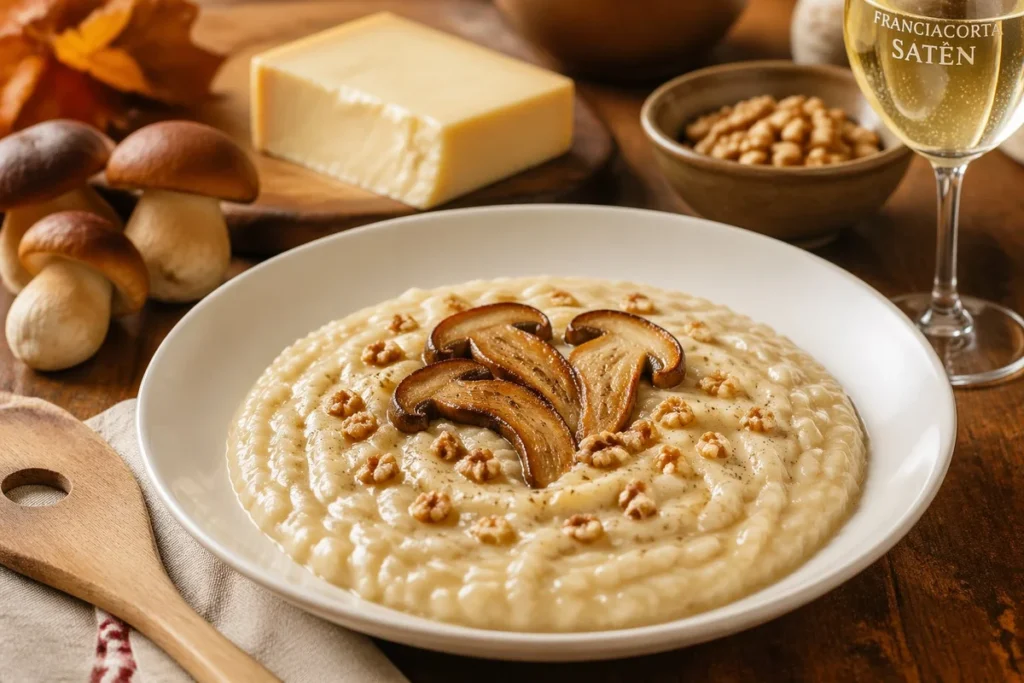
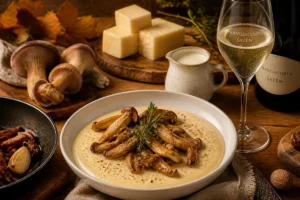
Selection Protocol: We use "Mixed Cuts." The stems are finely diced and added early to melt into the rice base, while the caps are sliced into large fans and sautéed separately to be placed on top as a garnish, preserving their visual majesty.
Essential Equipment
🔸 Heavy-Bottomed Sauté Pan (Wide): To allow the rice grains to toast evenly and the starch to be released consistently.
🔸 Carnaroli Rice: Often called the "King of Rices," its superior starch content and firm heart make it the only choice for a professional result.
🔸 Wooden Spatula with a Hole: The traditional tool that allows the rice to pass through, preventing the grains from breaking during constant stirring.
The Master Recipe: The Lombardian Wave
Stage 1: The Toasting (Tostatura)
In a hot pan, toast 320g of Carnaroli rice in a little butter until the grains are too hot to touch. This "seals" the exterior. Deglaze with a glass of dry white wine (Franciacorta or Pinot Grigio).
Stage 2: The Forest Infusion
Add 400g of diced porcini stems to the rice. Begin adding simmering mushroom stock one ladle at a time, stirring constantly. The rice must always be covered by a thin film of liquid.
Stage 3: The Sautéed Caps
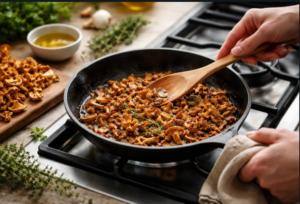
In a separate pan, sear the porcini caps in butter until golden-brown and crispy. Set aside. Simultaneously, lightly toast 50g of walnuts in a dry pan until fragrant.
Stage 4: The Mantecatura Off-Heat
Once the rice is al dente (approx. 18 mins), remove from heat. Add 60g of cold butter and 100g of cubed Taleggio DOP (rind removed). Beat vigorously with a wooden spoon until the cheese and butter form a silken glaze. Cover and rest for 2 minutes.
Chef’s Secret: The “Taleggio Rind” Broth
Don't throw away the rind of the Taleggio! While it's too strong to eat directly, you can add it to your simmering mushroom stock. The rind will release its unique cave-aged esters into the liquid, providing a background depth that makes the final risotto taste like it was prepared in an old Lombardian farmstead.
The Umami Secret: Amylopectin & Lactic Acid
Risotto science relies on the release of Amylopectin. When this starch is emulsified with the Lactic Acid and fats from the Taleggio, it creates a "Starch-Lipid Matrix." This matrix is incredibly efficient at trapping the Glutamates of the porcini. The result is a dish where the flavor doesn't just disappear; it "sticks" to the tongue.
The Art of Pairing
Sommelier's Selection: A sparkling Franciacorta Satèn. The fine bubbles and "creamy" mouthfeel are the perfect match for the silken texture of the risotto.
Non-Alcoholic: A chilled infusion of white grape juice and a touch of elderflower syrup.
Micro-FAQ
Q: Can I use Arborio rice? A: You can, but Arborio breaks more easily and has less starch than Carnaroli. For the "All'Onda" effect, Carnaroli is much more professional.
Q: My risotto is too thick! A: Add a final "splash" of hot stock just before serving. A perfect Lombardian risotto should spread across the plate on its own when given a gentle tap on the bottom.
The Porcini Directory: Global Names for Boletus edulis
The King Bolete, or simply Porcini, is arguably the most recognized wild mushroom in the culinary world. Its linguistic variety reflects its presence in forests from the Alps to the Himalayas:
Language
Regional & Folk Names
Expert Insights
Italian
Porcino, Brisa, Fungo di faggio
"Porcini" (little pigs) is the global trade name.
French
Cèpe de Bordeaux, Gros pied, Polonais
"Cèpe" comes from the Gascon word for trunk/stump.
German
Steinpilz, Herrenpilz, Edelpilz
"Steinpilz" (Stone mushroom) refers to its firm flesh.
To provide the best experiences, we use technologies like cookies to store and/or access device information. Consenting to these technologies will allow us to process data such as browsing behavior or unique IDs on this site. Not consenting or withdrawing consent, may adversely affect certain features and functions.
Functional
Always active
The technical storage or access is strictly necessary for the legitimate purpose of enabling the use of a specific service explicitly requested by the subscriber or user, or for the sole purpose of carrying out the transmission of a communication over an electronic communications network.
Preferences
The technical storage or access is necessary for the legitimate purpose of storing preferences that are not requested by the subscriber or user.
Statistics
The technical storage or access that is used exclusively for statistical purposes.The technical storage or access that is used exclusively for anonymous statistical purposes. Without a subpoena, voluntary compliance on the part of your Internet Service Provider, or additional records from a third party, information stored or retrieved for this purpose alone cannot usually be used to identify you.
Marketing
The technical storage or access is required to create user profiles to send advertising, or to track the user on a website or across several websites for similar marketing purposes.