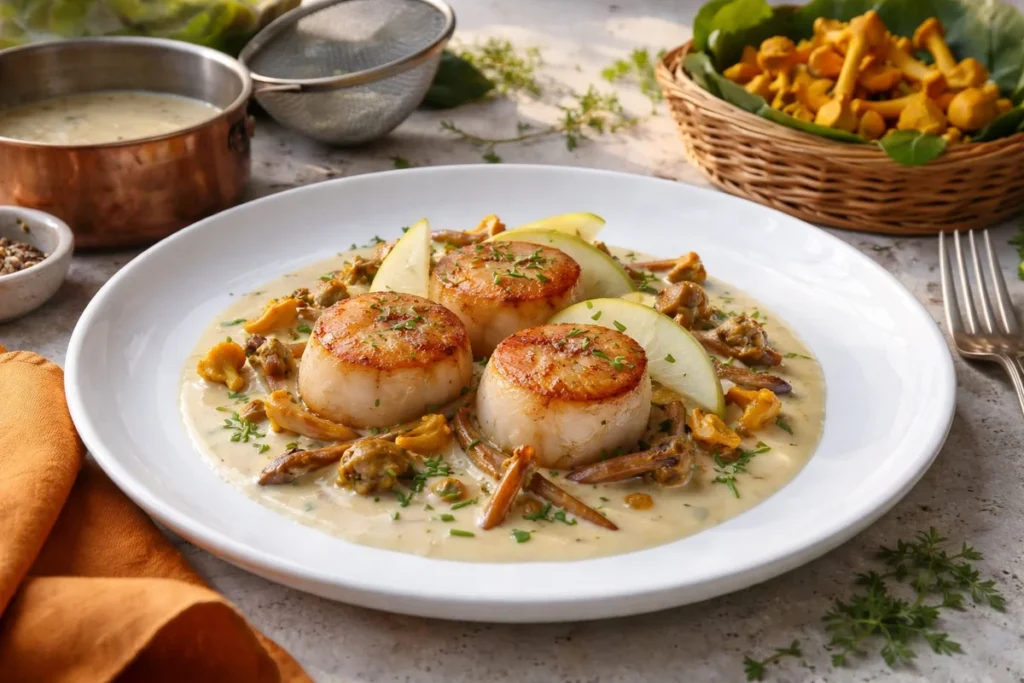
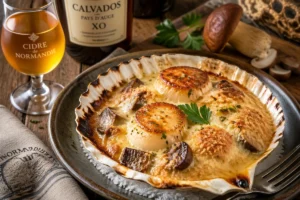
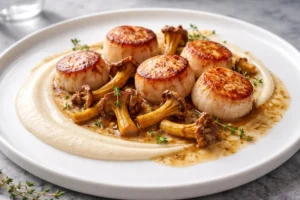
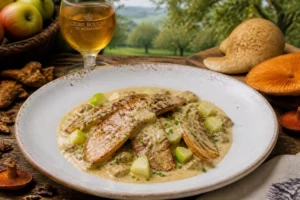
A sophisticated study in the "Orchard and Ocean" terroir of Normandy, featuring diver-caught scallops, Yellow Foot chanterelles, and an apple brandy emulsion.
The Historical Prelude: The Cider-Press and the Shore
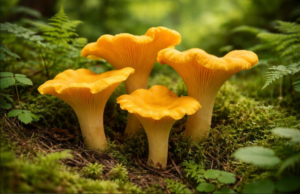
In the emerald-green landscape of Normandy, where the bocage pastures meet the grey swells of the English Channel, the culinary philosophy is defined by Le Terroir Normand—a trinity of cream, apples, and the sea. Historically, the Yellow Foot Chanterelle (Craterellus lutescens) was known to the foragers of the Pays d'Auge as the "Orchard Mushroom," as its seasonal arrival coincided perfectly with the final apple harvest in late autumn.
The pairing of scallops (Coquilles Saint-Jacques) with Yellow Feet is a classic of the Rouen school of cooking. Chefs discovered that the natural sweetness of the scallop—rich in glycogen—was the only protein capable of matching the mushroom's potent apricot and mirabelle aroma. By deglazing the pan with Calvados, the region's legendary apple brandy, they created a bridge between the forest floor and the seabed.
In the mid-20th century, the dish was refined into the "Vallée d'Auge" style, characterized by a reduction of crème fraîche that had been infused with the stems of the fungi. It represents the height of Atlantic French luxury: a dish that celebrates the moisture of the northern mists and the golden fermentation of the orchard. Today, it remains a technical benchmark for any chef mastering the balance of acid, fruit, and brine.
Narrative Intro: This dish is an "Esthetic Echo." Our philosophy is to align the stone-fruit profile of the Yellow Foot with the fermented apple notes of the Calvados. We use the cream as a stabilizer, ensuring the saline minerality of the scallop doesn't clash with the peppery finish of the mushroom, but rather dissolves into a single, orchard-scented velvet.
Sensory & Foraging Profile: The Coastal Moss and Chalk Terroir
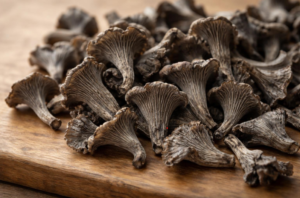
The Craterellus lutescens of Normandy is influenced by the alkaline chalk soils of the coastal cliffs. This imparts a softer, more floral apricot scent compared to the sharper mountain varieties. They grow in the humid microclimates beneath beech and hazel trees, absorbing the "salty air" which translates into a saline-savory finish that is perfect for seafood.
Ethical Harvesting & The "Cider-Mist" Protocol: In Normandy, we harvest only when the "Morning Dew" has reached the mid-stem of the mushroom. We use willow baskets lined with beech leaves to prevent the delicate yellow stems from bruising. We strictly adhere to the "Rule of Three"—leave three, take three—to maintain the symbiosis between the mushroom and the surrounding orchards.
Essential Equipment: The Normandy Station
Copper Sauté Pan: For the rapid heat transfer required to sear scallops without overcooking the core.
Fine Mesh Chinois: To strain the Calvados cream for a silk-smooth "Normand" finish.
Silicon Spatula: To gently fold the hollow Yellow Feet into the cream reduction.
Oyster Knife: For the professional cleaning and shucking of fresh Saint-Jacques.
Master Recipe: Normandy Scallops & Yellow Foot
Stage 1: The Scallop Preparation
Clean 12 large diver-caught scallops. Remove the tough side muscle. Pat them extremely dry with a cloth; moisture is the enemy of the golden Maillard crust. Season only with a touch of fine sea salt.
Stage 2: The Mushroom “Suhage”
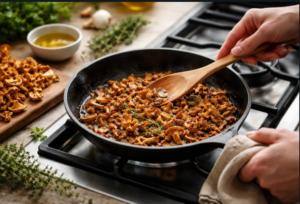
In a hot pan, sauté 300g of fresh Yellow Foot chanterelles in 20g of butter. Do not overcrowd. Once they release their liquid and begin to brown, add one finely minced shallot. Cook until translucent.
Stage 3: The Calvados Flambé
Pour 40ml of Aged Calvados AOP into the mushroom pan. Carefully ignite (flambé) to burn off the harsh alcohol, leaving only the concentrated apple essence. Once the flame dies, add 150ml of Crème Fraîche. Reduce by one-third until thick and glossy.
Stage 4: The Golden Sear
In a separate copper pan, heat oil until smoking. Add the scallops. Sear for exactly 90 seconds on one side without moving them. Flip and sear for 30 seconds on the other side. They should be "Rare-to-Medium" in the center.
Stage 5: The Assembly
Place 3 scallops per plate. Spoon the Yellow Foot and Calvados cream directly around the scallops, never over the top (to keep the crust crispy). Finish with a dusting of fresh chives and a few thin slices of Granny Smith apple for acidity.
Substitutions & Variations: The Luxury Palette
The Spirit: If Calvados is unavailable, use a dry Normandy Cider reduction or a splash of Armagnac.
The Cream: Use Isigny AOP Butter to finish the sauce for an even more decadent, "yellow-fat" profile.
The Mushroom: For a more textural dish, add a few Golden Chanterelles to the mix for their firmer bite.
Pro Technique: The “Scallop-Oil” Infusion
To deepen the sea-flavor, sauté the scallop "corals" (the orange roe) in the butter before adding the mushrooms. Strain them out after 2 minutes. The butter will turn a deep orange and carry a powerful marine umami that anchors the fruity Yellow Feet to the plate.
The Umami Secret: Glycine and Malic Acid Synergy
The **Scallops** are rich in Glycine (a sweet amino acid). The **Apples/Calvados** are rich in Malic Acid. The **Yellow Foot** contains high levels of Glutamic Acid. When these three meet, the malic acid "brightens" the glycine, making the scallop taste sweeter, while the glutamic acid provides a savory floor. It is a biological flavor loop that makes the palate perceive "infinite depth."
The Art of Pairing: The Sommelier’s Selection
Sommelier's Choice: A Dry Normandy Cider (Cidre Bouché). Its natural carbonation and tannic apple skin profile cut through the cream effortlessly.
Non-Alcoholic Alternative:Sparkling Apple Must with a drop of Balsamic Vinegar. The balsamic provides the fermented "funk" that mimics the Calvados.
Micro-FAQ
Q: My cream curdled when I added the Calvados. Why? A: You likely added the spirit to the cream. Always flambé the spirit *first* with the mushrooms, then add the cream once the alcohol is gone.
Q: Why are my scallops rubbery? A: You overcooked them. Scallops should be treated like steak—served medium-rare to maintain their sweetness.
Q: Can I use frozen scallops? A: It is difficult. Frozen scallops release too much water, preventing a proper sear. If using them, defrost thoroughly and press between towels for an hour before cooking.
To provide the best experiences, we use technologies like cookies to store and/or access device information. Consenting to these technologies will allow us to process data such as browsing behavior or unique IDs on this site. Not consenting or withdrawing consent, may adversely affect certain features and functions.
Functional
Always active
The technical storage or access is strictly necessary for the legitimate purpose of enabling the use of a specific service explicitly requested by the subscriber or user, or for the sole purpose of carrying out the transmission of a communication over an electronic communications network.
Preferences
The technical storage or access is necessary for the legitimate purpose of storing preferences that are not requested by the subscriber or user.
Statistics
The technical storage or access that is used exclusively for statistical purposes.The technical storage or access that is used exclusively for anonymous statistical purposes. Without a subpoena, voluntary compliance on the part of your Internet Service Provider, or additional records from a third party, information stored or retrieved for this purpose alone cannot usually be used to identify you.
Marketing
The technical storage or access is required to create user profiles to send advertising, or to track the user on a website or across several websites for similar marketing purposes.