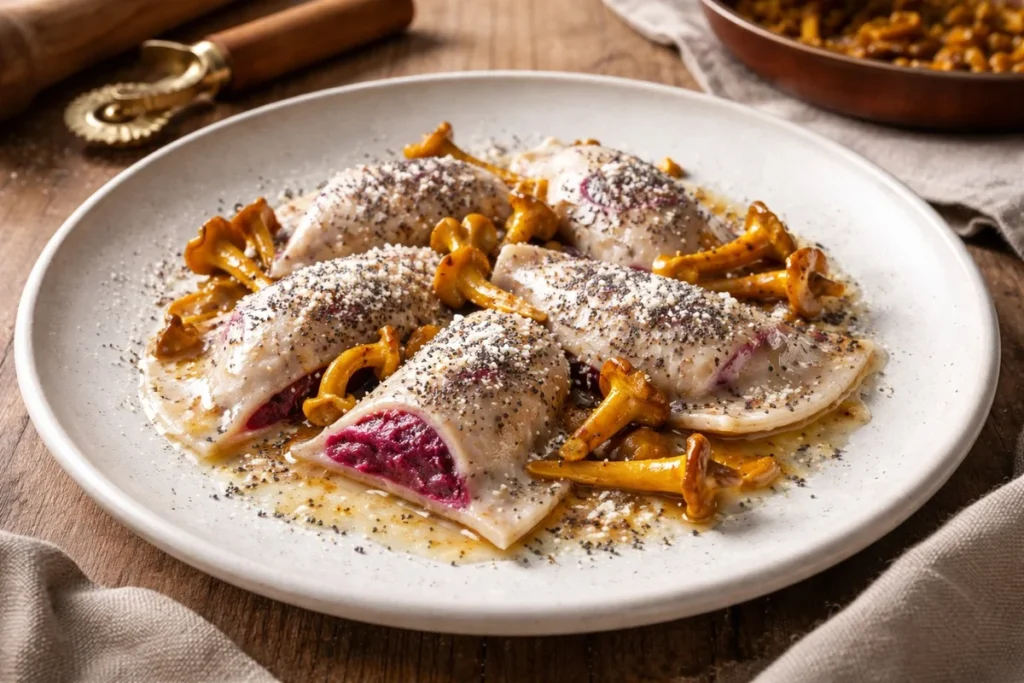
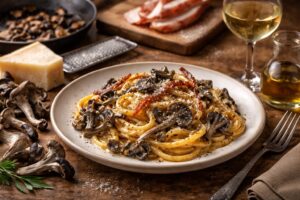
A technical study in Ladin "Cucina Povera" luxury, featuring beetroot-stuffed pasta, toasted poppy seeds, and the apricot-scented Yellow Foot chanterelle.
High within the limestone cathedrals of the Dolomites, the Ladin people have maintained a culinary identity that is distinct from both Italy and Austria. The Casunziei all'Ampezzana—delicate half-moon pasta stuffed with vibrant red beetroot—is the crown jewel of Cortina d'Ampezzo. Historically, this was a dish of the winter solstice, utilizing the last of the root cellar's bounty and the dried forest treasures gathered before the first snow.
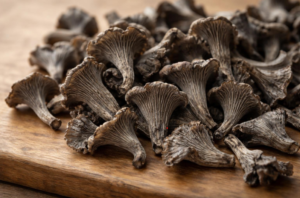
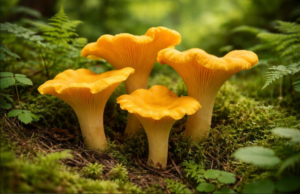
The Yellow Foot Chanterelle (Craterellus lutescens) became the definitive Alpine partner for Casunziei due to the shared terroir of the South Tyrolean slopes. For centuries, mountain foragers noticed that where the wild beetroot grew in the lower valleys, the Yellow Foot carpeted the damp pine needle beds just above them. The earthy, geosmin-rich profile of the beet was found to be the perfect anchor for the mushroom's ethereal apricot esters.
By the mid-20th century, the addition of poppy seeds (semi di papavero) became the hallmark of the professional Ampezzano kitchen. The seeds provided a nutty, mechanical crunch that contrasted with the silkiness of the pasta and the hollow, tender stems of the Yellow Foot. Today, this dish is served in the Michelin-starred rifugi of the Dolomites as a masterclass in "Alpine Minimalism"—where three or four wild ingredients create a flavor profile of immense geological depth.
Narrative Intro: This is a dish of "Sweet Soil and Stone Fruit." Our philosophy for the Casunziei is "Aromatic Contrast." We utilize the deep, purple-earth notes of the beetroot to provide a base for the Yellow Foot's bright, peppery acidity. The poppy seeds act as the "seasoning," providing a toasted oil finish that binds the mountain pasta to the forest floor.
Sensory & Foraging Profile: The Dolomitic Limestone Terroir
The Craterellus lutescens found in the Dolomites is unique for its high mineral clarity, a result of the calcium-rich limestone (dolomite) soils. This terroir produces a mushroom with a bracing peppery finish and an almost neon-orange stem. The scent is less like jammy apricots and more like unripe mirabelle plums, offering a sophisticated tartness that is essential for balancing the sweet beetroot.
Ethical Harvesting & The "Ladin" Protocol: In the South Tyrol, we harvest using wooden-handled brushes to ensure no limestone grit enters the hollow funnels. We follow the "Larch Cycle"—harvesting only when the larch needles begin to turn gold and fall, providing a natural mulch that protects the mycelium from the coming frost. We leave exactly three specimens in every "fairy ring" to ensure genetic continuity for the next summer season.
Essential Equipment: The Alpine Pasta Station
Brass Pasta Cutter: To create the traditional serrated "mezzaluna" (half-moon) edge.
Oak Rolling Pin (Mattarello): To roll the dough to a "translucent" thickness (approx 1mm).
Copper Skillet: For the precise "hazelnut" browning of the Alpine butter.
Potato Ricer: To ensure the beetroot filling is perfectly smooth and free of fibrous lumps.
Master Recipe: Casunziei with Yellow Foot
Stage 1: The Earthy Core (The Filling)
Roast 400g of red beetroots on a bed of salt until tender. Peel and pass through a ricer. Mix with 100g of creamy Ricotta, a pinch of nutmeg, and a tablespoon of grated horseradish for a sharp mountain kick. The filling should be stiff and vibrant purple.
Stage 2: The Pasta Silk
Create a dough using 300g of "00" flour and 3 large eggs. Roll to 1mm thickness. Cut 8cm circles, place a teaspoon of filling in the center, and fold into half-moons. Press firmly to seal, ensuring no air is trapped inside.
Stage 3: The Yellow Foot Sauté
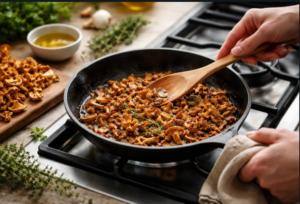
In a large copper skillet, melt 60g of Alpine butter. Add 250g of fresh Yellow Foot chanterelles. Cook until they release their water and begin to fry in the butter. Add a teaspoon of poppy seeds and toast until they start to pop and release their oils.
Stage 4: The Emulsion (The “Mantura”)
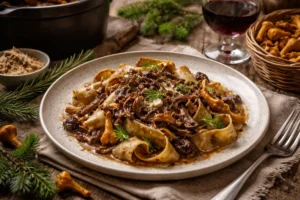
Boil the pasta for 3 minutes in salted water. Transfer directly into the skillet with the mushrooms and butter using a slotted spoon. Add 2 tablespoons of the starchy pasta water. Toss vigorously to create a creamy, glossy emulsion that coats the half-moons.
Stage 5: The Final Garnish
Serve 5-6 Casunziei per plate. Ensure each pasta is topped with several Yellow Feet and a generous sprinkle of toasted poppy seeds. Finish with a fine grating of Smoked Ricotta (Ricotta Affumicata).
Substitutions & Variations: The Luxury Palette
The Filling: Add roasted chestnuts to the beetroot for a more "Late Autumn" profile.
The Cheese: Replace Ricotta Affumicata with 36-month Parmigiano Reggiano for a more classic Italian finish.
The Mushroom: Use dried Yellow Feet powdered into the pasta dough itself for a "Double-Mushroom" experience.
Pro Technique: The “Horseradish Bridge”
Beetroot and Yellow Foot both possess "sweet" flavor profiles. To prevent the dish from tasting like a dessert, the addition of freshly grated horseradish to the filling is critical. The heat of the horseradish provides a "top note" that cuts through the sugars of the beet and the fats of the butter, allowing the subtle peppery minerals of the mushroom to shine.
The Umami Secret: Geosmin and Linalool Interaction
Beetroots are defined by Geosmin (the smell of earth). Yellow Feet are defined by Linalool (fruity esters). When these two compounds meet in the presence of Lactic Acid (Ricotta) and Short-Chain Fatty Acids (Brown Butter), they undergo a process of "Aromatic Masking." This softens the metallic edge of the beets and emphasizes the floral, stone-fruit notes of the mushroom, creating a perceived "freshness" that is rare in cooked root vegetable dishes.
The Art of Pairing: The Sommelier’s Selection
Sommelier's Choice: A Lagrein Kretzer (Rosé) from Alto Adige. Its berry-forward profile and earthy undertones provide a perfect chromatic and flavor match for the beetroot and chanterelles.
Non-Alcoholic Alternative: A Pomegranate and Rosemary Fizz. The tartness of the pomegranate mirrors the mushroom's fruit, while the rosemary echoes the pine forest.
Micro-FAQ
Q: Why did my pasta burst in the water? A: You likely had air trapped inside the Casunziei. When air heats, it expands. Use your fingers to press all air out before the final seal.
Q: Can I use pre-cooked beets? A: No. Pre-cooked, vacuum-packed beets are too wet and lack the concentrated earthiness required. Roasting fresh beets on salt is the only way to achieve the correct texture.
Q: Is the poppy seed mandatory? A: In the Ampezzano tradition, yes. It provides the essential textural "snap" that defines the dish.
To provide the best experiences, we use technologies like cookies to store and/or access device information. Consenting to these technologies will allow us to process data such as browsing behavior or unique IDs on this site. Not consenting or withdrawing consent, may adversely affect certain features and functions.
Functional
Always active
The technical storage or access is strictly necessary for the legitimate purpose of enabling the use of a specific service explicitly requested by the subscriber or user, or for the sole purpose of carrying out the transmission of a communication over an electronic communications network.
Preferences
The technical storage or access is necessary for the legitimate purpose of storing preferences that are not requested by the subscriber or user.
Statistics
The technical storage or access that is used exclusively for statistical purposes.The technical storage or access that is used exclusively for anonymous statistical purposes. Without a subpoena, voluntary compliance on the part of your Internet Service Provider, or additional records from a third party, information stored or retrieved for this purpose alone cannot usually be used to identify you.
Marketing
The technical storage or access is required to create user profiles to send advertising, or to track the user on a website or across several websites for similar marketing purposes.