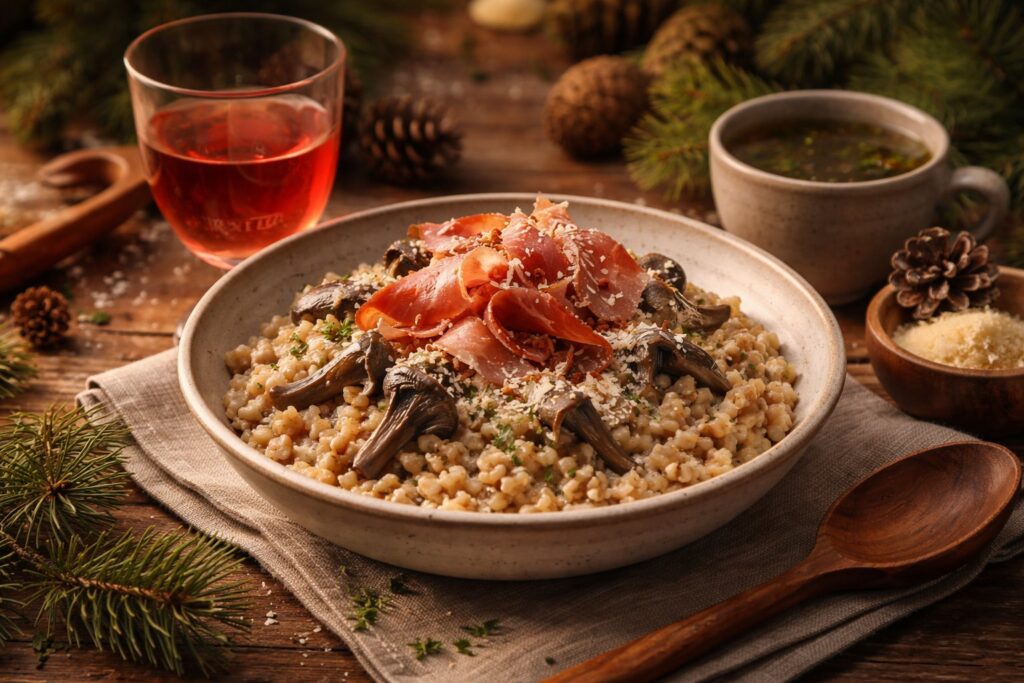
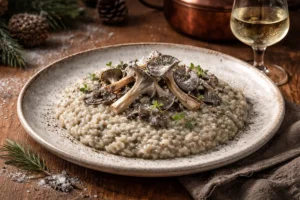
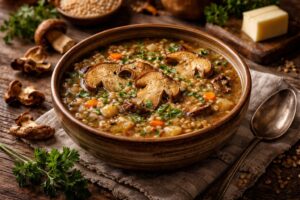
A rugged high-altitude Orzotto featuring pearl barley, the smoky mineral profile of Cantharellus cinereus, and traditional South Tyrolean Speck.
Dolomite Barley Orzotto
Cantharellus Cinereus and the Grains of the Pale Mountains
The Historical Prelude: The Ladin Grain-Mastery
In the jagged amphitheater of the Dolomites, specifically within the Ladin-speaking valleys of Val Badia and Val Gardena, rice was once a foreign luxury, reserved for the wealthy merchants of Venice. The mountain dwellers, facing the harsh realities of thin air and short growing seasons, turned instead to Barley (Orzo). This hardy grain became the foundation of the Orzotto, a dish that mimics the creamy technique of risotto but offers a resilient, nutty bite that rice simply cannot replicate.
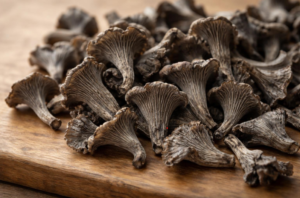
The culinary elevation of the Orzotto occurred during the late 19th century, as the first Alpine explorers and mountaineers began to patronize the mountain refuges (Rifugi). The local "Cooks of the Peaks" realized that the standard barley porridge needed a more sophisticated profile to satisfy the urban elite. They looked to the Cantharellus cinereus, known locally as the "Slate Mushroom," which carpeted the forest floors beneath the larch and spruce trees in early autumn.
By combining the peppery, ashen depth of these mushrooms with the smoked Speck Alto Adige PGI—a juniper-flavored ham cured in the cold mountain winds—they created a dish that defined the terroir of the South Tyrol. It was a favorite of the Austro-Hungarian nobility, who frequented the spas of Merano. They praised the Orzotto for its "Hearth-Umami," a flavor profile that evokes the smell of woodsmoke and the damp, stony silence of a Dolomite forest. Today, this dish remains a staple of high-end Alpine hospitality, representing the transition from a survivalist past to a refined, mycological present.
Narrative Intro: The Dolomites are a landscape of verticality and stone. Our philosophy for this Orzotto is "Mineral Resonance." Unlike a rice risotto, which aims for a silken uniformity, the barley Orzotto celebrates the individual grain. We use the Gray Chanterelle to provide a bridge between the smoky Speck and the nutty barley, creating a dish that feels like a walk through a South Tyrolean larch forest at dusk.
Sensory & Foraging Profile: The Schist and Spruce Fringes
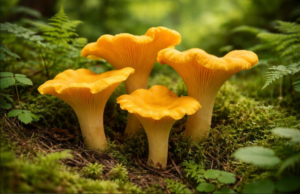
The Cantharellus cinereus of the Italian Dolomites is structurally denser than its cousins in the French Atlantic Fringes. Growing at altitudes between 800 and 1,500 meters, these mushrooms develop a unique resistance to frost, which concentrates their sugars and intensifies their peppery "slate-like" finish. Their aroma is dominated by damp earth, juniper, and cold ash.
Ethical Harvesting & The "Ladin Cycle": In the Dolomites, the "Ladin Cycle" dictates that foragers move according to the slope's orientation. We harvest the southern-facing slopes in the morning and the northern "shadow" slopes in the afternoon. When gathering Gray Chanterelles, we use small wooden trowels to avoid disturbing the fragile soil surface, and we never harvest the "Pioneer Mushroom"—the first, smallest specimen in a cluster—as it is believed to lead the rest of the mycelium's growth. This practice ensures that the forest floor remains a productive habitat for generations.
Essential Equipment: The Tools of the Orzotto
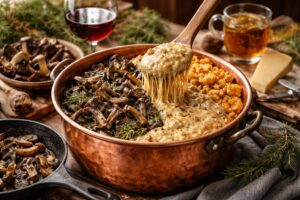
Copper or Heavy-Bottomed Sauté Pan: For even heat distribution during the slow absorption of the stock.
Hand-Carved Cherry Wood Spoon: Traditional for Mantecatura (the final thickening), as wood doesn't conduct heat away from the grain.
Mandoline: To achieve paper-thin slices of Speck for the garnish.
Fine Mesh Sieve: For rinsing the barley to remove excess surface starch.
Master Recipe: Dolomite Gray Orzotto
Stage 1: The Barley Preparation
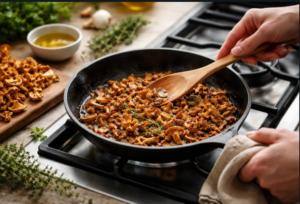
Rinse 320g of Pearl Barley under cold water until the water runs clear. In your sauté pan, toast the dry barley for 3 minutes over medium heat until it smells like roasted nuts. This "seals" the flavor within the grain and prevents it from becoming mushy during the long simmer.
Stage 2: The Forest Soffritto
Push the barley to the side and add 30g of Malga Butter (Alpine butter). Sauté 50g of finely diced Speck Alto Adige and 200g of fresh Gray Chanterelles. Add one minced shallot. Once the mushrooms are tender and have released their peppery oils, deglaze with 150ml of a dry Vernatsch (Schiava) red wine.
Stage 3: The Slow Infusion
Gradually add 1.2 liters of hot mushroom or poultry stock, one ladle at a time. Unlike rice, barley requires more liquid and a longer cooking time (approximately 35-40 minutes). Stir frequently to release the starches, creating a creamy "all'onda" (wavelike) consistency.
Stage 4: The Mantecatura (The Creaming)
Once the barley is al dente, remove from heat. Stir in 40g of cold butter and 60g of grated Stelvio AOP or a mature Piave cheese. Vigorously beat the Orzotto with your wooden spoon to create a luscious, velvety emulsion.
Stage 5: The Final Garnish
Divide the Orzotto into warm bowls. Top with a few sautéed whole Gray Chanterelles and a "nest" of paper-thin Speck. Finish with a grating of fresh mountain horseradish for a sharp, clean finish that cuts through the fat.
Substitutions & Variations: The High-Altitude Palette
The Grain: If pearl barley is unavailable, use Farro Monococco (Einkorn) for an even more ancient, earthy texture.
The Meat: Replace Speck with Bresaola della Valtellina for a leaner, beefy profile that still honors the Alpine tradition.
The Vegan Option: Use extra-virgin walnut oil and nutritional yeast in place of butter and cheese to maintain the nutty, umami profile.
Pro Technique: The “Speck-Fat Toast”
To deepen the flavor of the mushrooms, render the fat from a small piece of Speck first. Use this smoky, liquefied fat to sauté the Gray Chanterelles before adding any butter. This "layers" the smoke directly into the mushroom's ridges, creating a flavor that tastes as if the mushrooms were roasted over an open campfire.
The Umami Secret: Amylopectin and Lenthionine
Barley releases Amylopectin more slowly than rice, providing a sustained release of complex carbohydrates. When this starch combines with the Lenthionine (smoky sulfur compounds) in the Gray Chanterelle and the Glutamates in the aged mountain cheese, it creates a "slow-release" umami. The flavor doesn't peak instantly; instead, it builds with every bite, creating a deep sense of satiety and warmth that is the hallmark of Alpine "Comfort Luxury."
The Art of Pairing: The Sommelier’s Selection
Sommelier's Choice: A Lagrein Kretzer (Rosé) from South Tyrol. This wine has the red-fruit acidity to balance the Speck and the earthy undertones to complement the Gray Chanterelles.
Non-Alcoholic Alternative: A Warm Juniper and Spruce Needle Tea. The resinous notes of the tea provide a thematic bridge to the forest-floor aromatics of the dish.
Storage & Reheating: Professional Restoration
Unlike rice risotto, barley Orzotto holds its texture remarkably well. It can be stored for 24 hours. To reheat, add a splash of stock and a knob of fresh butter, then whisk over medium heat. It can also be cooled, sliced, and pan-fried to create **Orzotto Cakes**, a popular day-after delicacy in mountain huts.
Ancestral Nutrition: The Mountain Fortification
Barley is an incredible source of Beta-glucans, which are known to lower cholesterol and improve heart health. The Gray Chanterelle adds a significant dose of Vitamin D and Iron, while the Speck provides high-quality Protein and B-vitamins. This combination was historically designed to sustain the Ladin people through the physical rigors of high-altitude farming and winter travel.
Micro-FAQ
Q: Why use barley instead of Arborio rice? A: Barley offers a higher nutritional profile and a unique "pop" in texture that complements the resilience of wild mushrooms better than rice.
Q: Do I need to soak the barley overnight? A: For pearl barley, soaking is not necessary, but for "whole" or hulled barley, a 12-hour soak is recommended to reduce cooking time.
Q: Is the horseradish traditional? A: Yes. Horseradish (Kren) is a key element of the Tyrolean palate, used to provide a sharp, clean contrast to the heavy fats of Alpine cooking.
To provide the best experiences, we use technologies like cookies to store and/or access device information. Consenting to these technologies will allow us to process data such as browsing behavior or unique IDs on this site. Not consenting or withdrawing consent, may adversely affect certain features and functions.
Functional
Always active
The technical storage or access is strictly necessary for the legitimate purpose of enabling the use of a specific service explicitly requested by the subscriber or user, or for the sole purpose of carrying out the transmission of a communication over an electronic communications network.
Preferences
The technical storage or access is necessary for the legitimate purpose of storing preferences that are not requested by the subscriber or user.
Statistics
The technical storage or access that is used exclusively for statistical purposes.The technical storage or access that is used exclusively for anonymous statistical purposes. Without a subpoena, voluntary compliance on the part of your Internet Service Provider, or additional records from a third party, information stored or retrieved for this purpose alone cannot usually be used to identify you.
Marketing
The technical storage or access is required to create user profiles to send advertising, or to track the user on a website or across several websites for similar marketing purposes.